
Anastatus semiflavidus
Gahan, 1914
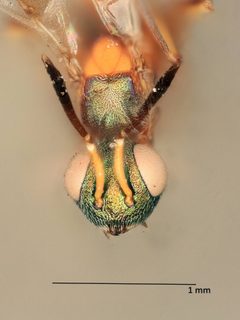
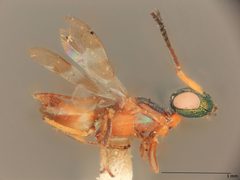
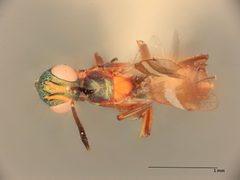
Anastatus semiflavidus is a minute in the Eupelmidae. It is a parasitoid of the range caterpillar (Hemileuca oliviae), a pest of rangeland grasses in western North America. The exhibits arrhenotokous , with females developing from fertilized eggs and males from unfertilized eggs. Laboratory studies demonstrate strong temperature-dependence in its development and .
Pronunciation
How to pronounce Anastatus semiflavidus: /ˌænəˈsteɪtəs ˌsɛmɪˈfleɪvɪdəs/
These audio files are automatically generated. While they are not always 100% accurate, they are a good starting point.
Identification
Members of the Anastatus are distinguished from similar eupelmid genera by females having a distinct pattern of bands on the forewings, thought to enhance mimicry. The wings adhere closely to the body when not flying, giving a wingless appearance at first glance. The ovipositor is almost entirely concealed. Females possess modified middle legs adapted for powerful jumping, a trait shared with other Eupelminae. Males lack these modifications and fly readily. Specific identification of A. semiflavidus requires microscopic examination; the was described by Gahan in 1914.
Images
Distribution
Recorded from Arizona, California, Kansas, Louisiana, New Mexico, and Texas. The distribution corresponds to the range of its , the range caterpillar Hemileuca oliviae, which inhabits rangeland areas of the southwestern and south-central United States.
Diet
of Hemileuca oliviae (range caterpillar, Lepidoptera: Saturniidae).
Host Associations
- Hemileuca oliviae - obligate ; laboratory studies confirm development only in of this
Life Cycle
Development from to ranges from 35.6 days at 15°C to 12.4 days at 35°C. The preoviposition period ranges from 3.4 days at 30°C to 8.8 days at 15°C. Arrhenotokous : mated females produce both sexes, unmated females produce only male offspring. Sex ratio is female-biased across all temperatures tested. is highest at intermediate temperatures (approximately 100 offspring per female at 25°C).
Behavior
Ecological Role
agent of the range caterpillar, a significant pest of rangeland grasses that can cause economic damage to grazing lands.
Human Relevance
Investigated as a potential agent for management of range caterpillar in rangeland . No direct economic importance beyond this biocontrol context.
Similar Taxa
- Anastatus orientalisBoth are in the Anastatus investigated for of pests; A. orientalis targets spotted lanternfly while A. semiflavidus targets range caterpillar
- Anastatus reduviiCongeneric of wheel bug (Arilus cristatus) eggs; shares -level traits including female jumping ability and -mimic wing patterns
- Anastatus disparisIntroduced congeneric for spongy moth (Lymantria dispar) biocontrol; shares arrhenotokous and general eupelminae
Sources and further reading
- BugGuide
- GBIF taxonomy match
- iNaturalist taxon
- Catalogue of Life
- Bug Eric: Wasp Wednesday: Anastatus spp. Eupelmids
- Anastatus orientalis - Entomology Today
- Be Prepared for the Invasive Spotted Lanternfly, Entomologists Warn
- Bug Eric: Rough Stink Bugs
- How One Entomologist Tackles Invasive Species as a State Pest Biologist
- Life-history Characteristics of Anastatus semiflavidus (Hymenoptera: Eupelmidae), an Egg Parasitoid of the Range Caterpillar, Hemileuca oliviae (Lepidoptera: Saturniidae) Over a Range of Temperatures