
Eupelminae
Walker, 1833
Genus Guides
9- Anastatus(eupelmid egg parasitoids)
- Arachnophaga
- Brasema
- Eupelmus
- Lecaniobius
- Phlebopenes
- Reikosiella
- Uropelma
- Zaischnopsis
Eupelminae is a of parasitic within the Eupelmidae (Chalcidoidea). Members exhibit extreme , with females possessing a remarkable jumping ability powered by modified mesothoracic musculature and energy storage. Females of many have reduced capability and rely on , while males fly readily. The subfamily includes important agents such as species of Anastatus, which parasitize the of diverse including , true bugs, , and stick insects.
Pronunciation
How to pronounce Eupelminae: /juːˈpɛlmɪniː/
These audio files are automatically generated. While they are not always 100% accurate, they are a good starting point.
Identification
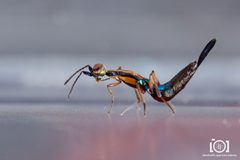
Distinguished from other Eupelmidae by the unique jumping in females: enlarged dorso-longitudinal mesothoracic muscles, modified middle legs with prominent tibial spurs, and blocks for energy storage. Females of Anastatus can be separated from similar eupelmine by the almost entirely concealed ovipositor and characteristic forewing banding. Males lack jumping modifications and resemble typical chalcidoid wasps. Metapelma are notably larger (ca. 6 mm) and associated with wood-boring beetles.
Images
Appearance
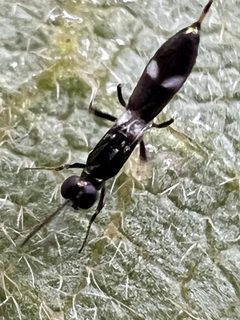
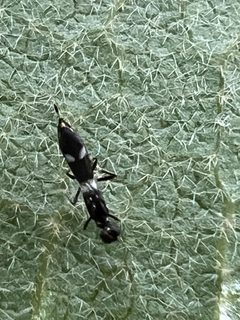
Small to minute chalcidoid wasps, typically under 6 mm. Females often display banded forewing patterns and hold wings tightly appressed to the body, appearing wingless at rest. is pronounced: females have enlarged mesothoracic segments with dorso-longitudinal jumping muscles that contort the , often dying in a characteristic U-shaped posture. Middle legs bear a well-developed tibial spur for anchoring jumps. Males lack these modifications and have normal musculature. Ovipositor is frequently concealed.
Habitat
Diverse including forests, agricultural areas, and oil palm plantations. occupy associated with their specific : Anastatus species occur where host are present (e.g., on vegetation with true eggs), while Metapelma species are found on tree trunks with exposed dead wood harboring wood-boring beetles. Glade habitats and nature reserves support diverse eupelmine .
Distribution
Worldwide distribution, primarily in tropical and subtropical regions. North America north of Mexico approximately 119 eupelmid across multiple . Documented from Papua New Guinea (West New Britain), China (Fujian Province), Missouri, Colorado, Arizona, Ohio, and Massachusetts in the United States.
Host Associations
- Eurycantha calcarata - Anastatus eurycanthae; pest of oil palm in Papua New Guinea
- Lymantria dispar - Anastatus disparis; introduced to North America for of spongy moth
- Supella longipalpa - Anastatus tenuipes; introduced accidentally with brown-banded cockroach
- Arilus cristatus - Anastatus reduvii; wheel bug
- Coreidae - Leaf-footed bug ; observed in Missouri
- Buprestidae - Metapelma ; wood-boring beetles
- Cerambycidae - Metapelma ; longhorn beetles
Life Cycle
or internal parasitoids of arthropods. Females insert single eggs into eggs; larvae develop internally, killing the host. Most overwinter as mature larvae or pupae. Hyperparasitic species attack parasitoids already present in hosts.
Behavior
Females exhibit powerful jumping using modified middle legs when disturbed, propelling themselves away from such as ants and spiders. The jump is powered by thoracic muscle contraction and energy storage rather than direct leg musculature. Females prefer over flying; males fly readily. Females use to measure before oviposition.
Ecological Role
Important agents acting as natural enemies of agricultural and forest pests. Some are primary of pest ; others are facultative hyperparasitoids. Anastatus disparis has been introduced for spongy moth control. Potential exists for expanded use in programs.
Human Relevance
Direct economic benefit through : Anastatus disparis introduced to control spongy moth (Lymantria dispar), a major forest pest. Anastatus tenuipes arrived accidentally with brown-banded cockroach and may contribute to . reared from harvested galls and parasitized contribute to scientific understanding of host- relationships. Many species remain undescribed or poorly known, representing opportunities for discovery.
Similar Taxa
- Other Eupelmidae subfamiliesLack the extreme jumping and associated thoracic modifications found in Eupelminae females
- Other Chalcidoidea familiesEupelminae females distinguished by U-shaped post-mortem posture, concealed ovipositor, and reduced combined with jumping ability
More Details
Jumping mechanism
Unlike other jumping insects that use muscles inserted directly on legs, eupelmine females use very large dorso-longitudinal thoracic muscles. Contraction contorts the , converting longitudinal force into vertical force to power the middle legs. Large blocks store elastic energy. The mechanism is so powerful that suggested include 'back-rolling wonders' due to tumbling landings.
Taxonomic challenges
Many Anastatus are known only from females; males are rare or not yet associated with females, complicating species delimitation and understanding.
Sexual dimorphism in dispersal
Females have apparently reduced apparatus due to thoracic modifications for jumping, while males retain normal flight capability. This represents a trade-off between escape ability and capacity between sexes.
Sources and further reading
- BugGuide
- iNaturalist taxon
- NCBI Taxonomy
- Catalogue of Life
- Bug Eric: Wasp Wednesday: Anastatus spp. Eupelmids
- Bug Eric: Wasp Wednesday: Eupelmidae
- Nomenclatural changes in Anastatus Motschulsky and the description of Anastatus eurycanthae Gibson n. sp. (Eupelmidae: Eupelminae), an egg parasitoid of Eurycantha calcarata Lucas (Phasmida: Phasmatidae) from Papua New Guinea
- A Compositional Heterogeneity Analysis of Mitochondrial Phylogenomics in Chalcidoidea Involving Two Newly Sequenced Mitogenomes of Eupelminae (Hymenoptera: Chalcidoidea).