
Supella longipalpa
(Fabricius, 1798)
brown-banded cockroach, brownbanded cockroach, TV roach
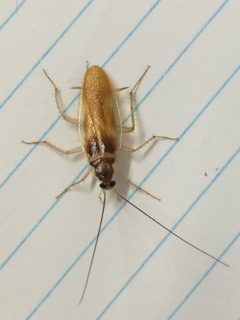
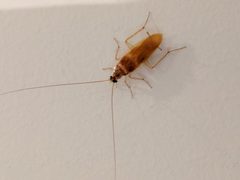
Supella longipalpa, commonly known as the brown-banded , is a small pest of presumed African origin that has become established in human-built structures worldwide. It is notable for pronounced : males are slender with long, functional wings and are capable of , while females are broader with short, non-functional wings. The completes its entire indoors and shows distinct behavioral preferences for warmer, drier locations compared to other domestic cockroaches, often inhabiting furniture, appliances, and upper wall areas.
Pronunciation
How to pronounce Supella longipalpa: //suːˈpɛlə lɒnˈɡɪpælpə//
These audio files are automatically generated. While they are not always 100% accurate, they are a good starting point.
Identification
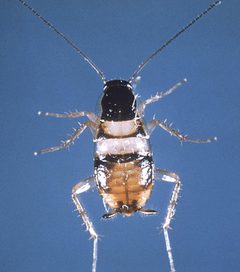
Distinguished from other domestic by the two pale transverse bands across the surface (when visible) and pronounced in wing development. Females resemble small, wingless or short-winged cockroaches with broad ; males appear more elongate with fully developed wings. Differs from German cockroach (Blattella germanica) by banding pattern and female wing reduction. Differs from American cockroach (Periplaneta americana) by much smaller size and distinct banding. The combination of small size, sexual dimorphism in wing length, and preference for drier, warmer indoor locations aids identification.
Images
Habitat
Strictly indoor; completes entire in human-built structures. Prefers warmer, drier locations than other domestic . Frequently found in and behind furniture, within electrical appliances (televisions, computers), behind wall-mounted pictures, and on upper portions of walls. Associated with human dwellings, food premises, dormitories, and institutional buildings.
Distribution
Presumed native to northern Africa; introduced and established across all inhabited continents. First recorded in Florida in 1903, introduced to Arizona by 1933, and reported in 47 of 48 contiguous United States by 1967. Established throughout North America, Europe, Asia (including Japan), the Caribbean, and South America. Recently confirmed in Baltic countries (Estonia 2022) and continues to expand range via human-mediated transport.
Diet
scavenger. Laboratory colonies maintained on dog chow and standard rat food. In natural indoor settings, feeds on starchy materials including bookbinding paste, wallpaper paste, and food residues. Does not show the same preferences as German cockroach; comparative food detection studies limited.
Host Associations
- Moniliformis moniliformis - Acanthocephalan that manipulates , increasing thigmotaxis and reducing activity
- Comperia merceti - Encyrtid , oothecal
- Anastatus tenuipes bolivar - Eupelmid , oothecal
- Blattabacterium - endosymbiontIntracellular bacterial endosymbiont, 59.1% relative abundance in surveyed specimens
- Wolbachia - endosymbiontIntracellular bacterial endosymbiont, 24.7% relative abundance; F-clade strain
- Lactobacillus - gut gut bacterium, probiotic
- Akkermansia - gut gut bacterium, probiotic , more abundant in early nymphs
Life Cycle
Hemimetabolous development with typically 6–8 from to . Females deposit () glued to substrates. Development occurs entirely within human-built structures; no outdoor life stage. Nymphal development significantly affects gut microbiome diversity, with Shannon alpha diversity higher in late instar nymphs than early instars. Early instars (1st–2nd) and late instars (>5th, approaching adult size) identified in studies.
Behavior
activity pattern with peak calling and behavioral response in scotophase (dark period). Males show circadian rhythmicity in response to female , with responsiveness peaking 10 days after and showing true circadian periodicity persisting under continuous darkness. Females exhibit strong thigmotactic , seeking contact with surfaces on multiple sides when selecting oviposition sites. deposited on vertical or near-vertical surfaces, with preference for rough substrates (corrugated cardboard, wood, paper) over smooth surfaces (glass, metal, Plexiglas). Oothecae frequently clustered, with 72.4% found in groups of two or more in established ; 92.5% of oothecae located on upper third of walls. Parasitized individuals show increased cryptic behavior (enhanced thigmotaxis, reduced activity).
Ecological Role
Nuisance and public health pest in human-built environments. Indicator of indoor conditions. Potential role in resistance against ingested human pathogenic bacteria suggested by comparison to related , though not directly demonstrated. Serves as for oothecal and acanthocephalan . Gut microbiome likely involved in olfaction, dietary preference, and other physiological functions as demonstrated in related species.
Human Relevance
Significant domestic pest requiring control measures in homes, restaurants, food premises, and institutional buildings. Body fluids from molting or dead specimens can cause short circuits in electronic equipment, earning the nickname "TV roach." Feeds on starchy materials including bookbinding paste and wallpaper paste, causing damage. Contributes to food and allergen exposure. Subject of automated detection research using AI and computer vision for monitoring. Potential target for microbiome-based control strategies given endosymbiont and gut bacterial dependencies.
Similar Taxa
- Blattella germanicaSimilar small size and domestic ; differs in having both sexes fully winged (though females rarely fly), lacking transverse banding pattern, showing different nutrient selection and thermal preferences, and having distinct oviposition
- Periplaneta americanaDomestic pest ; differs dramatically in larger size, reddish-brown coloration without banding, both sexes fully winged and capable of , and preference for warmer, more humid locations
- Blatta lateralisSimilar size range; primarily outdoor that occasionally enters buildings, both sexes winged with distinct coloration patterns, not established as indoor breeder
More Details
Sexual dimorphism significance
The extreme in Supella longipalpa is among the most pronounced in Blattodea and serves as a textbook example of differential selection pressures on (males) and (females).
Microbiome research importance
The 2024 PeerJ study provided the first quantitative characterization of endosymbiont and gut bacterial in this , revealing significant negative correlations between Blattabacterium and , and between Blattabacterium and gut microbiome, suggesting complex microbial interactions with potential control implications.
Sources and further reading
- BugGuide
- GBIF taxonomy match
- iNaturalist taxon
- NCBI Taxonomy
- A New Cockroach in Town? | Bug Squad
- Bug Eric: All Grown Up
- Bug Eric: The "University Roach"
- Bug Eric: January 2010
- How Artificial Intelligence is Helping Automate Cockroach Surveillance in Cities
- Wolbachia in Cockroaches: A New Paradigm for Urban Pest Management?
- Moniliformis moniliformis Increases Cryptic Behaviors in the Cockroach Supella longipalpa
- Endosymbiont and gut bacterial communities of the brown-banded cockroach, Supella longipalpa
- OVIPOSITION BEHAVIOR AND SITE PREFERENCE OF THE BROWNBANDED COCKROACH, SUPELLA LONGIPALPA (F.) (DICTYOPTERA: BLATTELLIDAE)
- Female Calling and Reproductive Behavior in the Brown Banded Cockroach, Supella longipalpa (F.) (Orthoptera: Blattellidae)1
- Habitation was confirmed of the Japanese mainland by the Brown banded cockroach <i>Supella longipalpa</i> (Fabricius)
- First record of the alien cockroach Supella longipalpa (Fabricius, 1798) (Blattodea, Pseudophyllodromiidae) from the Baltic countries
- Comparative biological parameters of Comperia merceti (compere) (Hym., Encyrtidae) and Anastatus tenuipes bolivar (Hym., Eupelmidae), oothecal parasitoids of the cockroach Supella longipalpa (Fab.)
- Effects of dextrin and cellulose on feeding and reproduction in female brown‐banded cockroaches, Supella longipalpa
- The physiological basis for the termination of pheromone-releasing behaviour in the female brown-banded cockroach, Supella longipalpa (F.) (Dictyoptera: Blattellidae)
- Food Detection and Feeding Behavior of Three Species of Household Cockroaches, Blatella germanica (L.), Periplaneta americana (L.), and Supella longipalpa (F.)
- Circadian rhythmicity and development of the behavioural response to sex pheromone in male brown‐banded cockroaches, Supella longipalpa
- Circadian calling behavior of the adult female brown-banded cockroach,Supella longipalpa (F.) (Dictyoptera: Blattellidae)
- Behavioral and Electrophysiological Responses of the Brownbanded Cockroach, Supella longipalpa, to Stereoisomers of Its Sex Pheromone, Supellapyrone
- Site of Pheromone Production in Female Supella longipalpa (Dictyoptera: Blattellidae): Behavioral, Electrophysiological, and Morphological Evidence
- Effects of pheromone concentration and photoperiod on the behavioral response sequence to sex pheromone in the male brown-banded cockroach,Supella longipalpa