
Neochrysocharis
Kurdjumov, 1912
Species Guides
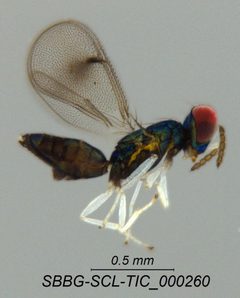
4Neochrysocharis is a of small in the Eulophidae. in this genus are endoparasitoids of leafmining insects, particularly agromyzid flies. Some species exhibit -feeding and possess both thelytokous () and arrhenotokous (sexual) reproductive strains. Multiple species have been evaluated as agents for leafminer pests in agricultural systems.
Pronunciation
How to pronounce Neochrysocharis: /ˌniː.oʊˌkrɪsoʊˈkɑːrɪs/
These audio files are automatically generated. While they are not always 100% accurate, they are a good starting point.
Images
Habitat
Vegetable agroecosystems; associated with supporting leafmining insects
Distribution
China; Indonesia; Vietnam; Southeast Asia; Argentina; India (Madhya Pradesh); United States (California, Florida); Canary Islands; Beijing
Diet
-feeding ; parasitizes and feeds on larval stages of leafmining insects
Host Associations
- Agromyzidae - primary leafmining flies
- Liriomyza - leafminer including L. chinensis, L. trifolii
- Liriomyza trifolii - American serpentine leafminer
- Tuta absoluta - South American tomato leafminer, tomato (Lepidoptera: Gelechiidae)
- Letana - Orthoptera: Tettigoniidae; record from India
Life Cycle
Larval endoparasitoid; development occurs inside larvae
Behavior
-killing include , host-feeding, and host-stinging; can directly parasitize and feed on 1st-3rd instar host larvae but kills 4th instar larvae only by host-stinging without successful development; exhibits host searching and oviposition behaviors affected by exposure
Ecological Role
agent for leafminer pests; natural enemy in programs for vegetables and tomato crops
Human Relevance
Evaluated and mass-reared as agent for agricultural pests including Tuta absoluta and Liriomyza leafminers; thelytokous strains show greater biocontrol potential than arrhenotokous strains with higher and -killing rates; sensitivity to certain (imidacloprid and ethofenprox highly toxic; pymetrozine harmless) affects integration into programs
Similar Taxa
- Diglyphus isaeaCoexisting -feeding of leafminers in same agroecosystems; compared in studies
- ClosterocerusFormerly treated as synonym; Neochrysocharis reinstated as valid based on morphological and biological differences
Sources and further reading
- BugGuide
- Wikipedia
- GBIF taxonomy match
- iNaturalist taxon
- NCBI Taxonomy
- Catalogue of Life
- Toxicity of Insecticides to Neochrysocharis okazakii, a Parasitoid Liriomyza Leafminers on Vegetables
- Thelytokous strains have better biocontrol potential than arrhenotokous strains: the parasitoid Neochrysocharis formosa on the invasive tomato leafminer Tuta absoluta as a case study
- A new species of Neochrysocharis Kurdjumov (Hymenoptera: Eulophidae), a parasitoid of serpentine leafminers (Diptera: Agromyzidae) in Southeast Asia
- Comparison of the suitability of Liriomyza chinensis and L. trifolii (Diptera: Agromyzidae) as hosts for Neochrysocharis okazakii (Hymenoptera: Eulophidae)
- Biology of Neochrysocharis okazakii (Hymenoptera: Eulophidae), A Parasitoid of The Stone Leak Leafminer Lifiomyza chinensis (Diptera: Agromyzidae)
- Effects of Temperature and Host on the Immature Development of the Parasitoid Neochrysocharis okazakii (Hymenoptera: Eulophidae)
- Oviposition and Larval Development of Neochrysocharis formosa (Hymenoptera: Eulophidae) inside the Host Larvae, Liriomyza trifolii
- Mass rearing of Neochrysocharis formosa (Westwood) (Eulophidae: Hymenoptera), a parasitoid of leafminers (Agromyzidae: Diptera)
- Correction to: Life history traits and host-killing rate of Neochrysocharis formosa on Tuta absoluta
- Neochrysocharis formosa (Westwood) (Hymenoptera: Eulophidae), a newly recorded parasitoid of the tomato moth, Tuta absoluta (Meyrick) (Lepidoptera: Gelechiidae), in Argentina
- Neochrysocharis Nr. <I>Diastatae</I> (Howard) (Hymenoptera:Eulophidae) Parasitic on Eggs of <I>Letana</I> Walker (Orthoptera:Tettigoniidae) in India:First Record of Host Association
- Life history traits and host-killing rate of Neochrysocharis formosa on Tuta absoluta
- Toxicity of Selective Insecticides to Neochrysocharis formosa (Westwood) (Hymenoptera: Eulophidae), a Parasitoid of the American Serpentine Leafminer Liriomyxa trifolii (Burgess) (Diptera: Agrizomydae)
- Effects of selective insecticides on host searching and oviposition behavior of Neochrysocharis formosa (Westwood) (Hymenoptera: Eulophidae), a larval parasitoid of the American serpentine leafminer
- Comparing Immature Development and Life History Traits in Two Coexisting Host-Feeding Parasitoids, Diglyphus isaea and Neochrysocharis formosa (Hymenoptera: Eulophidae)