
Closterocerus
Westwood, 1833
Species Guides
4Closterocerus is a of minute in the Eulophidae (Hymenoptera). within this genus are predominantly larval parasitoids of various insect , including leafmining Lepidoptera, Chrysomelidae beetles, and gall-forming Eulophidae. Several species have been documented as effective agents, particularly against pests. The genus exhibits considerable diversity in host associations and geographic distribution across multiple continents.
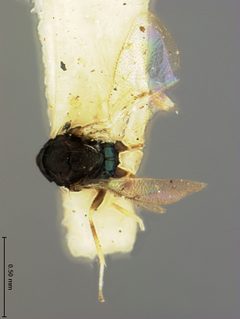
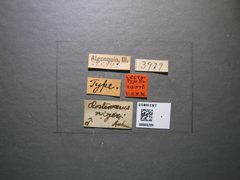
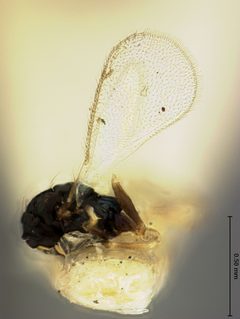
Pronunciation
How to pronounce Closterocerus: /klɒstəˈsɛrəs/
These audio files are automatically generated. While they are not always 100% accurate, they are a good starting point.
Identification
Members of Closterocerus can be distinguished from related Eulophidae by specific morphological features, though -level diagnostic characters require detailed examination. In Closterocerus oryzamyntor, deep on the vertex of males that connect to form a complete transvertexal suture in females, and a comparatively long malar space (0.3 times height), are noted diagnostic features. Closterocerus cruy is distinguished from the closely related C. mirabilis by specific character states detailed in taxonomic redescriptions. Accurate identification typically requires examination of structure, wing venation, and body patterns under magnification.
Images
Habitat
vary by and reflect associations. Closterocerus chamaeleon occurs in Eucalyptus plantations, periurban forests, and ornamental tree settings where its gall wasp hosts are present. Closterocerus oryzamyntor is associated with rice agroecosystems in Bangladesh. Closterocerus cruy has been recorded from New Zealand in association with lepidopteran leafminers. General habitat requirements include presence of suitable host insects on specific host plants.
Distribution
Documented from multiple continents including North America (USA: California, Alabama, Connecticut, Florida, Hawaii), South America (Colombia), Europe (Mediterranean Basin, Turkey), Africa (Algeria), Asia (Bangladesh), and Oceania (New Zealand, Australia). Distribution is -specific; Closterocerus chamaeleon is notably widespread following its association with Eucalyptus pests, with records from the Mediterranean Basin, Turkey, Algeria, USA, and Colombia.
Host Associations
- Ophelimus maskelli - Eucalyptus gall wasp; primary for C. chamaeleon
- Ophelimus near migdanorum - Eucalyptus gall wasp; for C. chamaeleon in Colombia
- Dicladispa armigera - Rice hispa (Chrysomelidae: Hispinae); for C. oryzamyntor in Bangladesh
- Lepidopteran leafminers - for C. cruy in New Zealand
- Winnemana argei - for C. winnemanae
Behavior
Closterocerus chamaeleon exhibits multivoltine with influenced by precipitation and microclimate conditions. In Colombia, only females of both the gall wasp and its were observed during field evaluations. The emerges from galled foliage and acts as a larval endoparasitoid. Drier microclimates have been observed to favor gall size, developmental stage frequency, and trends of associated species.
Ecological Role
agent and natural enemy of insect pests. Closterocerus chamaeleon is an effective natural enemy of Eucalyptus gall wasps, with rates documented as considerable in field studies. The contributes to regulation of gall wasp in both native and introduced ranges, with abundance sometimes exceeding that of its pest . C. oryzamyntor provides natural control of the rice hispa, a major agricultural pest in Bangladesh.
Human Relevance
Significant value in programs. Closterocerus chamaeleon has been successfully deployed or naturally established in multiple countries to manage Eucalyptus gall wasps (Ophelimus ) affecting plantation forestry and ornamental trees. Risk assessments for non-target effects have been conducted for this species. C. oryzamyntor represents a potential biocontrol resource for rice hispa management in South Asian agriculture.
Similar Taxa
- Closterocerus mirabilisClosely related Australian ; C. cruy distinguished by specific diagnostic character states in morphological redescriptions
More Details
Taxonomic Authority
established by Westwood in 1833. Classification within Eulophidae, Entedoninae confirmed by multiple sources.
Reproductive Biology
Closterocerus chamaeleon is uniparental (/parthenogenetic), with only females documented in some field studies.
Molecular Data
Partial 28S D2 ribosomal gene sequences have been used to characterize C. oryzamyntor, showing 6% divergence from other Closterocerus sequences on GenBank. CytB and COI mitochondrial markers show slight intraspecific variation but lack comparative eulophid data.
Sources and further reading
- BugGuide
- Wikipedia
- GBIF taxonomy match
- iNaturalist taxon
- NCBI Taxonomy
- Catalogue of Life
- closterocerus_phenacapsia_yoshimoto_holotype_female_ucrc_ent_151321_lateral.jpg | Entomology Research Museum
- Primary Type List | Entomology Research Museum
- Figures 1–2 from: Burks RA, Mottern JL, Pownall NG, Waterworth R, Paine TD (2015) First record of Closterocerus chamaeleon, parasitoid of the Eucalyptus Gall Wasp Ophelimus maskelli (Hymenoptera, Chalcidoidea, Eulophidae), in the New World. ZooKeys 504: 149-152. https://doi.org/10.3897/zookeys.504.9728
- New Host and Distribution Records for Winnemana argei and Its Parasite Closterocerus winnemanae (Hymenoptera: Eulophidae)
- Figure 3 from: Pinzón-Florián O (2020) First report on the gall wasp Ophelimus near migdanorum (Hymenoptera, Eulophidae) and its parasitoid Closterocerus chamaeleon (Hymenoptera, Eulophidae) in Eucalyptus globulus in Bogotá, Colombia. ZooKeys 902: 151-156. https://doi.org/10.3897/zookeys.902.39213
- Note: First record of the eucalyptus gall waspOphelimus maskelli and its parasitoid,Closterocerus chamaeleon, in Turkey
- First report on the gall wasp Ophelimus near migdanorum (Hymenoptera, Eulophidae) and its parasitoid Closterocerus chamaeleon (Hymenoptera, Eulophidae) in Eucalyptus globulus in Bogotá, Colombia
- Variations in Ophelimus maskelli (Hymenoptera: Eulophidae) population density and infestation on Eucalyptus and the impact of its parasitoid Closterocerus chamaeleon (Hymenoptera: Eulophidae) in Algeria
- Closterocerus oryzamyntor (Hymenoptera: Eulophidae: Entedoninae), a larval parasitoid of the rice hispa Dicladispa armigera in Bangladesh (Coleoptera: Chrysomelidae: Hispinae)
- Gall phenology, population trend and damage caused by Ophelimus migdanorum and its parasitoid Closterocerus chamaeleon on Eucalyptus globulus at two sites with different rainfall parameters in Bogotá
- First record of Closterocerus chamaeleon, parasitoid of the Eucalyptus Gall Wasp Ophelimus maskelli (Hymenoptera, Chalcidoidea, Eulophidae), in the New World
- The Gall Wasp Ophelimus migdanorum and Its Parasitoid Closterocerus chamaeleon on Eucalyptus globulus at Two Sites with Different Rainfall Parameters in Bogotá, Colombia
- Risk assessment of non-target effects of Closterocerus chamaeleon (Girault) parasitoid of the eucalypt gall maker Ophelimus maskelli (Ashmead) (Hymenoptera, Eulophidae)
- Redescription of Closterocerus cruy (Girault) (Hymenoptera: Eulophidae: Entedoninae), with new geographical and host records