
Ophelimus maskelli
(Ashmead, 1900)
eucalyptus gall wasp, Australian Eucalyptus Leafgall Wasp
Ophelimus maskelli is a minute chalcid (approximately 1 mm long) native to Australia and New Zealand that has become across multiple continents. Females oviposit on eucalyptus leaves, inducing leaf galls that developing larvae. Heavy cause widespread defoliation and growth loss in eucalyptus plantations. The has been successfully suppressed in some regions through using , particularly Closterocerus chamaeleon and Stethynium ophelimi.
Pronunciation
How to pronounce Ophelimus maskelli: //oʊˈfiːlɪməs ˈmæskəli//
These audio files are automatically generated. While they are not always 100% accurate, they are a good starting point.
Identification
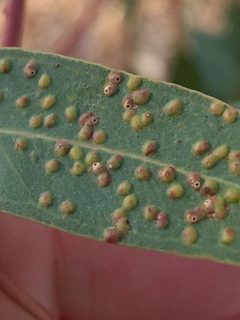
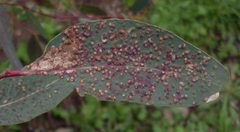
Identification to requires microscopic examination. The species induces characteristic leaf galls on Eucalyptus, which can serve as a field indicator of presence. Distinguishing Ophelimus maskelli from such as Ophelimus eucalypti requires examination of morphological characters; a comprehensive illustrated key to Cynipoidea (Buffington et al., 2020) provides resources for higher-level identification. The galls produced are on leaves rather than stems or other plant parts.
Images
Appearance
are approximately 1 mm in length. As a member of the Eulophidae, the exhibits typical chalcid with reduced wing venation and compact body form.
Habitat
Occurs in eucalyptus plantations, forests, and nurseries. In its native range, inhabits natural eucalyptus woodlands in Australia and New Zealand. In invaded regions, found wherever Eucalyptus are cultivated, including Mediterranean climates, tropical Asia, and semiarid environments.
Distribution
Native to Australia (New South Wales) and New Zealand. in: Mediterranean region (Spain including Balearic Islands, France including Corsica, Portugal, Italy including Sicily, Greece), Middle East (Israel, Turkey, Jordan), North Africa (Algeria, Morocco, Tunisia), South Africa, tropical Asia (Vietnam to Indonesia including Sumatra and Timor), China, and the United States (California). First recorded in the Canary Islands and has continued expanding its range.
Seasonality
emerge in large numbers in spring. In Mediterranean regions, show seasonal peaks corresponding to eucalyptus leaf flush. In Sumatra, Indonesia, lifespan studies indicate continuous activity with variable densities across seasons.
Host Associations
- Eucalyptus camaldulensis - gall inducerred gum
- Eucalyptus globulus - gall inducerTasmanian blue gum
- Eucalyptus tereticornis - gall inducer
- Eucalyptus grandis x E. camaldulensis hybrids - gall inducerclonal hybrids show higher susceptibility
- Eucalyptus urophylla - gall inducerampupu, important in Timor plantations
Life Cycle
Females lay on eucalyptus leaves. Larvae develop within leaf galls, inducing characteristic plant growth . Development proceeds through egg, larva, and pupa stages within the gall. emerge from galls, with spring producing large . Complete lifespan from egg to adult has been documented at approximately 44 days under greenhouse conditions for related .
Behavior
Females actively seek eucalyptus leaves for oviposition. may form dense or 'clouds' during spring , creating nuisance conditions for humans in heavily infested areas. The exhibits no known social .
Ecological Role
As a gall inducer, modifies plant physiology to create protected larval chambers. Serves as host for including Closterocerus chamaeleon (Eulophidae) and Stethynium ophelimi (Mymaridae), supporting parasitoid in invaded regions. Heavy alter structure and reduce host plant productivity.
Human Relevance
Significant economic pest of eucalyptus plantations and nurseries worldwide. Causes growth loss and defoliation in commercial timber operations. programs using Closterocerus chamaeleon and Stethynium ophelimi have been implemented successfully in Israel, the Mediterranean Basin, and other regions, reducing pest substantially. Spring clouds create nuisance conditions for and residents near infested plantations.
Similar Taxa
- Ophelimus eucalyptiCongeneric gall wasp on Eucalyptus; co-occurs in Sumatra and other regions where both are . O. eucalypti exhibits greater longevity and survival than O. maskelli, contributing to its higher threat status in some regions.
- Leptocybe invasaAnother eulophid gall wasp on Eucalyptus; co-occurs in Tanzania, Timor, and other regions. L. invasa shows higher invasive capacity and typically induces stem galls rather than leaf galls.
- Closterocerus chamaeleonEulophid of Ophelimus maskelli; may be confused with in but distinguished by its role as parasitoid and different . Exhibits substantially greater longevity and survival than its hosts.
More Details
Biological control success
In Israel, releases of three successfully reduced O. maskelli . Two species subsequently proliferated throughout the Mediterranean Basin: Closterocerus chamaeleon (Eulophidae) and Stethynium ophelimi (Mymaridae). These have proven to be excellent agents. Closterocerus chamaeleon was first recorded in the New World (California) in 2015.
Research history
Members of the Stethynium were investigated as potential agents as early as 2006 in Australia and Israel. Two new Australian Stethynium were subsequently described as larval of O. maskelli.
Sources and further reading
- BugGuide
- Wikipedia
- GBIF taxonomy match
- iNaturalist taxon
- NCBI Taxonomy
- Is That a Gall Wasp? Now You Can Find Out
- Ophelimus maskelli (Ashmead). [Distribution map].
- Ophelimus maskelli . [Distribution map].
- Population Trend , Host Susceptibility and Damage Study on the Eucalyptus Gall Wasp Ophelimus Maskelli ( Ashmead ) ( Hym. , Eulophidae ) in Jordan = دراسة تغيرات أعداد و حساسية العائل و ضرر دبور درنات الكينا Ophelimus Maskelli ( Ashmead ) ( Hym. , Eulophidae ) في الأردن
- First record of Closterocerus chamaeleon, parasitoid of the Eucalyptus Gall Wasp Ophelimus maskelli (Hymenoptera, Chalcidoidea, Eulophidae), in the New World
- The parasitoid Closterocerus chamaeleon has a greater development and survival rate than of its hosts, the Eucalyptus gall wasps Ophelimus eucalypti and Ophelimus maskelli in Sumatra, Indonesia
- Figures 1–2 from: Burks RA, Mottern JL, Pownall NG, Waterworth R, Paine TD (2015) First record of Closterocerus chamaeleon, parasitoid of the Eucalyptus Gall Wasp Ophelimus maskelli (Hymenoptera, Chalcidoidea, Eulophidae), in the New World. ZooKeys 504: 149-152. https://doi.org/10.3897/zookeys.504.9728
- First record of Eucalyptus leaf gall wasp, Ophelimus maskelli (Ashmead) (Hymenoptera: Eulophidae), an invasive pest of Eucalyptus spp., in the Canary Islands
- Risk assessment of non-target effects of Closterocerus chamaeleon (Girault) parasitoid of the eucalypt gall maker Ophelimus maskelli (Ashmead) (Hymenoptera, Eulophidae)
- Presence of the Eucalyptus gall wasp Ophelimus maskelli and its parasitoid Closterocerus chamaeleon in Portugal: First record, geographic distribution and host preference
- Biological control of the eucalyptus gall wasp Ophelimus maskelli (Ashmead): Taxonomy and biology of the parasitoid species Closterocerus chamaeleon (Girault), with information on its establishment in Israel
- Current Infestation Status and Damage Severity of Eucalyptus Gall Wasps, Leptocybe invasa (Fisher & La Salle), and Ophelimus maskelli Ashmead (Hymenoptera: Eulophidae), Infesting Eucalyptus Germplasms in Tanzania
- Variations in Ophelimus maskelli (Hymenoptera: Eulophidae) population density and infestation on Eucalyptus and the impact of its parasitoid Closterocerus chamaeleon (Hymenoptera: Eulophidae) in Algeria
- SPESIES HAMA INVASIF Leptocybe invasa FISHER & LA SALLE DAN Ophelimus maskelli (ASMEAD) DAN UPAYA PENGENDALIANNYA PADA TEGAKAN AMPUPU DI PULAU TIMOR
- A new invasive eucalypt gall wasp Ophelimus maskelli and its parasitoid Closterocerus chamaeleon in China: identification and population phenology
- Two new Australian species ofStethynium(Hymenoptera: Mymaridae), larval parasitoids ofOphelimus maskelli(Ashmead) (Hymenoptera: Eulophidae) onEucalyptus