
Ophelimus
Haliday, 1844
Eucalyptus gall wasps
Species Guides
1- Ophelimus maskelli(eucalyptus gall wasp)
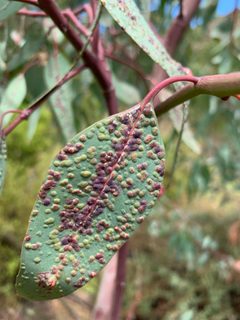
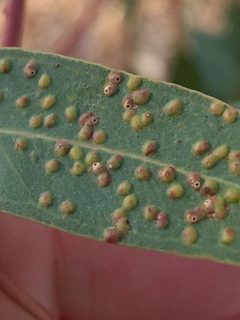
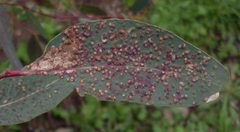
Ophelimus is a of minute in the Eulophidae. in this genus are gall inducers, causing the formation of leaf galls on Eucalyptus plants. Several species, including O. maskelli and O. eucalypti, have become pests in Eucalyptus plantations outside their native Australian range. The genus is subject to efforts using such as Closterocerus chamaeleon.
Pronunciation
How to pronounce Ophelimus: //oʊˈfɛlɪməs//
These audio files are automatically generated. While they are not always 100% accurate, they are a good starting point.
Identification
Members of this are small chalcid wasps, typically under 2 mm in length. -level identification requires examination of microscopic morphological characters; O. mediterraneus and O. maskelli can be distinguished using multivariate ratio analysis and molecular markers ( oxidase I, 28S).
Images
Habitat
Eucalyptus forests and plantations; associated with leaves of Eucalyptus .
Distribution
Native to Australia (Queensland, Western Australia, New South Wales). Introduced and established in New Zealand, Europe (France, Italy, Portugal, Spain, UK, Greece), Asia (Israel, Turkey), Africa (Algeria, Morocco, Tunisia), Indonesia (Sumatra), and Colombia.
Seasonality
Multivoltine; continuous breeding in suitable climates. Maximum of O. eucalypti observed in August and December in New Zealand.
Host Associations
- Eucalyptus - gall induction on leavesPrimary plant for all Ophelimus
- Eucalyptus globulus - gall induction for O. maskelli, O. eucalypti, O. migdanorum, and O. near migdanorum
- Eucalyptus saligna - gall induction for O. eucalypti
- Eucalyptus botryoides - gall induction for O. eucalypti
- Eucalyptus camaldulensis - gall induction for O. maskelli
- Eucalyptus grandis - gall induction for O. eucalypti
- Eucalyptus deanei - gall induction for O. eucalypti
- Closterocerus chamaeleon - Eulophid with greater longevity and survival than its Ophelimus ; used in biocontrol
- Aprostocetus causalis - Eulophid of O. eucalypti in Indonesia
- Chrysonotomyia spp. - Prevalent of O. eucalypti in North Sumatra
- Mikeius hartigi - that lays in galls induced by Ophelimus spp.
Life Cycle
Complete (, larva, pupa, ). Gall development progresses through six color-differentiated stages. Larvae grow to fill the entire gall cavity prior to gall . Gall mass peaks when larvae are at one-third of maximum mass. Adults live approximately 10 days; females produce up to 350 eggs. Lifespan of O. eucalypti averages 44 days in greenhouse conditions.
Behavior
Induces formation of leaf galls on Eucalyptus. Gall and development rate influenced by microclimate; drier conditions favor larger gall size, faster development, and higher densities.
Ecological Role
Herbivore and gall inducer on Eucalyptus. Acts as for multiple , supporting local parasitoid in invaded regions.
Human Relevance
Several are significant pests of commercial Eucalyptus plantations, causing foliar damage and reduced growth. Subject to classical and programs using . O. maskelli and O. eucalypti are particularly problematic in Mediterranean Europe, Indonesia, and New Zealand.
Similar Taxa
- Ophelimus maskelliClosely related to O. mediterraneus; distinguished by molecular and morphological analysis
- Ophelimus mediterraneusSympatric with O. maskelli in introduced Mediterranean areas; previously confused with O. maskelli
- Ophelimus eucalyptiSimilar and range; distinguished by gall characteristics and microscopic
- Ophelimus migdanorumSimilar leaf-gall induction on E. globulus; specific diagnostic characters not detailed in available sources
Sources and further reading
- BugGuide
- Wikipedia
- GBIF taxonomy match
- iNaturalist taxon
- NCBI Taxonomy
- Catalogue of Life
- Is That a Gall Wasp? Now You Can Find Out
- Ophelimus eucalypti . [Distribution map].
- Ophelimus maskelli (Ashmead). [Distribution map].
- Ophelimus maskelli . [Distribution map].
- The parasitoid Closterocerus chamaeleon has a greater development and survival rate than of its hosts, the Eucalyptus gall wasps Ophelimus eucalypti and Ophelimus maskelli in Sumatra, Indonesia
- Parasitoids associated to Ophelimus eucalypti (gahan) (Hymenoptera: Eulophidae) on Eucalyptus (Myrtaceae) plantations in North Sumatra, Indonesia
- Ophelimus mediterraneus sp. n. (Hymenoptera, Eulophidae): a new Eucalyptus gall wasp in the Mediterranean region
- Figure 2 from: Pinzón-Florián O (2020) First report on the gall wasp Ophelimus near migdanorum (Hymenoptera, Eulophidae) and its parasitoid Closterocerus chamaeleon (Hymenoptera, Eulophidae) in Eucalyptus globulus in Bogotá, Colombia. ZooKeys 902: 151-156. https://doi.org/10.3897/zookeys.902.39213
- Population Trend , Host Susceptibility and Damage Study on the Eucalyptus Gall Wasp Ophelimus Maskelli ( Ashmead ) ( Hym. , Eulophidae ) in Jordan = دراسة تغيرات أعداد و حساسية العائل و ضرر دبور درنات الكينا Ophelimus Maskelli ( Ashmead ) ( Hym. , Eulophidae ) في الأردن
- Figure 3 from: Pinzón-Florián O (2020) First report on the gall wasp Ophelimus near migdanorum (Hymenoptera, Eulophidae) and its parasitoid Closterocerus chamaeleon (Hymenoptera, Eulophidae) in Eucalyptus globulus in Bogotá, Colombia. ZooKeys 902: 151-156. https://doi.org/10.3897/zookeys.902.39213
- Host range and biology of <i>Ophelimus eucalyptii</i> (Gahan)(Hym Eulophidae) a pest of New Zealand eucalypts
- Figures 1–2 from: Burks RA, Mottern JL, Pownall NG, Waterworth R, Paine TD (2015) First record of Closterocerus chamaeleon, parasitoid of the Eucalyptus Gall Wasp Ophelimus maskelli (Hymenoptera, Chalcidoidea, Eulophidae), in the New World. ZooKeys 504: 149-152. https://doi.org/10.3897/zookeys.504.9728
- The Gall Wasp Ophelimus migdanorum and Its Parasitoid Closterocerus chamaeleon on Eucalyptus globulus at Two Sites with Different Rainfall Parameters in Bogotá, Colombia
- First report on the gall wasp Ophelimus near migdanorum (Hymenoptera, Eulophidae) and its parasitoid Closterocerus chamaeleon (Hymenoptera, Eulophidae) in Eucalyptus globulus in Bogotá, Colombia
- Gall phenology, population trend and damage caused by Ophelimus migdanorum and its parasitoid Closterocerus chamaeleon on Eucalyptus globulus at two sites with different rainfall parameters in Bogotá
- First record of Closterocerus chamaeleon, parasitoid of the Eucalyptus Gall Wasp Ophelimus maskelli (Hymenoptera, Chalcidoidea, Eulophidae), in the New World
- A New Species of Aprostocetus (Hymenoptera: Eulophidae), a Parasitoid from China of the Invasive Gall Wasp Ophelimus bipolaris (Hymenoptera: Eulophidae) on Eucalyptus.
- Ophelimus bipolaris sp. n. (Hymenoptera, Eulophidae), a New Invasive Eucalyptus Pest and Its Host Plants in China.