
Chrysonotomyia
Ashmead, 1904
Species Guides
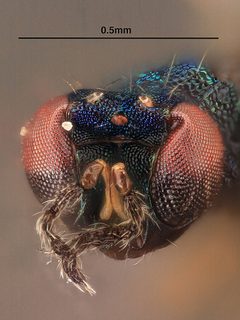
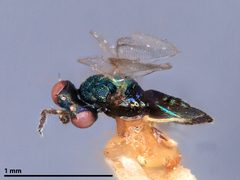
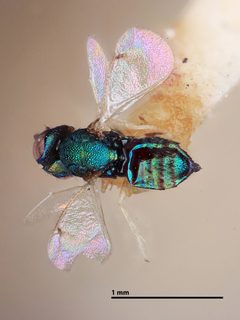
1Chrysonotomyia is a of small in the Eulophidae containing over 170 described , with the greatest diversity in the Neotropics. Members are specialized parasitoids of insect larvae that develop within living plant tissue, including gall-formers, leaf-miners, and stem-miners. The genus is characterized by distinctive morphological features including a delimited only on the sides, a postmarginal usually shorter than the stigmal vein, and L-shaped peg on the . A newly described species from Texas, C. susbelli, represents the first known association between Chrysonotomyia and cynipid gall wasps, expanding the understood range of the genus.
Pronunciation
How to pronounce Chrysonotomyia: //ˌkɹɪzoʊnəˈtoʊmi.ə//
These audio files are automatically generated. While they are not always 100% accurate, they are a good starting point.
Identification
Diagnostic features include: delimited on the sides only (not on top or bottom); postmarginal usually shorter than stigmal vein (though longer in some ); midlobe of mesoscutum with one pair of hairs (2-3 in some species); notauli poorly delimited or absent; bearing L-shaped peg . C. susbelli specifically exhibits golden yellow mesosoma coloration with dark brown markings and is approximately 1 mm in length.
Images
Habitat
Associated with plants bearing galls, leaf mines, or stem mines created by insects. C. susbelli was collected from southern live oak (Quercus virginiana) leaves bearing galls of the cynipid Neuroterus nr. bussae.
Distribution
Most described occur in the Neotropics. Six species are known from North America north of Mexico. GBIF records indicate presence in Alabama, Alberta, California, and Florida. C. susbelli is currently confirmed only from Rice University campus in Houston, Texas, USA, though expected to occur throughout the range of its on Quercus virginiana along the Gulf Coast of the southern United States.
Seasonality
of C. susbelli emerge from galls in laboratory conditions from late April to early May, with field observations on plant leaves from mid-April to mid-May. Broader seasonal patterns for the are not documented.
Host Associations
- Cecidomyiidae - of gall-forming Primary for most Neotropical
- Cynipidae - of gall-forming First documented for C. susbelli on Neuroterus nr. bussae
- Torymidae - recorded from galls
- Psyllidae - recorded from galls
- Momphidae - of leaf-mining
- Coccidae - of scale insects
Life Cycle
Development occurs within galls or mines. emerge from galls in laboratory conditions from late April to early May for C. susbelli. Specific details of -laying, larval development, and are not documented.
Behavior
Female C. susbelli exhibit leaf-scanning on upper leaf surfaces, hypothesized to represent gall-searching for location. Zigzag movement patterns have been observed in both laboratory and field conditions for this .
Ecological Role
regulating of gall-forming and mining insects on plants. Natural enemy within gall-based microhabitat .
Human Relevance
Potential agent for pest gall-formers and miners. Discovery of C. susbelli on a university campus illustrates the undocumented biodiversity present in urban environments.
Similar Taxa
- Other Eulophidae generaChrysonotomyia is distinguished by the combination of delimited on sides only, postmarginal usually shorter than stigmal vein, midlobe of mesoscutum with reduced hair pairs, and L-shaped peg on
More Details
Taxonomic significance of C. susbelli
The discovery of Chrysonotomyia susbelli represents the first global record of a Chrysonotomyia parasitizing cynipid gall wasps, suggesting an undiscovered involving Chrysonotomyia , cynipid gall wasps, and oaks in the Nearctic region.
Genetic considerations
Genetic data suggest the Texas of Neuroterus nr. bussae may represent a different than the Florida-described N. bussae, hence the conservative 'nr.' (near) designation in records.