
Euphyllura
Förster, 1848
olive psyllids, olive psylla
Species Guides
1- Euphyllura olivina(olive psyllid)
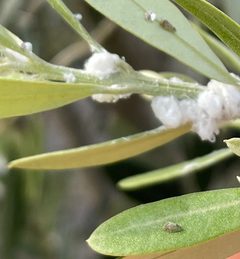
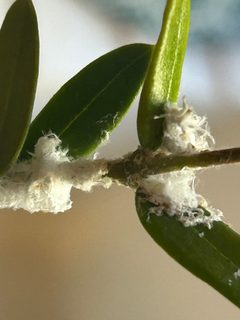
is a of plant-feeding psyllids (Hemiptera: Liviidae) established by Arnold Förster in 1848. are primarily associated with olive (Olea europaea) and related plants in the Oleaceae. The genus is predominantly Palaearctic in distribution, with most species occurring in southern Europe and Asia, though records extend to southern Africa and western North America. Several species are economically significant pests of olive , including E. olivina, E. phillyreae, and E. straminea, which damage developing inflorescences and fruits. The genus exhibits typical with temperature-dependent and seasonal strategies.
Pronunciation
How to pronounce Euphyllura: //juːfɪlˈjʊrə//
These audio files are automatically generated. While they are not always 100% accurate, they are a good starting point.
Identification
Members of can be distinguished from other Liviidae by their association with Oleaceae , particularly Olea and Phillyrea. Specific identification to level requires examination of genitalia and wing venation patterns. E. olivina and E. phillyreae are frequently confused but differ in their seasonal and precise host plant preferences. E. straminea and E. pakistanica can be differentiated by their bacterial endosymbiont profiles, with E. straminea showing high titres and Alphaproteobacteria dominance versus Gammaproteobacteria dominance in E. pakistanica.
Images
Habitat
Olive groves and natural stands of Oleaceae, particularly Olea europaea and Phillyrea latifolia. Nymphal stages are found on developing buds, inflorescences, and young fruits, with distribution influenced by sun exposure and bud development stage.
Distribution
Primarily Palaearctic: southern Europe (Greece, Spain, Italy, France), Mediterranean basin, Middle East, Central and South Asia. Disjunct records from southern Africa and western United States (California).
Seasonality
or monovoltine depending on and latitude. E. olivina shows two annually in spring (mid-May) and early summer (late June). E. phillyreae exhibits reproductive from June through December, with diapause termination occurring mid-December to early January and reproductive extending to February-March. Oviposition begins in late March, intensifying with bud swell.
Diet
Phloem sap from plants in Oleaceae, primarily Olea europaea (olive) and Phillyrea latifolia. Feeding occurs on developing buds, inflorescences, and young fruits.
Host Associations
- Olea europaea - primary olive, major economic
- Phillyrea latifolia - primary recorded for E. phillyreae
- Arbutus - recorded for E. arbuti
Life Cycle
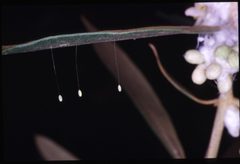
, five nymphal instars, and stages. Eggs are laid on swollen buds and developing inflorescences, with precise placement related to bud developmental stage. Nymphal development occurs on buds and young fruits. Temperature strongly influences development rate and ; development and are inhibited above 32°C. Some exhibit reproductive in adults during summer-autumn-winter.
Behavior
Oviposition preference is determined by bud developmental stage rather than position on twig. On olive, are concentrated on inner surfaces of middle pairs of developing leaves on swollen buds. enter reproductive during summer months, with termination requiring specific sequential temperature and cues (summer-like followed by winter-like then spring-like conditions).
Ecological Role
Herbivore and agricultural pest of olive . Serves as for including Psyllaephagus euphyllurae and P. saxaulicus (Encyrtidae), which function as agents. Bacterial endosymbionts including Carsonella (primary), Arsenophonus, and mediate nutritional supplementation and potentially reproductive manipulation.
Human Relevance
Significant economic pest of olive production in Mediterranean region, Middle East, and Central Asia. Summer of E. olivina causes substantial fruit damage and yield loss. Subject of programs incorporating , (phenolic compounds affect abundance), and based prediction models for management timing.
Similar Taxa
- Other Liviidae genera distinguished by Oleaceae specialization; other typically associated with different host plant
- CacopsyllaSome Cacopsylla occur on olive but differ in and seasonal ; species show more pronounced summer
- PsyllaGeneral similar but Psylla typically on different and lack the specific bud-associated oviposition of
More Details
Endosymbiont biology
harbor characteristic bacterial dominated by Proteobacteria. Carsonella serves as primary endosymbiont for nutritional supplementation. E. straminea shows notably high titres with negative correlation to Carsonella and Arsenophonus abundance, suggesting potential competition or modulation. These endosymbionts represent potential targets for symbiont-based pest management strategies.
Climate adaptation
show distinct thermal with laying activity ceasing in summer when temperatures exceed 20°C, and complete reproductive inhibition at 32°C. This thermal sensitivity explains geographic distribution patterns and seasonal , with in warmer regions (e.g., southern Tunisia) showing modified compared to northern Mediterranean populations.
Sources and further reading
- BugGuide
- Wikipedia
- GBIF taxonomy match
- iNaturalist taxon
- NCBI Taxonomy
- Catalogue of Life
- Publications | Entomology Research Museum
- Targeting the Light Brown Apple Moth | Bug Squad
- Comparative analysis of bacterial communities in olive psyllids, Euphyllura straminea and Euphyllura pakistanica expose proteobacteria dominance
- THE LIFE HISTORY OF EUPHYLLURA ARBUTI SCHWARZ (HEMIPTERA; CHERMIDAE)
- TEMPERATURE EFFECT ON THE BIOLOGY OF EUPHYLLURA OLIVINA COSTA
- Contributions to the reproductive biology of olive psylla Euphyllura olivina Costa (Hom., Psyllidae)
- Factors affecting the distribution of Euphyllura olivina Costa (Hom., Psyllidae) on olive
- Sites and Time of Oviposition of Euphyllura phillyreae Foerster on Olive Trees and οon Phillyrea latifolia
- Population dynamics, seasonal fluctuations and spatial distribution of the olive psyllid Euphyllura olivina Costa (Homoptera, Psyllidae) in Algeria
- Egg Distribution Patterns of Olive Psyllid Euphyllura phillyreae (Homoptera: Aphalaridae) on Phillyrea latifolia and Olea europaea in Northern Greece
- Ecology, Population Development and Damage of Euphyllura Straminea Log. (Hemiptera: Psyllidae) Causing Damage in Olive Orchards
- Effect of temperature on the development and reproduction of olive psyllid Euphyllura olivina Costa (Hemiptera: Psyllidae)
- Description of the Male of Psyllaephagus saxaulicus Sugonjaev (Hymenoptera: Encyrtidae) Parasitising the Olive Psyllid, Euphyllura straminea Loginova (Hemiptera: Liviidae) in Iran, with Notes on Its Hyperparasitoids
- Using degree-day accumulations and host phenology for predicting larval emergence patterns of the olive psyllid, Euphyllura phillyreae
- Population dynamics, spatiotemporal distribution of the olive psyllid Euphyllura olivina, (Costa, 1839) (Hemiptera: Psyllidae) on the Chemlal variety in the Oasis of Boussaâda
- Distribution Area, Population Changes and Natural Enemies of Olive psyllid Euphyllura straminea Loginova 1973 (Hemiptera: Psyllidae) in the Olive Orchards in Hatay Province of Turkey
- Diapause termination in the olive psyllid Euphyllura phillyreae, in the field and in the laboratory
- The effects of phenolic compounds on the abundance of olive psyllid, Euphyllura straminea Loginova in commercial and promising olive cultivars.