
Euphyllura olivina
(Costa, 1839)
olive psyllid
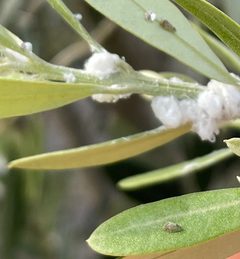
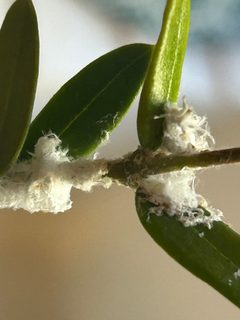
Euphyllura olivina is a in the Liviidae that feeds exclusively on olive (Olea europaea). Native to the Mediterranean region, it has become in California where it threatens olive production. The species develops two annually, with spring and autumn reproductive activity and summer reproductive induced by high temperatures. Nymphal concentrate near fruits and on shaded, lower portions. Temperature sensitivity shapes its distribution and seasonal activity patterns.
Pronunciation
How to pronounce Euphyllura olivina: /juːˈfɪljʊrə oʊˈlɪvaɪnə/
These audio files are automatically generated. While they are not always 100% accurate, they are a good starting point.
Identification
Euphyllura olivina can be distinguished from other by its exclusive association with olive (Olea europaea). are small, typically 2-3 mm in length. The species is characterized by its preference for shaded, lower positions and near developing fruits. Morphological identification requires examination of wing venation and genitalia; precise diagnostic features are documented in taxonomic literature on Mediterranean psyllids.
Images
Habitat
Olive groves and abandoned olive orchards. Within trees, nymphs prefer shaded areas, lower positions, and older leaves. Distribution on individual trees is influenced by sun exposure, with highest densities on southern and central orientations in some regions, though nymphs generally avoid direct sunlight.
Distribution
Native to the Mediterranean basin including Spain, Tunisia, Algeria, and Jordan. in California, USA, where current distribution is limited to coastal areas between Monterey and San Diego; not yet established in California's Central Valley olive production regions. Records from the Azores (Graciosa, Terceira).
Seasonality
with two annually: spring generation (emerging mid-April to mid-May) and summer generation (emerging end June). Reproductive activity occurs in spring and autumn, with reproductive in from mid-June to mid-November. peaks in spring (March-May). First appearance of biological stages recorded mid-March in North African populations.
Diet
Phloem sap of olive trees (Olea europaea). Nymphs feed on leaves, shoots, and buds, with highest rates near developing fruits.
Host Associations
- Olea europaea - obligate Exclusive plant; all life stages dependent on olive
Life Cycle
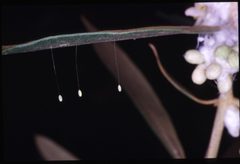
Five nymphal instars. to development temperature-dependent. Eggs laid on olive leaves, shoots, and buds. as adults in reproductive . Development threshold: optimal below 20°C, inhibited above 20°C, completely arrested at 32°C.
Behavior
Aggregates in shaded, lower areas. Shows temperature-mediated reproductive from mid-June to mid-November. Females exhibit pre-oviposition period before -laying begins. Short exposures to high temperatures (34-35°C for 24-48 hours) negatively impact . Laying activity ceases during summer months.
Ecological Role
Pest of cultivated olive causing direct damage to foliage and fruits. Serves as for specialized including Psyllaephagus euphyllurae (primary parasitoid) and hyperparasitoids Apocharips trapezoidea and Pachyneuron sp.
Human Relevance
Economic pest of olive production. in California where programs have been initiated using the Mediterranean Psyllaephagus euphyllurae. Subject to research focusing on temperature-based prediction and parasitoid introduction.
Similar Taxa
- Other Euphyllura speciesSame ; E. olivina distinguished by exclusive olive association and Mediterranean/California distribution
- Other Liviidae on oliveSame plant; E. olivina distinguished by and specific temperature responses
More Details
Temperature sensitivity
Critical for management: ceases at 32°C, explaining summer decline and Mediterranean distribution limits. Climate change may expand suitable range in California.
Biological control status
Psyllaephagus euphyllurae established in at UC Riverside; non-target testing showed no development on three native North American . Field releases pending for California olive protection.
Sources and further reading
- BugGuide
- GBIF taxonomy match
- iNaturalist taxon
- NCBI Taxonomy
- Catalogue of Life
- Publications | Entomology Research Museum
- Targeting the Light Brown Apple Moth | Bug Squad
- TEMPERATURE EFFECT ON THE BIOLOGY OF EUPHYLLURA OLIVINA COSTA
- Factors affecting the distribution of Euphyllura olivina Costa (Hom., Psyllidae) on olive
- Contributions to the reproductive biology of olive psylla Euphyllura olivina Costa (Hom., Psyllidae)
- Effect of temperature on the development and reproduction of olive psyllid Euphyllura olivina Costa (Hemiptera: Psyllidae)
- Population dynamics, seasonal fluctuations and spatial distribution of the olive psyllid Euphyllura olivina Costa (Homoptera, Psyllidae) in Algeria
- Population dynamics, spatiotemporal distribution of the olive psyllid Euphyllura olivina, (Costa, 1839) (Hemiptera: Psyllidae) on the Chemlal variety in the Oasis of Boussaâda
- Current Distribution of the Olive Psyllid, Euphyllura olivina, in California and Initial Evaluation of the Mediterranean Parasitoid Psyllaephagus euphyllurae as a Biological Control Candidate
- Description of the male of Psyllaephagus euphyllurae (Masi) (Hymenoptera, Encyrtidae), a parasitoid of the olive psylla, Euphyllura olivina (Costa) (Hemiptera, Liviidae), with notes on its reproductive traits and hyperparasitoids
- SPATIOTEMPORAL DISTRIBUTION OF THE OLIVE PSYLLID EUPHYLLURA OLIVINA COSTA, 1839 (HEMIPTERA: PSYLLIDAE) ON THE CHEMLAL VARIETY IN THE MOUNTAINS OF KABYLIE – ALGERIA