
Pachypsylla celtidisgemma
Riley, 1885
Hackberry Gemma Psyllid
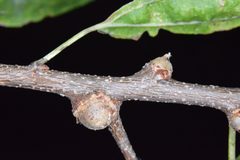
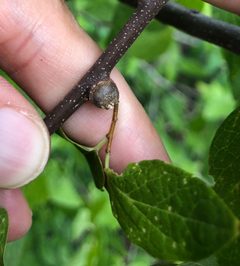
Pachypsylla celtidisgemma is a hackberry that induces distinct galls on hackberry trees (Celtis spp.). are small, -like insects measuring 3.5–4.5 mm, with . The species produces "gemma galls"—irregular, wart-like growths on hackberry leaves that house developing nymphs. Like other hackberry psyllids, it has a single per year and overwinters as adults in concealed locations.
Pronunciation
How to pronounce Pachypsylla celtidisgemma: /ˌpækɪˈsɪlə sɛlˌtɪdɪsˈɡɛmə/
These audio files are automatically generated. While they are not always 100% accurate, they are a good starting point.
Identification
Distinguished from other Pachypsylla by the gemma gall it produces: irregular, wart-like or blister-like galls on the upper leaf surface, in contrast to the nipple galls of P. celtidismama (underside of leaves) or the petiole galls of P. venusta. identification requires microscopic examination; species are morphologically similar and best identified by gall association.
Images
Habitat
Associated with hackberry trees (Celtis spp.), occurring wherever hackberry grows naturally or as an ornamental. overwinter in sheltered locations including building exteriors, window frames, and tree bark crevices.
Distribution
North America, with records from Ontario, Georgia, Idaho, Iowa, and Kansas. Range corresponds to native and planted distribution of hackberry trees.
Seasonality
emerge in fall and seek sites. occurs in spring when females deposit on unfolding hackberry leaves; nymphs develop within galls through summer.
Diet
Nymphs feed on plant sap within galls. feed on hackberry sap using .
Host Associations
- Celtis - obligatory hackberry trees; specific gall formation induced on leaves
Life Cycle
deposited on unfolding spring leaves hatch into nymphs that induce gall formation. Nymphs pass through five instars within galls. emerge in fall, seek sites, and reproduce the following spring. Single per year ().
Behavior
are strong jumpers, capable of vaulting away when disturbed. Fall on building exteriors create nuisance conditions. Precise -laying timing required: females must deposit eggs when leaves are at specific unfolding stage.
Ecological Role
Gall formation creates microhabitats exploited by including Psyllaephagus spp. (Encyrtidae) and Torymus spp. (Torymidae). Nymphs serve as for these parasitoids, which may chew exit holes in galls upon .
Human Relevance
Fall of on homes and buildings constitute a seasonal nuisance. No structural damage, transmission, or plant health impact documented; galls are cosmetic and do not harm hackberry trees. Control through physical removal (water spray) rather than chemical intervention.
Similar Taxa
- Pachypsylla celtidismamaProduces nipple galls on underside of hackberry leaves; distinguished by gall and location
- Pachypsylla venustaProduces petiole galls rather than leaf galls
- Pachypsylla celtidisvesiculumProduces blister or vesicular galls with different
- Cecidomyiidae (gall midges)Also produce galls on hackberry; distinguished by gall structure and presence of larvae rather than nymphs
More Details
Gall morphology
Gemma galls are irregular, clustered, wart-like growths typically on upper leaf surfaces. Double and triple galls occasionally occur. Gall can reach high numbers per leaf without apparent tree health impact.
Parasitoid associations
Psyllaephagus pachypsyllae (Encyrtidae) is a documented . Rearing galls may yield undocumented parasitoid or new records.