
Phylloxera caryaescissa
Riley, 1880
pecan leaf phylloxera, hickory phylloxeran
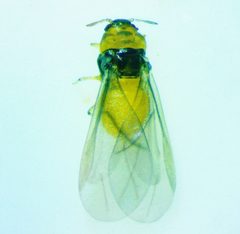
Phylloxera caryaescissa is a tiny, soft-bodied insect closely related to aphids that forms galls on hickory and pecan leaves. The survives winter as in bark crevices, with nymphs emerging during spring bud break to feed on new growth. Unlike the more destructive pecan phylloxera (Phylloxera devastatrix), this species attacks leaf tissue only and does not damage shoots or nuts. Extensive may cause some defoliation but typically do not significantly reduce yield.
Pronunciation
How to pronounce Phylloxera caryaescissa: /fɪˈlɒksərə ˌkæriəˈsɪsə/
These audio files are automatically generated. While they are not always 100% accurate, they are a good starting point.
Identification
Distinguished from the more damaging pecan phylloxera (Phylloxera devastatrix) by gall location: P. caryaescissa forms galls on leaves only, while P. devastatrix attacks shoots and nuts. Leaf galls are spherical swellings on leaf blades or petioles, ranging from 1/10 to 1 inch in diameter. Galls eventually crack open to release winged . The is also known as the hickory phylloxeran and occurs on hickory species as well as pecan.
Images
Habitat
Found in pecan orchards and native hickory stands; requires trees with new spring growth for gall formation. move slowly from tree to tree because cannot fly long distances.
Distribution
Documented in Texas and eastern North America where pecan (Carya illinoinensis) and hickory (Carya spp.) occur; specific range boundaries not well documented in available sources
Seasonality
hatch during spring bud break; nymphs feed and form galls on new growth; winged emerge from galls by late May; second and sometimes third occur if new growth remains available. eggs are laid in bark crevices in fall.
Diet
Feeds on phloem sap of pecan and hickory leaves; nymphs insert needle-like mouthparts into leaf tissue, stimulating gall formation
Host Associations
- Carya illinoinensis - primary pecan; forms leaf galls
- Carya spp. - primary hickory including mockernut hickory
Life Cycle
Overwinters as in bark crevices. In spring, nymphs (fundatrices) hatch during bud break and feed on new leaf tissue, secreting substances that stimulate gall formation. Nymphs develop to maturity inside galls and reproduce parthenogenetically, laying hundreds of eggs. Legions of nymphs hatch within galls and develop into winged forms. Galls crack open in late May, releasing winged that move to leaf undersurfaces to lay eggs. These eggs produce sexual males and females that mate and deposit eggs. Two to three may occur per year if new growth persists.
Behavior
Nymphs stimulate abnormal plant growth (galls) through feeding secretions; winged disperse short distances to new leaves; cannot fly long distances, so spread slowly between trees
Ecological Role
Creates leaf galls that provide food and shelter for developing nymphs; gall formation reduces photosynthetic leaf area; extensive may cause minor defoliation. Serves as prey for natural enemies including lacewings, lady beetles, and predatory .
Human Relevance
Minor pest of commercial pecans; causes cosmetic damage and limited defoliation but does not directly reduce nut yield like shoot-attacking phylloxera . Control rarely needed; may be applied in spring after bud break when growth is 1-2 inches long, targeting nymphs before gall formation protects them.
Similar Taxa
- Phylloxera devastatrixAlso attacks pecans but forms galls on shoots and nuts rather than leaves; more economically damaging
- Phylloxera caryaecaulisSimilar hickory-feeding phylloxera ; may be synonym or closely related species with overlapping use
More Details
Gall formation mechanism
Fundatrix nymphs secrete potent chemicals that derail normal plant development, causing hickory or pecan cells to differentiate into hollow, globular galls that serve as food source and
Parthenogenesis
First- females within galls reproduce parthenogenetically (without males), producing hundreds to over a thousand each
Control timing
must be applied after hatch but before nymphs are enclosed within protective galls; once galls form, insects are shielded from chemical contact
Sources and further reading
- BugGuide
- iNaturalist taxon
- Catalogue of Life
- Insects and mites that feed on leaves - AgriLife Extension Entomology
- Managing Insect and Mite Pests of Commercial Pecans in Texas - AgriLife Extension Entomology
- Meet 'The Moth Man' at Bohart Museum's Moth Night | Bug Squad
- A Victory for the Bees | Bug Squad
- Gall darn it! Gall insects on hickory, oak, and elm, Phylloxera caryaecaulis, Andricus palustris, Colopha ulmicola — Bug of the Week
- grape phylloxera Archives - Entomology Today