
Phylloxera
Boyer de Fonscolombe, 1834
phylloxeras
Species Guides
52- Phylloxera auburnensis
- Phylloxera bispinae
- Phylloxera caryaeavellana(hickory phylloxeran)
- Phylloxera caryaecaulis(Hickory Gall Phylloxera)
- Phylloxera caryaefallax(pecan leaf phylloxera)
- Phylloxera caryaefoliae(pecan leaf phylloxera)
- Phylloxera caryaeglobuli(hickory phylloxeran)
- Phylloxera caryaegummosa(pecan phylloxera)
- Phylloxera caryaemagna(pecan phylloxera)
Phylloxera is a of tiny, soft-bodied, sap-sucking insects in the Phylloxeridae, closely related to aphids. The genus includes economically significant agricultural pests, most notably the grape phylloxera (Daktulosphaira vitifoliae), which devastated European vineyards in the late 19th century and remains a major threat to viticulture worldwide. Phylloxera induce characteristic galls on plants through chemical secretions that manipulate plant tissue development. The genus exhibits complex involving multiple morphological forms, including winged and wingless parthenogenetic and a brief sexual generation.
Pronunciation
How to pronounce Phylloxera: /fɪˈlɒksəɹə/
These audio files are automatically generated. While they are not always 100% accurate, they are a good starting point.
Identification
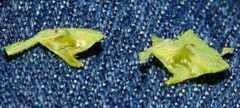
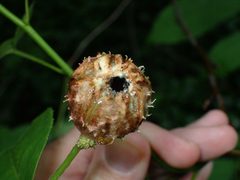
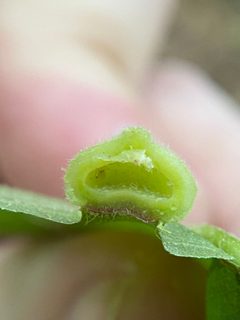
Distinguished from aphids (Aphididae) by gall-forming on specific plants and complex involving root-feeding and leaf-galling forms. Gall is often diagnostic for identification. Distinguished from other gall-forming Sternorrhyncha by the combination of: minute size, specific gall structures on hickory, pecan, or grape hosts, and presence of both root-feeding and leaf-galling .
Images
Habitat
Associated with trees and vines; specific vary by . Grape phylloxera occurs in vineyards and wild Vitis . Hickory and pecan phylloxera species inhabit deciduous forests and orchards with Carya species. Soil texture influences distribution: sandy soils inhibit populations, while clay soils favor establishment.
Distribution
Native to North America; introduced to Europe, Australia, South America, and other viticultural regions via human activity. GBIF records indicate presence in Denmark, Norway, Sweden, and the United States (including Vermont).
Seasonality
Activity begins in spring with hatch coinciding with bud break. Multiple occur through summer. as eggs in bark crevices or as nymphs in roots. Winged forms typically appear in late summer to disperse to new hosts.
Diet
Phloem sap from plants; specific tissues vary by life stage and . Root-feeding forms extract sap from vine and tree roots. Leaf-galling forms feed within protective galls on leaf tissue.
Host Associations
- Vitis vinifera - European wine grape; highly susceptible to grape phylloxera
- Vitis labrusca - American grape ; possesses partial resistance through sticky root exudates and wound sealing
- Vitis riparia - American ; source of rootstock
- Vitis berlandieri - American ; used in hybrid rootstocks
- Vitis rupestris - American ; highly , used in rootstock breeding
- Carya illinoinensis - Pecan; to pecan phylloxera and pecan leaf phylloxera
- Carya ovata - Shagbark hickory; to hickory phylloxeran
- Carya tomentosa - Mockernut hickory; to hickory phylloxeran
Life Cycle
Complex with up to 18 distinct stages encompassing four principal forms: (1) sexual form—males and females hatch from on leaf undersides, mate without feeding, and die; female deposits single winter egg in bark before death; (2) fundatrix (stem mother)—develops from winter egg, climbs to leaf, initiates gall through saliva injection, reproduces parthenogenetically within gall; (3) leaf form—nymphs from fundatrix either continue on leaves or migrate to roots; (4) root form—nymphs feed on roots, reproduce parthenogenetically for multiple , secrete toxin preventing wound healing, eventually killing susceptible ; autumn generation may develop wings for or remain wingless.
Behavior
Induces gall formation on plants through chemical secretions injected during feeding. Root-feeding forms create permanent feeding wounds that become entry points for secondary . occurs through crawling in soil, movement along vine roots, and by winged forms. Cannot fly long distances; spread slowly between trees without human assistance.
Ecological Role
Agricultural pest of major economic significance in viticulture and nut production. In native , functions as a natural herbivore of North American Vitis and Carya , which have evolved defensive adaptations. Galls provide microhabitats for other organisms.
Human Relevance
Grape phylloxera caused the most devastating pest in agricultural history, destroying two-thirds to nine-tenths of European vineyards in the late 19th century. No chemical control is effective; management relies exclusively on grafting susceptible V. vinifera scions onto American rootstocks. Pecan phylloxera reduce nut yield and tree vitality in commercial orchards. Some phylloxera-induced galls have been investigated as pollution bioindicators due to their ability to concentrate soil contaminants.
Similar Taxa
- Aphididae (aphids)Similar size, , and sap-feeding habit; distinguished by Phylloxera's gall-forming , root-feeding , and more complex polymorphic
- Adelgidae (adelgids)Related within Phylloxeroidea; also gall-forming on conifers; distinguished by specificity to gymnosperms and different gall structures
- Cynipidae (gall wasps)Also induce plant galls; distinguished by being Hymenoptera with complete , typically larger size, and different gall morphologies on oaks and other
Sources and further reading
- BugGuide
- Wikipedia
- GBIF taxonomy match
- iNaturalist taxon
- NCBI Taxonomy
- Catalogue of Life
- Insects and mites that feed on leaves - AgriLife Extension Entomology
- Managing Insect and Mite Pests of Commercial Pecans in Texas - AgriLife Extension Entomology
- Meet 'The Moth Man' at Bohart Museum's Moth Night | Bug Squad
- A Victory for the Bees | Bug Squad
- Gall darn it! Gall insects on hickory, oak, and elm, Phylloxera caryaecaulis, Andricus palustris, Colopha ulmicola — Bug of the Week
- grape phylloxera Archives - Entomology Today
- Appendix A. Life Cycle of Phylloxera
- ABUNDANCE AND DISTRIBUTION OF THE GRAPE PHYLLOXERA, PHYLLOXERA VITIFOLIAE, IN THE NIAGARA PENINSULA, ONTARIO