
Phylloxera devastatrix
Pergande, 1904
pecan phylloxera
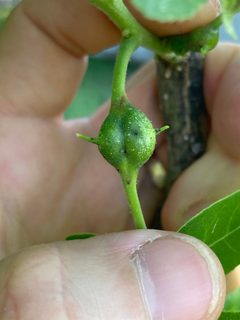
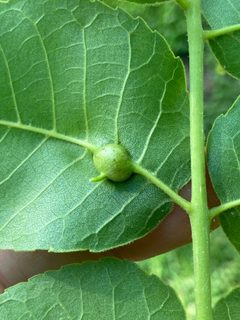
Phylloxera devastatrix, commonly known as the pecan phylloxera, is a gall-forming insect closely related to aphids that infests pecan trees (Carya illinoinensis). It is considered the most damaging phylloxera attacking pecans because it attacks shoots and nuts, whereas the related pecan leaf phylloxera (Phylloxera notabilis) forms galls only on leaves. Heavy reduce yield, impair tree vitality, and curtail subsequent production. The insect's galls also serve as an alternate for hickory shuckworm (Cydia caryana) larvae.
Pronunciation
How to pronounce Phylloxera devastatrix: /fɪˈlɒksərə ˌdɛvəˈstreɪtɹɪks/
These audio files are automatically generated. While they are not always 100% accurate, they are a good starting point.
Identification
Distinguished from pecan leaf phylloxera (Phylloxera notabilis) by gall location: P. devastatrix forms galls on shoots and nuts, while P. notabilis galls appear only on leaves. Galls on shoots and nuts indicate P. devastatrix; leaf-only galls indicate P. notabilis. The two require different management timing because P. devastatrix produces only one of galls per season, while P. notabilis may produce two to three generations.
Images
Appearance
Habitat
Pecan orchards and native pecan groves. Found on pecan trees (Carya illinoinensis) throughout the native range of this . move slowly from tree to tree because cannot fly long distances.
Distribution
Throughout the native range of the pecan tree in North America, including Texas and other pecan-growing regions of the southern and central United States.
Seasonality
hatch in spring during bud break. Nymphs emerge and begin feeding on new growth when shoots are 1-2 inches long. Galls form and enclose developing nymphs. Winged emerge from cracked galls in late spring. Sexual forms mate, and females deposit overwintering eggs that remain protected within the mother's body through winter.
Diet
Feeds on phloem sap of pecan trees, obtained by inserting needle-like mouthparts into new shoot, twig, and nut tissue.
Host Associations
- Carya illinoinensis - primary pecan tree; attacks new growth on shoots, twigs, and nuts
Life Cycle
Overwinters as within the body of the sexual female, protected on tree bark. In spring, eggs hatch and stem mothers (fundatrices) move to buds and begin feeding on new growth, inducing gall formation. Galls enclose the developing insect. Stem mothers deposit eggs within galls; these hatch into (wingless) and (winged) females. Eggs produced by these females develop into sexual males and females. After mating, females produce a single egg within their body and seek sites on bark, completing the cycle. The stem mother and apterous/alate females develop through hemimetabolous (incomplete) ; sexual males and females develop through holometabolous (complete) metamorphosis. Only one of galls is produced per season.
Behavior
Nymphs secrete substances during feeding that stimulate abnormal plant tissue development, forming protective galls. The insects feed and complete development entirely within these galls. cannot fly long distances, limiting natural spread between trees.
Ecological Role
Galls formed by this serve as an alternate for hickory shuckworm (Cydia caryana) larvae, which feed inside phylloxera galls in spring before pecan nuts are available. This relationship may facilitate shuckworm survival and establishment.
Human Relevance
Major economic pest of commercial pecan production. Widespread reduce current-year yield and tree vitality, with carryover effects on subsequent production. Managed through cultivar selection (varieties vary in susceptibility), targeted applications timed to nymph before gall formation, and spot-treatment of infested trees due to slow .
Similar Taxa
- Phylloxera notabilisAlso called pecan leaf phylloxera; distinguished by forming galls only on leaves rather than shoots and nuts, and by producing multiple per season
- Phylloxera caryaecaulisHickory phylloxeran; attacks hickory (Carya) rather than pecan, forming globular galls on leaf blades and petioles
More Details
Gall classification
Galls of P. devastatrix are classified as 'cover galls,' characterized by upwalling of plant tissue around the insect
Insecticide timing
Control requires precise timing: must be applied after hatch in spring but before nymphs are protected inside galls. Effective treatment window is when new growth is 1-2 inches long, after bud break
Monitoring approach
Survey orchards in May to mark trees with galls; treat only infested trees the following spring due to limited ability
Sources and further reading
- BugGuide
- GBIF taxonomy match
- iNaturalist taxon
- NCBI Taxonomy
- Catalogue of Life
- Insects and mites that feed on leaves - AgriLife Extension Entomology
- Managing Insect and Mite Pests of Commercial Pecans in Texas - AgriLife Extension Entomology
- Meet 'The Moth Man' at Bohart Museum's Moth Night | Bug Squad
- A Victory for the Bees | Bug Squad
- Gall darn it! Gall insects on hickory, oak, and elm, Phylloxera caryaecaulis, Andricus palustris, Colopha ulmicola — Bug of the Week
- grape phylloxera Archives - Entomology Today
- A Scanning Electron Microscope study of the pecan phylloxera, Phylloxera devastatrix, with observations on emergence