
Tetraneura ulmi
(Linnaeus, 1758)
elm sack gall aphid, fig gall aphid
Tetraneura ulmi, commonly known as the elm sack gall or fig gall aphid, is a gall-forming aphid in the Aphididae. First described by Linnaeus in 1758, this induces distinctive club-like pouch galls on elm leaves. The aphid exhibits a complex involving alternation between primary elm and secondary grass hosts. Founding mothers stimulate gall formation through sap-sucking , creating a protected environment for their offspring. The species is distributed across Asia, Europe, and North America, with particular dominance in northwestern Europe.
Pronunciation
How to pronounce Tetraneura ulmi: //ˌtɛtrəˈnjʊərə ˈʌlmi//
These audio files are automatically generated. While they are not always 100% accurate, they are a good starting point.
Identification
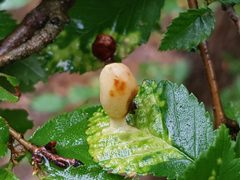
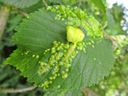
Distinguished from similar gall aphids by the distinctive stalked, club-shaped gall on elm leaves. Partly formed galls show pale yellow patches with lumpy projections on upper leaf surfaces. Can be separated from Tetraneura nigriabdominalis by morphological characteristics of winged morphs; T. ulmi dominates on elms in northwestern Europe while T. nigriabdominalis is expanding northward.
Images
Appearance
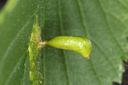
The gall is a stalked, club-like smooth pouch measuring 7–15 mm high on elm leaves. Young galls appear as pale yellow patches with irregular lumpy projections on the upper leaf surface, with a hairy opening on the underside. Mature females are pink, orange, or purple, 2–3 mm long, and covered in a thin layer of powdered wax. Winged forms develop in galls and migrate to secondary .
Habitat
Primary is on elm trees (Ulmus ), where galls form on leaves. Secondary habitat on roots of various grasses during summer months. Galls develop on leaf tissues, with nymphs feeding inside the protected pouch structure.
Distribution
Native to and widespread across Asia, Europe, and North America. Dominates on elms in northwestern Europe. Documented on elm including Ulmus minor (small-leaved elm), Ulmus glabra (wych elm), and rarely on Ulmus americana (American elm), Ulmus davidiana (David elm), and Ulmus laevis (European white elm).
Seasonality
Galls form in spring when leaf buds break. Mature females leave galls in summer to lay on grass roots. Winged forms fly to elms in autumn and give birth to wingless forms of both sexes. After mating, females lay eggs that hatch in spring.
Diet
Phloem sap feeder. Founding mothers feed on expanding leaf tissues to induce gall formation. Nymphs feed within galls on plant tissues modified by gall induction. Summer feed on roots of various grasses.
Host Associations
- Ulmus minor - primary small-leaved elm, common gall
- Ulmus glabra - primary wych elm, common gall
- Ulmus americana - primary American elm, rare
- Ulmus davidiana - primary David elm, rare
- Ulmus laevis - primary European white elm, rare
- Ulmus pumila - primary Siberian elm, documented with biochemical galling responses studied
- Poaceae - secondary various grasses, roots serve as summer
Life Cycle
Complex with alternation. hatch in spring; female nymphs feed on leaf undersides inducing gall formation. Galls develop as yellowish pimples that enlarge into stalked pouches. Nymphs enter galls, feed, and reproduce parthenogenetically. Mature females exit galls in summer and migrate to grass roots to lay eggs. Autumn sees winged forms return to elms, producing sexual morphs that mate and lay overwintering eggs.
Behavior
Founding mothers exhibit sap-sucking that manipulates plant development, inducing formation of novel plant organs (galls). The manipulates host plant biochemistry, enhancing decarboxylase activities and altering biogenic amine profiles in gall tissues. Creates nutritional sink in galls with high protein accumulation during initial formation and increased phenolic biosynthesis during development.
Ecological Role
Gall-forming herbivore that acts as a nutritional sink, redirecting plant resources to gall tissues. Induces plant defense responses including -related protein production. Alters host plant primary and secondary metabolism through gall induction. Provides and food source for specialized and within galls.
Human Relevance
Primarily of ecological and scientific interest. Galls generally cause little to no harm to trees, requiring no remediation. Studied for insights into plant-insect interactions, gall induction mechanisms, and biochemical manipulation of host plants. Potential minor pest concern in ornamental elm plantings due to gall formation.
Similar Taxa
- Tetraneura nigriabdominalisExpanding northward in Europe; distinguished by morphological characteristics of winged morphs; T. ulmi dominates in northwestern Europe while T. nigriabdominalis has different secondary including maize
- Colopha ulmicolaAnother elm gall producing cockscomb-shaped galls rather than club-shaped pouches; different gall on same
More Details
Biochemical Impact on Host
Research on Ulmus pumila demonstrates that T. ulmi galling significantly alters plant biochemistry. The process enhances lysine decarboxylase and ornithine decarboxylase activities, increases biogenic amine content (putrescine, cadaverine, spermidine, tryptamine, spermine, histamine) in early gall stages, and elevates -related proteins at mature gall stages. These changes suggest sophisticated manipulation of host plant metabolic machinery for the 's nutritional benefit.
Historical Taxonomy
First described by Carl Linnaeus in Systema Naturae (1758), making it one of the earliest described . The species has been subject to taxonomic revision, with some sources listing it as ambiguous synonym under Tetraneura (Indotetraneura) javensis, though GBIF and other modern databases maintain it as accepted species Tetraneura ulmi.
Sources and further reading
- BugGuide
- Wikipedia
- GBIF taxonomy match
- iNaturalist taxon
- NCBI Taxonomy
- Catalogue of Life
- Gall darn it! Gall insects on hickory, oak, and elm, Phylloxera caryaecaulis, Andricus palustris, Colopha ulmicola — Bug of the Week
- Botanizing at Salt Lick Point Land & Water Reserve | Beetles In The Bush
- 🌿 Botanizing w/ the Webster Groves Nature Study Society (WGNSS) Botany Group at Rockwoods Reservation – 3 Nov 2025 | Beetles In The Bush
- Uncategorized | Blog - Part 28
- Thelypteridaceae | Beetles In The Bush
- Archive — Bug of the Week
- BIOCHEMICAL ALTERATIONS IN Ulmus pumila L. LEAVES INDUCED BY GALLING APHID Tetraneura ulmi L.
- <i>Tetraneura (Tetraneurella) nigriabdominalis</i> (Hemiptera: Aphidoidea) – a species extending its range in Europe, and morphological comparison with <i>Tetraneura (Tetraneura) ulmi</i>
- The effect ofTetraneura ulmiL. galling process on the activity of amino acid decarboxylases and the content of biogenic amines in Siberian elm tissues