
Tetraneura
Hartig, 1841
elm-grass root aphids, woolly elm aphids
Species Guides
2- Tetraneura nigriabdominalis
- Tetraneura ulmi(elm sack gall aphid)
Tetraneura is a of gall-forming aphids in the Aphididae, comprising more than 30 described . These aphids are heteroecious, alternating between primary in the genus Ulmus (elms), where they induce characteristic galls on leaves, and secondary hosts in the family Poaceae (grasses), where they feed on roots. The genus is notable for complex host manipulation, with species capable of altering host plant biochemistry to create nutritional sinks within galls. Several species, including the T. nigriabdominalis, are expanding their ranges in Europe and pose potential threats to cereal crops such as maize.
Pronunciation
How to pronounce Tetraneura: /tɛtrəˈnʊərə/
These audio files are automatically generated. While they are not always 100% accurate, they are a good starting point.
Identification
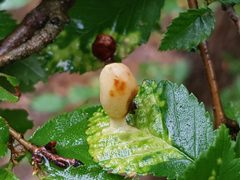
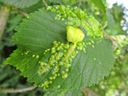
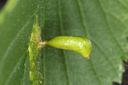
Galls on Ulmus leaves are the most visible diagnostic feature; these appear as pouch-like or bladder-like structures, often reddish or greenish, on leaf blades. Winged migrants (alatae) emerging from galls have distinct morphological features including specific antennal segment ratios and wing venation patterns that separate Tetraneura from other Eriosomatinae . T. nigriabdominalis can be distinguished from T. ulmi by morphological characteristics of winged morphs developing in galls, though specific diagnostic traits require microscopic examination. Fundatrices (founding females) are typically small, oval, and densely covered with wax filaments.
Images
Habitat
Primary consists of galls on leaves of elm (Ulmus), particularly in the medial and basal parts of leaf blades. Secondary habitat is the root zone of grasses (Poaceae), including agricultural cereals and maize. Gall formation occurs on leaf tissues where fundatrices induce localized growth through biochemical manipulation of plants.
Distribution
has worldwide distribution; T. nigriabdominalis is native to Asia and has become established as an in Europe, with documented range expansion northward including first records from Poland. Other species occur in their native ranges across Asia, Europe, and North America. Specific distribution varies by species; T. ulmi occurs in Europe and Asia where Ulmus pumila is present.
Seasonality
Activity is strongly temperature-dependent and tied to . Fundatrices hatch between late April and mid-May in temperate regions, with gall formation occurring 6–8 days after hatching. Two typically complete development on the primary host over 4–6 weeks, with winged migrants appearing between late May and late June. -hatching time varies among individual trees and is subject to heterogeneous based on host budburst timing.
Diet
Phloem sap feeding on primary (Ulmus spp.) and secondary hosts (Poaceae). On primary hosts, feeding induces gall formation creating specialized nutritional sinks with elevated protein accumulation and modified metabolism. On secondary hosts, feeding occurs on grass roots; T. nigriabdominalis has been observed on Zea mays (maize) and various Poaceae .
Host Associations
- Ulmus - primary Gall formation on leaves; includes U. pumila, U. minor, U. glabra, U. davidiana
- Poaceae - secondary Root feeding; includes multiple
- Zea mays - secondary Agricultural ; potential pest status
Life Cycle
Heteroecious with obligatory alternation between primary (Ulmus, sexual phase and gall formation) and secondary host (Poaceae, parthenogenetic phase on roots). Cycle begins with on elm bark; fundatrices hatch in spring and induce galls on leaves. Fundatrices mature in 12–21 days and produce nymphs parthenogenetically. Second develops as winged migrants (alatae) that disperse to secondary hosts. Sexual morphs return to primary hosts in autumn; mating occurs with copulation duration of 30–60 minutes, followed by oviposition of overwintering eggs.
Behavior
Induces gall formation through biochemical manipulation of plant tissues, including enhancement of decarboxylase activity and altered biogenic amine content. Manipulates host jasmonic acid signaling , rendering gall tissues defective in typical plant defensive responses. Fundatrix is influenced by temperature, leaf size, and gall size; females on U. glabra produce 2–58 nymphs versus 1–29 on U. minor. Males locate mates through random and antennal contact, with courtship involving antennal tapping; multiple male competition and post-copulatory mate guarding occur.
Ecological Role
Gall inducer that creates specialized microhabitats and nutritional sinks within plant tissues. Alters host plant secondary chemistry and defense signaling, potentially affecting broader plant-insect interactions. As , T. nigriabdominalis represents a novel ecological interaction in invaded European . are regulated by -dependent factors on individual host trees coupled with heterogeneous selection pressures across host environments.
Human Relevance
T. nigriabdominalis is an emerging agricultural pest in Europe due to its association with maize and other cereals; range expansion is linked to climate warming and increased maize . Gall formation on ornamental elms may have minor aesthetic impact. No significant direct human health effects documented.
Similar Taxa
- Other Eriosomatinae genera (e.g., Eriosoma, Pemphigus)Also gall-forming aphids on trees with root-feeding secondary ; distinguished by gall , host specificity, and winged morph antennal structure
- Tetraneura ulmi vs. T. nigriabdominalisCo-occur on European elms; distinguished by morphological characteristics of winged morphs, with T. nigriabdominalis being and expanding northward while T. ulmi is native and in northwestern Europe
Sources and further reading
- BugGuide
- Wikipedia
- iNaturalist taxon
- NCBI Taxonomy
- Catalogue of Life
- <i>Tetraneura (Tetraneurella) nigriabdominalis</i> (Hemiptera: Aphidoidea) – a species extending its range in Europe, and morphological comparison with <i>Tetraneura (Tetraneura) ulmi</i>
- Mating behaviour inTetraneura nigriabdominalisSasaki (=akinireSasaki) (Hemiptera, Pemphiginae)
- BIOCHEMICAL ALTERATIONS IN Ulmus pumila L. LEAVES INDUCED BY GALLING APHID Tetraneura ulmi L.
- Temperature-Dependent Development and Population Growth of Tetraneura nigriabdominalis (Homoptera: Pemphigidae) on Three Host Plants
- Host preference and galling success in closely related aphids, Tetraneura yezoensis and T. radicicola (Pemphigidae: Aphidoidea), associated with the Japanese elm
- Heterogeneous selective pressures on egg‐hatching time and the maintenance of its genetic variance in a Tetraneura gall‐forming aphid
- The effect ofTetraneura ulmiL. galling process on the activity of amino acid decarboxylases and the content of biogenic amines in Siberian elm tissues
- Population Development of Alien Gall-Forming Aphid Tetraneura nigriabdominalis on Ulmus minor and Ulmus glabra
- Temperature-Dependent Development and Population Growth of <I>Tetraneura nigriabdominalis</I> (Homoptera: Pemphigidae) on Three Host Plants
- Transcriptomic characterization of gall tissue of Japanese elm tree (Ulmus davidiana var. japonica) induced by the aphid Tetraneura nigriabdominalis