
Tetraneura nigriabdominalis
(Sasaki, 1899)
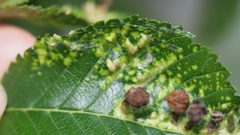
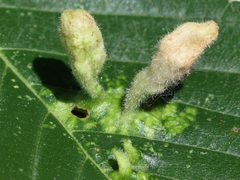
Tetraneura nigriabdominalis is a holocyclic, heteroecious gall-forming native to East Asia that has expanded its range globally and is now established in Europe and North America. The alternates between primary (elm trees, Ulmus) and secondary hosts (roots of grasses in the Poaceae, including maize). On elms, fundatrices induce characteristic galls on leaves, with development rates and strongly influenced by spring temperatures. The species has been documented as a potential agricultural pest due to its association with cultivated maize.
Pronunciation
How to pronounce Tetraneura nigriabdominalis: //ˌtɛtrəˈnʊərə ˌnɪɡriæbdɒmɪˈneɪlɪs//
These audio files are automatically generated. While they are not always 100% accurate, they are a good starting point.
Identification
Winged morphs developing in galls on Ulmus can be distinguished from the similar Tetraneura ulmi by specific morphological characteristics of the winged forms; detailed morphological comparison reveals diagnostic features separating these two that both occur on elm .
Images
Habitat
Primary are elm trees (Ulmus spp.), including Ulmus minor, Ulmus glabra, and Ulmus davidiana var. japonica, where galls form on leaves. Secondary hosts are roots of grasses (Poaceae), including Zea mays (maize) and other grass . Gall formation occurs predominantly on medial and basal parts of leaf blades.
Distribution
Native to East Asia (Japan, described from specimens collected by Sasaki in 1899); established in Europe with records from Poland, Belgium, and other locations showing northward range expansion; present in North America (Vermont, USA). The northward expansion in Europe is presumably connected with climate warming.
Seasonality
Fundatrices hatch between late April and mid-May (27 April to 12 May in studied ). First galls appear 6–8 days after fundatrix hatching. Fundatrices mature within 12–21 days and produce nymphs within 2–3 weeks. Winged migrants of the second appear between late May and late June. Complete development of two generations on the primary lasts four to six weeks, depending on temperature.
Diet
Phloem sap from primary elm trees (Ulmus spp.) during gall-forming ; phloem sap from secondary host grass roots (Poaceae) during parthenogenetic generations on secondary hosts.
Host Associations
- Ulmus minor - primary suitable for fundatrices and gall development; females less fecund than on U. glabra (1–29 nymphs)
- Ulmus glabra - primary suitable for fundatrices and gall development; females more fecund than on U. minor (2–58 nymphs)
- Ulmus davidiana var. japonica - primary native ; site of male production in second
- Poaceae - secondary grass roots, including cultivated
- Zea mays - secondary maize; potential agricultural threat given expanding in Europe
Life Cycle
Holocyclic and heteroecious with alternation. Fundatrices hatch on primary host (Ulmus) in spring and induce galls. Second includes males produced on primary host; these migrate to secondary host (Poaceae roots) where mating occurs with females. Parthenogenetic generations continue on secondary host roots. involves males locating females using visual cues from female body shape; males exhibit mate guarding and attempt multiple matings.
Behavior
Gall-forming: fundatrices induce abnormal plant tissue growth on elm leaves for and feeding. Males use visual cues, specifically female body shape, to locate potential mates; female wing posture influences male approach . Males exhibit mate guarding behavior and attempt multiple matings with different females. Development and activity are strongly temperature-dependent, with April temperatures significantly influencing developmental duration and fundatrix .
Ecological Role
Induces galls on elm leaves, creating specialized microhabitats that may affect leaf physiology and plant defense responses. Gall tissues show reduced responsiveness to jasmonic acid signaling compared to normal leaf tissue, indicating manipulation of plant defense . Potential pest of cultivated cereals, particularly maize, through root feeding on secondary hosts.
Human Relevance
Potential agricultural pest: association with maize (Zea mays) and expanding range in Europe raises concern given increasing maize area. Subject of research on gall induction mechanisms, plant-insect interactions, and climate change effects on insect range expansion.
Similar Taxa
- Tetraneura ulmiBoth form galls on elm trees (Ulmus) and occur in northwestern Europe; T. nigriabdominalis is expanding its range while T. ulmi dominates in northwestern Europe; morphological characteristics of winged morphs allow distinction
Sources and further reading
- BugGuide
- GBIF taxonomy match
- NCBI Taxonomy
- Catalogue of Life
- Mating behaviour inTetraneura nigriabdominalisSasaki (=akinireSasaki) (Hemiptera, Pemphiginae)
- Temperature-Dependent Development and Population Growth of Tetraneura nigriabdominalis (Homoptera: Pemphigidae) on Three Host Plants
- Population Development of Alien Gall-Forming Aphid Tetraneura nigriabdominalis on Ulmus minor and Ulmus glabra
- <i>Tetraneura (Tetraneurella) nigriabdominalis</i> (Hemiptera: Aphidoidea) – a species extending its range in Europe, and morphological comparison with <i>Tetraneura (Tetraneura) ulmi</i>
- Temperature-Dependent Development and Population Growth of <I>Tetraneura nigriabdominalis</I> (Homoptera: Pemphigidae) on Three Host Plants
- Transcriptomic characterization of gall tissue of Japanese elm tree (Ulmus davidiana var. japonica) induced by the aphid Tetraneura nigriabdominalis