
Colopha ulmicola
(Fitch, 1859)
Elm Cockscomb Gall Aphid
Colopha ulmicola is an that induces distinctive cockscomb-shaped galls on American elm leaves. It has a complex involving alternation between elm and grass roots, with parthenogenetic within galls and producing winged migrants that return to elm in autumn. The species is notable for its dramatic seasonal aerial and its ability to manipulate plant development through chemical secretions.
Pronunciation
How to pronounce Colopha ulmicola: /kəˈloʊfə ˌʌlmɪˈkoʊlə/
These audio files are automatically generated. While they are not always 100% accurate, they are a good starting point.
Identification
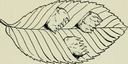
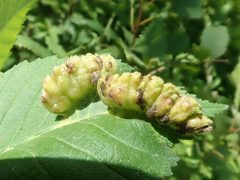
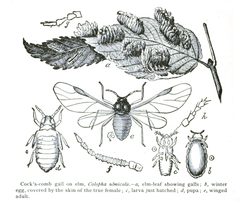
The presence of red, cockscomb-shaped galls on American elm leaves is diagnostic. These galls are unique in shape—resembling a rooster's comb—and typically appear on leaf . Later in the season, galls split open on the undersurface to release winged aphids. The autumn of hundreds of tiny insects around elm trees is a conspicuous sign of this .
Images
Appearance
Tiny soft-bodied , typically pale to dark in color. Winged sexual forms are observed in autumn . The is most readily identified by the distinctive gall structure it induces rather than by direct examination of the insect itself.
Habitat
Associated with American elm (Ulmus americana) as the primary , and various grasses as secondary summer hosts. Requires mature elm trees for gall formation and grassy areas for summer root-feeding stages.
Distribution
Eastern North America; documented from Vermont and surrounding regions in the United States. Associated with the native range of American elm.
Seasonality
overwinter on elm bark. Nymphs hatch in spring when leaf buds break, inducing galls on expanding leaves. Galls mature through spring and early summer; winged forms exit in summer to migrate to grass roots. Sexual winged forms return to elm in autumn (late September to October) to mate and lay eggs.
Diet
Phloem sap feeder. Nymphs feed on undifferentiated leaf tissue within elm galls in spring; summer feed on grass roots underground.
Host Associations
- Ulmus americana - primary Gall formation on leaves; site
- Grasses - secondary Root-feeding during summer
Life Cycle
Complex with alternation. hatch in spring; fundatrices induce galls and reproduce parthenogenetically as stem mothers, producing hundreds of offspring within the gall. These develop into winged forms that migrate to grass roots for summer. Cooler temperatures trigger production of sexual forms that fly back to elm in autumn, mate, and females deposit single large eggs under bark flaps to overwinter.
Behavior
Nymphs secrete chemical compounds that co-opt plant genetic machinery to induce gall formation. Winged sexual forms engage in conspicuous autumn aerial , filling the airspace around elm trees on bright afternoons. Stem mothers reproduce parthenogenetically within the protected gall environment.
Ecological Role
Minor plant that typically causes no significant harm to healthy elm trees. Gall formation represents a form of plant manipulation for insect shelter and nutrition. Honeydew production within galls may support other organisms, though specific mutualisms are not documented.
Human Relevance
Primarily of aesthetic and educational interest. Galls may cause minor cosmetic damage to ornamental elms but do not require remediation. Autumn of sexual forms can be conspicuous around residential trees. No economic or medical significance.
Similar Taxa
- Other gall-forming aphidsMany induce galls, but the cockscomb shape on elm is distinctive to Colopha ulmicola
- Phylloxera speciesRelated gall-forming sternorrhynchans with similar , but induce different gall morphologies on different (e.g., hickory)
- Other Colopha speciesCongeneric may exist but are distinguished by associations and gall
More Details
Gall chemistry
The precise chemical mechanisms by which secretions redirect plant development remain incompletely understood, representing an area of active research in insect-plant interactions.
Historical research
The was referenced in Edith Patch's classic work 'Gall aphids on elm', a foundational study in .
Sources and further reading
- BugGuide
- GBIF taxonomy match
- iNaturalist taxon
- NCBI Taxonomy
- Catalogue of Life
- Archive — Bug of the Week
- Gall darn it! Gall insects on hickory, oak, and elm, Phylloxera caryaecaulis, Andricus palustris, Colopha ulmicola — Bug of the Week
- When aphids fill the air: Elm cockscomb gall aphid, Colopha ulmicola — Bug of the Week
- Sunny with a chance of aphid flurries: Elm cockscomb gall aphid, Colopha ulmicola — Bug of the Week