
Colopha
Monell, 1877
Species Guides
2- Colopha graminis
- Colopha ulmicola(Elm Cockscomb Gall Aphid)
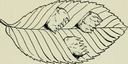
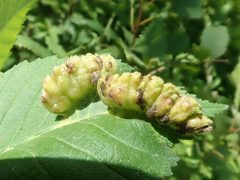
Colopha is a of gall-forming aphids in the Aphididae, first described by Monell in 1877. in this genus induce distinctive galls on plants, most notably the elm cockscomb gall on American elm. The genus exhibits complex involving host alternation between woody plants and grasses, with both bisexual and unisexual reproductive strategies documented across species.
Pronunciation
How to pronounce Colopha: /kəˈloʊfə/
These audio files are automatically generated. While they are not always 100% accurate, they are a good starting point.
Identification
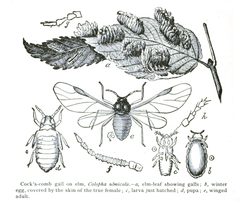
Colopha are recognized by their association with characteristic plant galls, particularly the cockscomb-shaped galls on elm leaves. The is distinguished from other gall-forming aphids by its involving between elm and grass roots. Species-level identification requires examination of morphological features such as length, wax gland number, and leg structure.
Images
Habitat
Associated with plants including American elm (Ulmus americana) for primary hosts, and various grasses for secondary hosts. One , Colopha hispanica, has been documented living endophytically inside the stems of Scirpus holoschoenus (Cyperaceae).
Distribution
Europe and North America, with records from Denmark, Norway, Sweden, the United States (including Vermont), and Spain. A new was described from Japan, indicating broader distribution in Asia.
Seasonality
Active during spring and summer when gall formation occurs on primary . Sexual migrate back to sites on elm bark in autumn. Overwintering hatch in spring when leaf buds burst.
Diet
Phloem sap from plants. Primary hosts include elm ; secondary hosts include grass roots.
Host Associations
- Ulmus americana - primary American elm; site of gall formation and
- Grasses - secondary Root-feeding during summer months
- Scirpus holoschoenus - Endophytic for C. hispanica
Life Cycle
Complex with alternation. hatch in spring; nymphs induce galls on primary host leaves. Stem mothers reproduce parthenogenetically within galls, producing winged offspring that migrate to secondary grass hosts. In autumn, sexual forms develop, mate, and females return to primary host to lay overwintering eggs. Some exhibit anholocyclic (unisexual) .
Behavior
Induces gall formation on plants through chemical secretions that co-opt plant developmental processes. Winged forms undertake seasonal between primary and secondary hosts.
Ecological Role
Gall formation creates microhabitats that may support other organisms. Honeydew production potentially contributes to nutrient cycling.
Human Relevance
Primarily of academic interest; elm cockscomb galls caused by C. ulmicola are generally harmless to tree health and require no management.
Similar Taxa
- Kaltenbachiella pallidaSimilar gall-forming found in Spain; compared in taxonomic literature with Colopha
- PhylloxeraRelated gall-forming insects with similar ; distinguished by taxonomic placement and gall
- EriosomaRelated in Eriosomatinae with similar involving alternation and gall formation
Sources and further reading
- BugGuide
- Wikipedia
- GBIF taxonomy match
- iNaturalist taxon
- NCBI Taxonomy
- Catalogue of Life
- Gall darn it! Gall insects on hickory, oak, and elm, Phylloxera caryaecaulis, Andricus palustris, Colopha ulmicola — Bug of the Week
- When aphids fill the air: Elm cockscomb gall aphid, Colopha ulmicola — Bug of the Week
- Sunny with a chance of aphid flurries: Elm cockscomb gall aphid, Colopha ulmicola — Bug of the Week
- Archive — Bug of the Week
- Colopha hispanica sp.n. (Homoptera: Aphidoidea: Pemphigidae): an unusual endophytic aphid living inside the stems of Scirpus holoschoenus (Cyperaceae)
- Distribution of bisexual and unisexual species in the aphid genusColophaMonell (Aphididae: Eriosomatinae), with the description of a new species in Japan