
Uroleucon sonchi
(Linnaeus, 1767)
Sow-thistle Aphid, Large Sow-thistle Aphid, Brown Lettuce Aphid
Uroleucon sonchi is a large in the Aphididae, commonly known as the sow-thistle aphid or brown lettuce aphid. Native to the Palaearctic region, it has been introduced to multiple continents and is now in distribution. The species is economically significant as a pest of cultivated lettuce and related crops, while also occurring on wild Asteraceae . It reproduces parthenogenetically during spring and summer, typical of many aphids.
Pronunciation
How to pronounce Uroleucon sonchi: //ˌjʊəroʊˈljuːkɒn ˈsɒŋkaɪ//
These audio files are automatically generated. While they are not always 100% accurate, they are a good starting point.
Identification
Distinguished from other Uroleucon by its association with Sonchus and Lactuca , combined with its large size and brown coloration. Uroleucon sonchi can be separated from the similar Uroleucon ambrosiae (brown ambrosia ) by host plant: U. sonchi occurs on Asteraceae tribe Lactuceae (sow-thistles, lettuce, endive), while U. ambrosiae feeds on Ambrosia and related . Uroleucon sonchi is larger than many . Confirmation requires examination of morphological details including siphunculus and cauda shape, and the number and arrangement of setae.
Images
Appearance
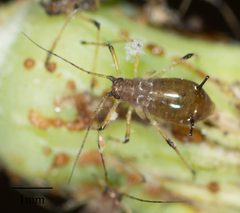
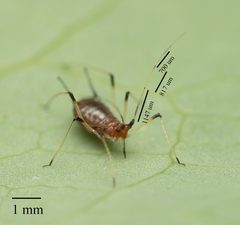
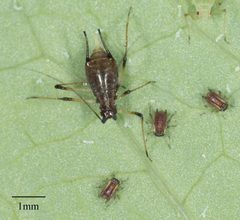
A relatively large with an elongated body form. Coloration is typically brownish, contributing to its 'brown lettuce aphid'. Like other members of Uroleucon, it possesses long siphunculi (the paired tubular structures on the used for secreting ) and a cauda (tail-like structure). The body is covered with fine setae. Winged and wingless morphs occur; winged individuals () develop for when colonies become crowded or quality declines.
Habitat
Found in agricultural settings, particularly lettuce and endive fields, as well as in and natural where plants in tribe Lactuceae occur. Thrives in temperate to subtropical conditions. Colonies develop on the leaves and stems of host plants, often becoming dense on young growth and flowering .
Distribution
Native to the Palaearctic region (Europe, North Africa, Asia). Introduced and established in North America, South America, the Middle East, Yemen, Africa, India, Japan, China, Korea, New Zealand, and Australia (since 1995). Records also exist from the Azores (Corvo, Faial, Flores, Graciosa, São Miguel).
Seasonality
Active during spring through autumn in temperate regions; parthenogenetic occurs throughout the growing season. Sexual morphs and are produced in autumn to overwinter in colder climates. In milder climates and greenhouses, may persist year-round.
Diet
Phloem-feeding on Asteraceae tribe Lactuceae. Primary include sow-thistle (Sonchus oleraceus and other Sonchus ). Secondary hosts include cultivated lettuce (Lactuca sativa), other Lactuca species, endive (Cichorium endivia), Emilia sonchifolia, Geropogon glabrum, and Picris hieracioides.
Host Associations
- Sonchus oleraceus - primary Common sow-thistle
- Sonchus sp. - primary Other sow-thistle
- Lactuca sativa - secondary Cultivated lettuce
- Lactuca sp. - secondary Wild lettuce
- Cichorium endivia - secondary Endive
- Emilia sonchifolia - secondary
- Geropogon glabrum - secondary
- Picris hieracioides - secondary Hawkweed oxtongue
Life Cycle
Hemimetabolous development with parthenogenetic dominating during the growing season. Females produce live young (viviparity) without mating. Under favorable conditions, time is short, allowing rapid increase. As day length shortens and temperatures drop in autumn, sexual morphs (males and females) are produced. These mate and produce cold- that overwinter on plants. In mild climates or protected environments, may continue year-round.
Behavior
Forms dense colonies on plant stems and undersides of leaves. Excretes honeydew, which attracts ants and supports growth. When disturbed, individuals may drop from the plant () or attempt to escape. release from siphunculi triggers in colony members. Winged morphs develop in response to crowding and declining host quality, enabling dispersal to new plants.
Ecological Role
Herbivore that can reach pest densities on cultivated crops. Serves as prey for diverse natural enemies including lady beetles (Coccinellidae), larvae (Chrysopidae), predatory larvae (Cecidomyiidae), hoverfly larvae (Syrphidae), spiders, and parasitic (including Aphidius sonchi, though this is primarily associated with Hyperomyzus lactucae). Honeydew production supports associations and secondary fungal growth.
Human Relevance
Economic pest of lettuce and endive production, capable of reducing yield and quality through direct feeding damage and virus transmission potential. Heavy cause leaf distortion and with honeydew and . Management in agriculture relies on , selective , and varieties where available.
Similar Taxa
- Uroleucon ambrosiaeSimilar brown coloration and large size, but distinguished by plant preference for Ambrosia (ragweed) and related rather than Lactuceae
- Hyperomyzus lactucaeShares lettuce and is parasitized by Aphidius sonchi; differs in and morphological details
- Other Uroleucon speciesMany overlap in distribution but differ in range, body size, coloration, and microscopic features of siphunculi and cauda
More Details
Parasitoid Relationships
Aphidius sonchi, a braconid primarily associated with Hyperomyzus lactucae, has been reared occasionally from U. sonchi, suggesting some flexibility.
Subspecies
Three have been described: U. s. sonchi (nominate), U. s. afghanicum (synonymized), and U. s. stepposa, though their current taxonomic validity varies.
Invasive Status
Widely introduced outside native range through human-mediated transport of lettuce and related crops; established now occur on multiple continents.