
Neotoxoptera formosana
(Takahashi, 1921)
Onion Aphid
Neotoxoptera formosana is an oligophagous pest specialized on Allium crops, originally described from Taiwan in 1921 and now distributed globally. It causes severe economic losses to Allium agriculture, particularly Allium tuberosum in China, through direct feeding damage and as a for plant viruses including garlic latent potyvirus and alstroemeria mosaic potyvirus. The exhibits temperature-sensitive with optimal at 20°C, and employs specific olfactory cues—particularly sulfur compounds like diallyl disulphide and dipropyl trisulphide—to locate plants.
Pronunciation
How to pronounce Neotoxoptera formosana: /niː.oʊˈtɒksəpˌtɪrə fɔːrmoʊˈsɑːnə/
These audio files are automatically generated. While they are not always 100% accurate, they are a good starting point.
Identification
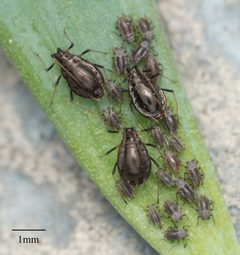
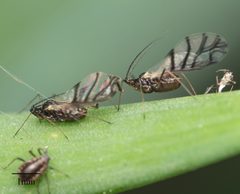
Dark reddish brown coloration distinguishes this from many other aphids. Oligophagous association with Allium plants provides a strong ecological indicator. Confirmation requires examination of morphological characters typical of the genus Neotoxoptera.
Images
Appearance
Dark reddish brown in color.
Habitat
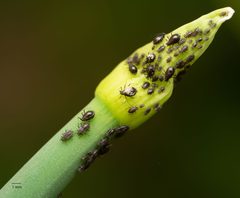
Agricultural environments, specifically Allium crop fields including onion, garlic, leek, and chive .
Distribution
Originally described from Taiwan (1921). Established in Asia (China, Japan, Korea), Europe (Finland, Italy, UK), Africa (St Helena), North America (USA, Mexico), South America (Brazil, Chile), and Oceania (Australia, New Zealand, Papua New Guinea).
Seasonality
In Guizhou Province, China, two main hazard peaks occur annually: March–May and July–September. Temperature-dependent development with optimal growth at 20°C; inhibited above 20°C and severely reduced at 28°C.
Diet
Oligophagous; feeds on plants from the Allium . Known include Allium ascalonicum, A. cepa, A. chinense, A. fistulosum, A. porrum, A. sativum, A. schoenoprasum, and A. tuberosum. Uses specific sulfur compounds (diallyl disulphide from A. tuberosum, dipropyl trisulphide from A. fistulosum) as olfactory cues to locate host plants.
Host Associations
- Allium tuberosum - primary Causes severe economic losses to garlic chive agriculture in China
- Allium fistulosum - Welsh onion; used in laboratory rearing and studies
- Allium cepa - Common onion
- Allium sativum - Garlic
- Allium porrum - Leek
- Allium schoenoprasum - Chives
- Allium ascalonicum - Shallot
- Allium chinense - Chinese onion
Life Cycle
Developmental stages include first through fourth instar nymphs followed by . Effective cumulative temperature (K) for nymphal development: 145.252 days °C with threshold temperature (C) of 4.002 °C. Individual instar K values: 1.852°C (first), 5.029°C (second), 4.747°C (third), 5.979°C (fourth). Increasing temperature accelerates development but reduces body size, longevity, and period.
Behavior
Produces with (E)-β-farnesene as the main effective component and (+)-limonene as secondary component; natural blend ratio 67.8:1 elicits strongest repellent response. Produces sticky honeydew. Shows significant response to volatile sulfides from Allium plants, using these as olfactory location cues.
Ecological Role
Agricultural pest causing direct feeding damage through phloem sap extraction. garlic latent potyvirus and alstroemeria mosaic potyvirus. Serves as prey for predatory insects including Chrysoperla externa (green lacewing) and Aphidoletes aphidimyza (predatory gall midge), supporting programs.
Human Relevance
Significant agricultural pest of Allium crops with severe economic impact on Allium tuberosum production in China. Potential target for using blends and agents. sequenced (371.791 Mb, 6 ) to support research on specificity and .
Similar Taxa
- Pentalonia nigronervosaPhylogenetic sister group based on analysis; both in Aphididae but differs in specialization (P. nigronervosa associated with banana and ginger)
More Details
Alarm pheromone composition
Seven major components identified: α-thujene, sabinene, (+)-limonene, (E)-β-farnesene, cis-β-farnesene, cis-α-bergamotene, and α-farnesene. (E)-β-farnesene and (+)-limonene detected in cornicles at 67.8:1 ratio; blend shows higher repellency than individual components.
Genomic resources
-level assembly: 371.791 Mb, 30.96% GC content, 14,175 protein-coding genes, 719 noncoding RNAs. Significantly expanded gene include THAP domain, DDE superfamily endonuclease, zinc finger, (ankyrin repeats), digestive (serine carboxypeptidase), and chemosensory receptors.
Temperature effects on physiology
Superoxide dismutase and peroxidase activity elevated at 28°C; catalase activity highest at 12°C, indicating temperature-specific oxidative stress responses.
Sources and further reading
- BugGuide
- Wikipedia
- GBIF taxonomy match
- iNaturalist taxon
- NCBI Taxonomy
- Catalogue of Life
- American Sweetgum Picks Up a Beetle Pest in China
- Neotoxoptera formosana . [Distribution map].
- A chromosome-level genome assembly of Neotoxoptera formosana (Takahashi, 1921) (Hemiptera: Aphididae)
- Identification and behavioral bioassays of alarm pheromones from the onion aphid Neotoxoptera formosana
- The Effects of Temperature on Development, Reproduction, Population Dynamics and Protective Enzyme Activity of Neotoxoptera formosana (Hemiptera: Aphididae)
- Development and Reproduction of Chrysoperla Externa (Neuroptera: Chrysopidae) Fed With Neotoxoptera Formosana (Hemiptera: Aphididae)
- Onion aphid (Neotoxoptera formosana) attractants, in the headspace of Allium fistulosum and A. tuberosum leaves