
Metopolophium
Mordvilko, 1914
Species Guides
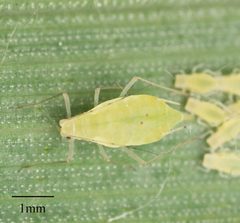
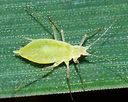
1- Metopolophium dirhodum(rose-grain aphid)
Metopolophium is a of aphids in the Aphididae. in this genus are found in Eurasia, Australia, and North America. Several species are significant agricultural pests of cereal crops, particularly M. dirhodum () and M. festucae (fescue ). The genus exhibits typical aphid with alternation between woody primary (Rosa species) and herbaceous secondary hosts (Poaceae).
Pronunciation
How to pronounce Metopolophium: /metəˌpɒloʊˈfiːəm/
These audio files are automatically generated. While they are not always 100% accurate, they are a good starting point.
Identification
Metopolophium are distinguished from related by features of the siphunculi and cauda. The siphunculi are typically cylindrical or slightly swollen, with a distinct flange. The cauda is usually finger-shaped or conical. Antennal are well-developed. Specific identification to species level requires examination of antennal segment ratios, siphunculus-to-cauda length ratios, and the number of accessory setae on the ultimate rostral segment.
Images
Habitat
occur in two distinct : primary are Rosa species (roses) in gardens, hedgerows, and natural stands; secondary hosts are cereal crops and grasses in agricultural fields and grasslands. The occupies temperate and subtropical regions across its range.
Distribution
Eurasia, Australia, and North America. Specific documented occurrences include Europe (widespread), Asia (China, India, Central Asia, Middle East), Africa (Egypt, Ethiopia, Kenya, Morocco, South Africa), North America (Canada, USA, Mexico), South America (Argentina, Brazil, Chile, Colombia, Ecuador, Peru, Uruguay), and Oceania (Australia, New Zealand).
Seasonality
Activity patterns vary by and climate. M. dirhodum on primary (Rosa) begin with fundatrix in late March, peak in mid-May, and return for in autumn. On secondary hosts (cereals), populations develop during the growing season with peak abundance typically occurring in early summer. Development threshold is approximately 5°C.
Diet
Phloem-feeding on plants. Primary hosts are Rosa (Rosaceae). Secondary hosts are Poaceae, including wheat, barley, oats, and forage grasses. Feeding causes in some associations.
Host Associations
- Rosa - primary and
- Triticum - secondary Parthenogenetic , major pest of wheat
- Hordeum - secondary Barley
- Avena - secondary Oats
- Poaceae - secondary Various grasses and cereals
Life Cycle
with alternation. Sexual forms (oviparae and males) produced on primary host (Rosa) in autumn, where are laid. In spring, fundatrices hatch and produce of that migrate to secondary hosts (Poaceae). Parthenogenetic continues on cereals through summer. Anholocyclic may persist year-round on secondary hosts in milder climates.
Behavior
Exhibits wing dimorphism with both (wingless) and (winged) morphs produced in response to environmental cues. Alates disperse between plants and fields. are strongly influenced by host plant quality, particularly nitrogen content of leaves. Produces alatae for when host plant quality declines or crowding occurs.
Ecological Role
Agricultural pest of significant economic importance on cereal crops. can cause substantial yield losses through direct feeding damage and . Serves as food source for , , and fungi. M. dirhodum has been studied as a model for ecological genetics and plant . Possible role as virus , though this requires confirmation for specific .
Human Relevance
Major pest of wheat, barley, and oat production worldwide. M. dirhodum and M. festucae cerealium cause economic damage through feeding and . Subject of extensive research on , genetics, and management. Control methods include natural products (kaolin, insecticidal soap, neem oil), chemical , and breeding. sequenced for M. dirhodum (447.8 Mb, 18,003 protein-coding genes).
Similar Taxa
- Sitobion avenaeAlso a major cereal pest; distinguished by longer siphunculi and different antennal development
- Schizaphis graminumGreenbug, another destructive cereal ; distinguished by green coloration and different cornicle shape
- Rhopalosiphum padiBird cherry-oat aphid, similar range; distinguished by shorter siphunculi and different primary host (Prunus)
More Details
Genomic resources
-level assembly available for M. dirhodum: 447.8 Mb genome, 98.50% anchored to nine chromosomes, 18,003 protein-coding genes. Comparative transcriptomics identified candidate genes for wing dimorphism including insulin receptor, Foxo, and receptor.
Ecological genetics
M. dirhodum exhibits broad physiological plasticity within but wide genetic variability between clones in plant to barley, wheat, and oats. Field show genetic adaptation to local host plants, with adaptation patterns influenced by field size.
Subspecific variation
M. festucae cerealium is recognized as the responsible for nearly all global in small grains, distinct from the nominate form associated with forage grasses.
Sources and further reading
- BugGuide
- Wikipedia
- GBIF taxonomy match
- iNaturalist taxon
- NCBI Taxonomy
- Catalogue of Life
- Fescue aphid (Metopolophium festucae)
- Metopolophium dirhodum . [Distribution map].
- On the Ecological Genetics of Metopolophium dirhodum (Walker) (Hemiptera, Aphididae)
- Effects of some natural products on population of Metopolophium dirhodum (Walker) (Hemiptera: Aphididae) on rose plants Gül Üzerinde Metopolophium dirhodum (Walker) (Hemiptera: Aphididae)’un Kontrolunda Bazı Doğal Ürünlerin Etkileri
- Occurrence of entomopathogenic fungi in populations of Metopolophium dirhodum (Walker) aphids feeding on primary and secondary host plants
- A high-quality chromosome-level genome assembly provides insights into wing dimorphism in Metopolophium dirhodum (Walker)
- A new species of Metopolophium Mordvilko, 1914 (Hemiptera: Aphididae: Aphidinae) on Rosa beggeriana from Iran
- Factors determining the peak abundance of Metopolophium dirhodum (Homoptera: Aphididae) on cereals
- Chromosome-level genome assemblies of two cereal aphids, Metopolophium dirhodum and Schizaphis graminum, provides insights into wing dimorphism
- Treatment by glyphosate-based herbicide alters life history parameters of the rose-grain aphid Metopolophium dirhodum
- NUTRIENT CONSTITUENTS OF A GRAIN APHID,METOPOLOPHIUM DIRHODUM(HOMOPTERA: APHIDIDAE), AND ITS HOST, OATS
- Dynamics of serious pest ofMetopolophium dirhodum(Walk.) (Hemiptera: Aphididae) on shrubs ofRosa rugosaThunb.
- The development rate of Metopolophium dirhodum (Walker) (Hemiptera: Aphididae) on winter wheat
- Wirkungen systemischer Fungizide auf die Getreideblattäuse Sitobion avenae F. und Metopolophium dirhodum Walk.1
- Host plant age and population development of a cereal aphid, Metopolophium dirhodum (Hemiptera: Aphididae)