
Metopolophium dirhodum
(Walker, 1849)
rose-grain aphid, rose-grass aphid
Metopolophium dirhodum is a globally distributed with a alternating between rose (Rosa) as primary and grasses, particularly cereal crops, as secondary hosts. It is a significant agricultural pest and of barley yellow dwarf virus (BYDV), causing yield reductions in wheat, barley, oats, and rye. The species exhibits wing dimorphism with both and morphs, and shows genetic variability in host plant among .
Pronunciation
How to pronounce Metopolophium dirhodum: /mɛtoʊpoʊˈloʊfiəm daɪˈroʊdəm/
These audio files are automatically generated. While they are not always 100% accurate, they are a good starting point.
Identification
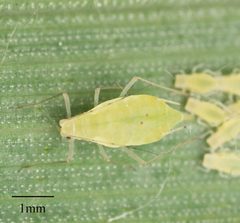
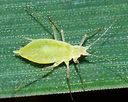
Distinguished from the rose aphid (Macrosiphum rosae) by its more slender build, longer pale appendages, and preference for migrating to grasses rather than persisting on rose. Separated from other cereal aphids (Sitobion avenae, Rhopalosiphum padi) by yellowish-green coloration with dark stripe, and relatively long siphunculi. Winged forms are uniformly green without the contrasting markings seen in some related .
Images
Habitat
Agricultural : cereal fields (wheat, barley, oats, rye) as summer ; rose shrubs and hedgerows as sites. Occupies lower leaves of cereals early in season, moving to flag leaves as plants mature. Greenhouse environments recorded for rose-feeding .
Distribution
distribution across temperate and subtropical regions. Europe (widespread including UK, Germany, France, Czech Republic, Poland), Asia (China, India, Iran, Japan, Central Asia), Africa (Egypt, Ethiopia, Kenya, South Africa), North America (USA, Canada, Mexico), South America (Argentina, Brazil, Chile, Colombia, Peru), Oceania (Australia, New Zealand—first detected 1982).
Seasonality
Overwinters as on rose; hatching in early spring (late March to April in temperate regions). persist on rose until approximately June in northern hemisphere, then migrate to cereals. Peak abundance on cereals typically June–July; production shows three-phase pattern with increases to 50% in early June and 90% in late July. Return to rose in autumn for and egg-laying.
Diet
Phloem sap feeder; primary Rosa spp. (rose), secondary hosts Poaceae including Avena sativa (oats), Triticum aestivum (wheat), Hordeum vulgare (barley), Secale cereale (rye), and various wild grasses.
Host Associations
- Rosa spp. - primary Sexual phase and ; fundatrices hatch from in spring
- Triticum aestivum - secondary Major cereal crop ; lower leaves preferred early, flag leaves later
- Hordeum vulgare - secondary More affected than wheat in some studies; winter barley varieties used
- Avena sativa - secondary Genetic to oat documented; field size affects adaptation pattern
- Secale cereale - secondary Cereal crop
Life Cycle
Heteroecious holocyclic: obligate alternation between woody primary (Rosa) and herbaceous secondary hosts (Poaceae). Overwinters as on rose. Fundatrices hatch spring, reproduce parthenogenetically on rose. Winged migrants (alatae) produced late spring, disperse to cereals. Multiple parthenogenetic on cereals through summer. Winged return migrants produced in autumn, move to rose; sexual forms (oviparae and males) develop, mate, and produce eggs. Anholocyclic may persist year-round on cereals in milder climates without sexual phase.
Behavior
Exhibits with distinct winged and wingless morphs; morph determination influenced by colony size, quality, and environmental cues. production follows colony-specific patterns tied to . fourth instar serves as main stage on cereals. Shows host plant selection , with preference for certain -treated plants (attracted to tridemorph, chloraniformethane; repelled by benomyl). Repelled by kaolin, neem oil soap, and insecticidal soap treatments.
Ecological Role
Significant agricultural pest; of barley yellow dwarf virus (BYDV), causing serious yield reductions in cereal crops. Serves as prey for fungi (mycoses contribute to decline) and . influenced by plant and natural enemy pressure.
Human Relevance
Major economic pest of cereal production worldwide; BYDV transmission causes substantial crop losses. Subject to including monitoring of thresholds. Evaluated for control using organic-approved products (kaolin, insecticidal soap, neem oil soap, spinosad) with partial success. Glyphosate herbicide exposure negatively affects parameters and population development. sequenced (447.8 Mb, 18,003 protein-coding genes) to understand wing dimorphism and develop control strategies.
Similar Taxa
- Macrosiphum rosaeAlso occurs on rose but more robust, duller, and persists on rose throughout season rather than migrating to grasses; causes more direct damage to rose
- Sitobion avenaeShares cereal but has shorter, darker siphunculi and different coloration; often co-occurs in same fields
- Rhopalosiphum padiAnother cereal of BYDV; differs in range and morphological details
More Details
Genetic Variation
Clonal show broad physiological plasticity within individuals, but wide genetic variability between in plant to barley, wheat, and oat. Field populations can genetically adapt to local cereal crops, particularly oats, with adaptation pattern influenced by field size.
Population Dynamics
Maximum abundance determined primarily by duration of growth period rather than growth rate. Population peaks synchronized across sowing dates based on thermal time (day degrees above 0°C), occurring 106–171 day degrees after sowing. Decline after peak occurs within 3–7 days, driven more by natural enemies and alata production timing than plant alone.
Wing Dimorphism Genetics
Comparative transcriptomics identified candidate genes associated with wing morph determination: insulin receptor, insulin receptor substrate, forkhead box protein O (Foxo), and receptor.
Sources and further reading
- BugGuide
- Wikipedia
- GBIF taxonomy match
- iNaturalist taxon
- NCBI Taxonomy
- Catalogue of Life
- Metopolophium dirhodum . [Distribution map].
- On the Ecological Genetics of Metopolophium dirhodum (Walker) (Hemiptera, Aphididae)
- Effects of some natural products on population of Metopolophium dirhodum (Walker) (Hemiptera: Aphididae) on rose plants Gül Üzerinde Metopolophium dirhodum (Walker) (Hemiptera: Aphididae)’un Kontrolunda Bazı Doğal Ürünlerin Etkileri
- Occurrence of entomopathogenic fungi in populations of Metopolophium dirhodum (Walker) aphids feeding on primary and secondary host plants
- A high-quality chromosome-level genome assembly provides insights into wing dimorphism in Metopolophium dirhodum (Walker)
- Factors determining the peak abundance of Metopolophium dirhodum (Homoptera: Aphididae) on cereals
- Chromosome-level genome assemblies of two cereal aphids, Metopolophium dirhodum and Schizaphis graminum, provides insights into wing dimorphism
- Treatment by glyphosate-based herbicide alters life history parameters of the rose-grain aphid Metopolophium dirhodum
- NUTRIENT CONSTITUENTS OF A GRAIN APHID,METOPOLOPHIUM DIRHODUM(HOMOPTERA: APHIDIDAE), AND ITS HOST, OATS
- Dynamics of serious pest ofMetopolophium dirhodum(Walk.) (Hemiptera: Aphididae) on shrubs ofRosa rugosaThunb.
- The development rate of Metopolophium dirhodum (Walker) (Hemiptera: Aphididae) on winter wheat
- Wirkungen systemischer Fungizide auf die Getreideblattäuse Sitobion avenae F. und Metopolophium dirhodum Walk.1
- Host plant age and population development of a cereal aphid, Metopolophium dirhodum (Hemiptera: Aphididae)
- Colony development and alate production in Metopolophium dirhodum (Walker) (Hemiptera: Aphididae) on winter wheat