
Illinoia
Wilson, 1910
Species Guides
7- Illinoia crystleae(Pale-streaked Honeysuckle Aphid)
- Illinoia liriodendri(tuliptree aphid)
- Illinoia maxima(Green-striped Thimbleberry Aphid)
- Illinoia menziesiae(Rusty Menziesia Aphid)
- Illinoia morrisoni(Sequoia Aphid)
- Illinoia rubicola(Spot-winged Raspberry Aphid)
- Illinoia spiraecola(spirea aphid)
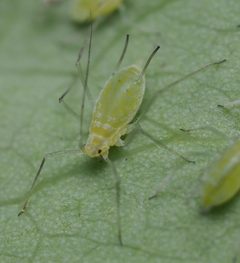
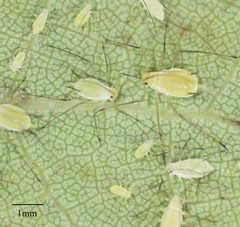
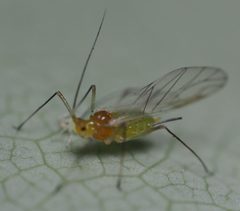
Illinoia is a of aphids (Aphididae: Aphidinae: Macrosiphini) established by Wilson in 1910. The genus contains multiple economically and ecologically significant , including the tuliptree (I. liriodendri), a notable pest of ornamental Liriodendron tulipifera, and the blueberry aphid (I. pepperi). Species in this genus are phloem-feeding insects associated with specific plants, with some having become outside their native ranges.
Pronunciation
How to pronounce Illinoia: /ˌɪlɪˈnɔɪə/
These audio files are automatically generated. While they are not always 100% accurate, they are a good starting point.
Identification
Members of Illinoia can be distinguished from other Macrosiphini aphids by a combination of morphological features including the presence of siphunculi (cornicles) on the , typical of Aphididae. Specific identification to requires examination of association and detailed morphological characters; for example, I. liriodendri is reliably identified by its exclusive association with Liriodendron tulipifera in combination with genetic confirmation. The belongs to the tribe Macrosiphini, which is characterized by long and siphunculi.
Images
Habitat
within Illinoia occupy defined by their plants. I. liriodendri occurs on ornamental tulip trees in urban forests and landscaped settings. I. pepperi is associated with blueberry . I. lambersi occurs on rhododendron. The is found in temperate regions, with individual species distributions tied to the cultivation or natural occurrence of their respective host plants.
Distribution
The has a broad distribution corresponding to plant availability. I. liriodendri is native to eastern North America and has been introduced to Europe (Spain, France, Germany, Italy, Slovenia, UK, Croatia), Japan, and northern California. I. pepperi occurs in Michigan and other blueberry-growing regions of North America. Distribution records for the genus include Denmark, Norway, and Sweden.
Seasonality
I. liriodendri shows highest levels in May and June in Spain, with a monoecic-holocyclic cycle. I. pepperi exhibits seasonal tied to blueberry in Michigan. Seasonality varies by and latitude.
Diet
Phloem-feeding on specific plants. I. liriodendri feeds on Liriodendron tulipifera (tuliptree/tulip poplar) and has been recorded on Magnolia grandiflora (southern magnolia). I. pepperi feeds on blueberry. I. lambersi feeds on rhododendron. I. pisi feeds on pea.
Host Associations
- Liriodendron tulipifera - primary Tuliptree/tulip poplar; of I. liriodendri
- Magnolia grandiflora - secondary Southern magnolia; recorded of I. liriodendri
- Vaccinium - primary Blueberry; of I. pepperi
- Rhododendron - primary of I. lambersi
- Pisum sativum - primary Pea; of I. pisi
Life Cycle
I. liriodendri has a monoecic-holocyclic , completing its entire life cycle on a single with sexual and . This life cycle type has been explicitly demonstrated in European . Life cycle details for other species in the vary and are not uniformly documented.
Behavior
I. liriodendri produces honeydew, with a strong positive relationship between severity and honeydew dripping observed. The commonly reaches high densities on urban trees. I. lambersi has been documented as prey for under experimental temperature regimes.
Ecological Role
in Illinoia serve as prey for diverse natural enemy complexes. I. liriodendri supports Coccinellidae (comprising >95% of with positive to ), in Hymenoptera: Aphidiinae and Aphelinidae, and the native European endoparasitoid Areopraon silvestre (Braconidae). The functions as a herbivore in plant-insect and as a prey resource for predators and parasitoids.
Human Relevance
I. liriodendri is considered the most important insect pest of tuliptree in urban landscapes, with heavy significantly impacting young trees despite mostly aesthetic effects. I. pepperi is an agricultural pest of blueberry. The spread of I. liriodendri in Europe has prompted research and monitoring. Some serve as study organisms for -prey interactions and temperature effects on biological control.
Similar Taxa
- MetopeurumIllinoia has been treated as a synonym of Metopeurum in some taxonomic treatments (Catalogue of Life), but is accepted as distinct in GBIF and other sources; separation requires examination of taxonomic authority and current classification systems.
- Other Macrosiphini generaShared tribal characteristics including long and siphunculi; -level identification within Illinoia and separation from related requires association data and detailed morphological or genetic analysis.
More Details
Taxonomic Status
Illinoia is accepted as a valid in GBIF and NCBI , though Catalogue of Life lists it as a synonym of Metopeurum. The genus was established by Wilson in 1910.
Invasive Species Documentation
I. liriodendri has been genetically confirmed as an in Croatia and is established in multiple European countries. Its introduction to Europe, Japan, Korea, and California represents documented range expansion beyond its native eastern North American distribution.
Research Significance
The includes used in studies of efficacy (I. lambersi with ), pest (I. liriodendri in Europe), and agricultural pest management (I. pepperi in blueberry systems).
Sources and further reading
- BugGuide
- GBIF taxonomy match
- iNaturalist taxon
- NCBI Taxonomy
- Catalogue of Life
- Illinoia liriodendri . [Distribution map].
- Tuliptree Aphid Scientific Name: Illinoia liriodendri (Monell) (Insecta: Hempitera: Aphididae)
- Phenology, population trends and natural enemy complex of Illinoia liriodendri in Spain
- DISTRIBUTION AND SEASONAL PHENOLOGY OF BLUEBERRY APHIDS (ILLINOIA PEPPERI (MACG.)) IN MICHIGAN
- Genetic identification of new alien pest species Illinoia liriodendri and its parasitoid Areopraon silvestre in Croatia
- Natural Enemies of the Pea Aphid (Illinoia Pisi Kalt.); Their Abundance and Distribution in Wisconsin
- Genetic identification of new alien pest species Illinoia liriodendri and its parasitoid Areopraon silvestre in Croatia
- Survey of the parasitoids of the tuliptree aphid,Illinoia liriodendri (Hom: Aphididae), in northern California
- The Lacewings Micromus angulatus and Chrysoperla carnea as Predators of the Rhododendron Aphid, Illinoia lambersi, Under Different Temperature Regimes.