
Illinoia liriodendri
(Monell, 1879)
tuliptree aphid, tulip tree aphid
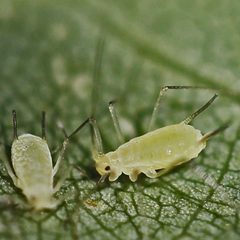
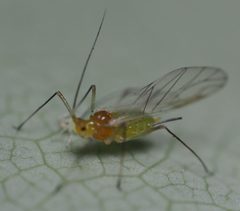
Illinoia liriodendri is a sap-feeding native to eastern North America that specializes on tuliptree (Liriodendron tulipifera). It has become an pest in Europe, where it was first recorded in the early 2000s and has since spread to multiple countries. The exhibits a monoecic-, with peak occurring in late spring. It is considered the most significant insect pest of tuliptree in urban landscapes, capable of reaching high densities that produce substantial honeydew and impact young trees.
Pronunciation
How to pronounce Illinoia liriodendri: /ˌɪlɪˈnɔɪə ˌlɪrioʊˈdɛndri/
These audio files are automatically generated. While they are not always 100% accurate, they are a good starting point.
Identification
Distinguished from other aphids by exclusive association with Liriodendron tulipifera as plant. Molecular identification () may be required for definitive separation from congeneric , particularly in invaded ranges where it co-occurs with native aphids.
Images
Habitat
Urban forests, parks, and ornamental plantings of tuliptree (Liriodendron tulipifera). Found in both pit-planted and ground-planted trees. Native range occupies temperate deciduous forests of eastern North America; established in urban environments across southern Europe.
Distribution
Native to eastern North America, from Ontario and British Columbia (Canada) south to Louisiana and North Carolina (USA), with in California. in Europe: confirmed in France, Germany, Italy, Slovenia, UK (England and Wales), Spain, Croatia, Hungary, Slovakia, and Serbia. Also recorded in Japan and Korea.
Seasonality
Monoecic-holocyclic cycle with highest levels recorded in May and June in European . vary among localities.
Diet
Phloem sap feeder specializing on Liriodendron tulipifera (tuliptree/tulip poplar). Honeydew production increases with severity.
Host Associations
- Liriodendron tulipifera - primary Exclusive ; tuliptree or tulip poplar, Magnoliaceae
- Magnolia grandiflora - secondary Southern magnolia; recorded as occasional in distribution records
Life Cycle
Monoecic-holocyclic cycle: completes entire on single (Liriodendron tulipifera) with both sexual and . as . Peak occur in late spring (May-June in Europe).
Behavior
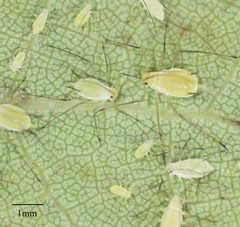
Forms dense colonies on leaves and shoots. Produces copious honeydew that drips from infested trees, creating aesthetic problems and supporting growth of sooty molds. High- on young trees can cause significant impact.
Ecological Role
Herbivore and honeydew producer. Serves as prey for diverse natural enemy complex including Coccinellidae (lady beetles, comprising >95% of with positive to ) and (Aphidiinae and Aphelinidae). In invaded ranges, native European parasitoids such as Areopraon silvestre (Braconidae) have rapidly colonized the aphid, contributing to .
Human Relevance
Primary pest of ornamental tuliptrees in urban landscapes. Heavy impact young trees and produce nuisance honeydew. Considered the most important insect pest of Liriodendron tulipifera in urban settings. Subject to management through using natural enemies and potentially chemical interventions.
Similar Taxa
- Other Illinoia speciesCongeneric aphids may require molecular identification for separation; specificity to Liriodendron is key diagnostic feature
- Macrosiphum spp.Similar large aphids in tribe Macrosiphini; distinguished by plant association and morphological details
More Details
Invasion History
First detected in Europe in early 2000s; genetic confirmation of Croatian in 2015 demonstrates ongoing range expansion. Rapid by native (e.g., Areopraon silvestre) suggests potential for natural in invaded ranges.
Research Significance
Subject of first comprehensive European study on and (Spain, 2024), documenting , trends, and natural enemy complex in invaded range.
Sources and further reading
- BugGuide
- GBIF taxonomy match
- iNaturalist taxon
- NCBI Taxonomy
- Green Tree Ant Sister Act: Oecophylla smaragdina — Bug of the Week
- Archive — Bug of the Week
- Illinoia liriodendri . [Distribution map].
- Tuliptree Aphid Scientific Name: Illinoia liriodendri (Monell) (Insecta: Hempitera: Aphididae)
- Phenology, population trends and natural enemy complex of Illinoia liriodendri in Spain
- Genetic identification of new alien pest species Illinoia liriodendri and its parasitoid Areopraon silvestre in Croatia
- Genetic identification of new alien pest species Illinoia liriodendri and its parasitoid Areopraon silvestre in Croatia
- Survey of the parasitoids of the tuliptree aphid,Illinoia liriodendri (Hom: Aphididae), in northern California