
Rhopalosiphum nymphaeae
(Linnaeus, 1761)
waterlily aphid, water lily aphid
Rhopalosiphum nymphaeae, the waterlily , is a , -alternating aphid with a unique ability to thrive in both aquatic and terrestrial environments. It is a significant agricultural pest that damages crops through direct herbivory and as a for plant viruses, particularly affecting Prunus spp. fruits and various aquatic plants. The species exhibits complex traits including rapid growth ( 0.315 day⁻¹, doubling time 2.2 days) and strong host preferences among aquatic vegetation.
Pronunciation
How to pronounce Rhopalosiphum nymphaeae: //ˌroʊpəloʊˈsɪfəm ˌnɪmfiˈiːiː//
These audio files are automatically generated. While they are not always 100% accurate, they are a good starting point.
Identification
Distinguished from congeneric by its association with aquatic and water lily plants; from () and R. padi (bird cherry-oat ) by host plant preferences—R. nymphaeae uniquely exploits both terrestrial Prunus hosts and diverse aquatic plants including Nymphaeaceae and Araceae. Molecular identification via COI is effective for species confirmation.
Images
Appearance
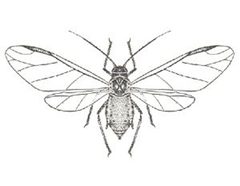
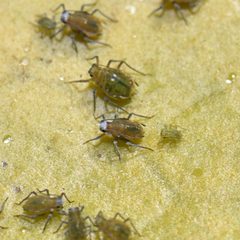
Small soft-bodied typical of Aphididae; specific morphological details not extensively described in available sources. Like other Rhopalosiphum , likely possesses cornicles (siphunculi) on the . Winged () and wingless () forms occur.
Habitat
Dual use: terrestrial environments on primary (Prunus spp.) and freshwater aquatic environments on secondary hosts including water lilies, water ferns (Azolla), and other aquatic vegetation. Thrives in wetland habitats, rice fields, and water bodies containing host aquatic plants.
Distribution
distribution. Documented from Europe (including Belgium, Flemish Region), Asia (India, China, Japan, Indonesia, Korea), North America, South America (Brazil: Espírito Santo, Paraná, Rio de Janeiro, São Paulo states), and Atlantic islands (Azores: Flores, São Miguel). First recorded in Serbia with expanding records. Specific new records from Varanasi region, Uttar Pradesh, India; Kerala, India; and various wetland localities in Serbia.
Seasonality
In northern India (Varanasi region), initiates in late October (1.35 aphids/leaf) coinciding with winter onset, peaks in late January (21.95 aphids/leaf), then declines. likely vary by latitude and availability.
Diet
Phloem sap feeder. Primary : Prunus (terrestrial). Secondary hosts: diverse aquatic and semi-aquatic plants including Nymphaea (water lily), Nelumbo (lotus), Euryale ferox (makhana), Trapa (water chestnut), Azolla (water fern), Salvinia, Limnobium laevigatum, Monochoria vaginalis, Spirodela polyrhiza, Marsilea quadrifolia, and others. Strongest preference observed for Limnobium laevigatum among tested hosts.
Host Associations
- Prunus spp. - primary terrestrial for and
- Nymphaea spp. - secondary aquatic including N. nouchali
- Nelumbo nucifera - secondary lotus; causes leaf curling, flower damage,
- Euryale ferox - secondary makhana/gorgon nut
- Trapa spp. - secondary water chestnut
- Azolla spp. - secondary water fern; important green manure in rice
- Salvinia natans - secondary most common in Serbian wetlands
- Limnobium laevigatum - secondary strongest preference in choice tests (49.28%)
- Monochoria vaginalis - secondary moderate preference (20.43%)
- Spirodela polyrhiza - secondary lower preference (16.33%)
- Azolla filiculoides - secondary lowest preference (1.75%), poor offspring production
- Marsilea quadrifolia - secondary four-leaf clover fern
Life Cycle
-alternating (heteroecious) with both sexual and parthenogenetic . On primary host (Prunus): hatch to fundatrices, followed by several parthenogenetic generations, then production of alatae that migrate to secondary aquatic hosts. On secondary hosts: continuous parthenogenetic (virginopary) through multiple generations. Development time: average 6.1 days under controlled conditions. Maximum recorded lifespan: 24 days. Return to primary host in autumn for and egg-laying.
Behavior
Strong selection demonstrated in and choice experiments; actively discriminate among aquatic hosts. Feeds preferentially on petioles, leaf lamina, and terminal buds of aquatic plants. Produces honeydew that promotes growth. forms disperse between host types and geographic locations.
Ecological Role
Agricultural pest causing direct damage through sap removal (leaf curling, stunted growth, reduced fruit production) and indirect damage via honeydew deposition and proliferation reducing . Documented virus capability threatening Prunus fruit production. Potential agent for aquatic weeds in rice systems, though this application requires careful management given its pest status on crop plants.
Human Relevance
Negative: significant pest of aquatic vegetable crops (water chestnut, makhana, lotus) and Prunus fruit trees. Causes economic losses through yield reduction and quality degradation. Management involves ( lecanii most effective, lethal time 31.09 h; neem oil, Metarhizium anisopliae also used). Positive: studied as potential biocontrol for ducksalad (Heteranthera limosa) in rice systems. sequenced (324.4 Mb, 16,834 protein-coding genes) enabling research on mechanisms.
Similar Taxa
- Rhopalosiphum maidis with similar ; distinguished by preference for maize/sorghum rather than aquatic plants
- Rhopalosiphum padi closely related phylogenetically; bird cherry-oat uses cereal grains and Prunus but not aquatic ; key greenhouse pest managed via banker plant systems
- Rhopalosiphum rufiabdominalisRice root aphid; with root-feeding habit primarily on grasses and sedges, recently documented on Cannabis; distinct
More Details
Genomic resources
First high-quality assembly published 2024: 324.4 Mb, contig N50 12.7 Mb, 97.5% BUSCO completeness, 16.9% repetitive elements, 16,834 predicted protein-coding genes. Phylogenetic analysis confirms placement in Aphidini tribe with close relation to R. maidis and R. padi.
Population dynamics
parameters on Azolla microphylla: (rm) = 0.315 day⁻¹, mean 36.8 larvae/female, doubling time 2.2 days under favorable conditions.
Genetic diversity
COI barcode studies show low genetic diversity in Indian compared to moderate variation in Chinese, Canadian, and Lithuanian populations; no genetic variation detected within Indian .
Sources and further reading
- BugGuide
- Wikipedia
- GBIF taxonomy match
- iNaturalist taxon
- NCBI Taxonomy
- Catalogue of Life
- Aboveground Pests - AgriLife Extension Entomology
- Stem- and Leaf- Feeding Insects - AgriLife Extension Entomology
- Rice Root Aphid: An Insect Surprise on Indoor-Grown Cannabis
- Got Aphids? Call in the Reinforcements With Banker Plants
- Uncategorized | Blog - Part 50
- An Entomologist's Adventure in the Web of Plant-Virus-Insect Interactions
- Selection of Azolla forms resistant to the water lily aphid, Rhopalosiphum nymphaeaeLife history of Rhopalosiphum nymphaeae
- A high-quality genome assembly of the waterlily aphid Rhopalosiphum nymphaeae
- Preference of the Waterlily Aphid, Rhopalosiphum nymphaeae (Hemiptera: Aphididae) on Four Hostplants
- Report of Rhopalosiphum nymphaeae L. (Hem.: Aphididae) infesting lotus (Nelumbo nucifera Nelumbonaceae)
- SECONDARY HOST PLANTS OF WATER LILY APHID, RHOPALOSIPHUM NYMPHAEAE (HEMIPTERA: APHIDIDAE) IN SERBIA
- DNA barcoding and genetic diversity studies of Water lily aphid, Rhopalosiphum nymphaeae from India
- Distribution, Host Range and Bionomics of Rhopalosiphum nymphaeae (Linnaeus, 1761) a Polyphagous Aphid in Aquatic Vegetables
- Spatial distribution and optimum sample size for monitoring of water lily aphid Rhopalosiphum nymphaeae (L.) in Makhana Euryale ferox Salisb