
Hysteroneura setariae
(Thomas, 1878)
Rusty Plum Aphid
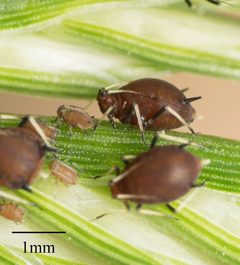
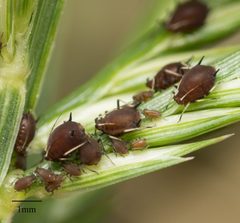
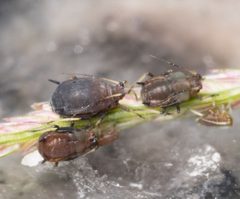
Hysteroneura setariae is a known primarily as the Rusty Plum Aphid. It feeds on grasses and fruit trees, with documented associations including Muhlenbergia capillaris and various Prunus species. The species has been recorded across six continents, with particularly dense observed in urban park settings in Japan. It serves as prey for including Coccinella septempunctata.
Pronunciation
How to pronounce Hysteroneura setariae: /ˌhɪstɛroˈnjʊərə ˌsɛtəˈraɪiː/
These audio files are automatically generated. While they are not always 100% accurate, they are a good starting point.
Identification
Small ; specific diagnostic features distinguishing it from and similar grass-feeding aphids such as Rhopalosiphum species are not documented in available sources. The "Rusty Plum Aphid" suggests possible coloration associated with plum feeding, but this is not explicitly described.
Images
Habitat
Urban parks and ornamental plantings; agricultural and natural grassland settings. Documented specifically on tussock-forming grasses in park environments.
Distribution
Widespread across six continents: North America (Canada, USA), Central America (Honduras, West Indies), South America (Argentina, Brazil, Chile, Colombia, Guyana, Surinam, Venezuela), Africa (Cameroon, Gambia, Ghana, Nigeria, Portuguese Guinea, Sierra Leone, South Africa, South-West Africa), Asia (Hong Kong, India, Malaysia, Philippines, Vietnam, Japan), and Australasia/Pacific Islands (Australia, Easter Island, Fiji, Hawaii, Oahu, Papua, Solomon Islands). Also recorded from Galápagos Islands and Madeira Island.
Seasonality
Autumn activity documented in central Japan; broader seasonal patterns not established in available sources.
Diet
Phloem feeder on grasses (Poaceae) including Muhlenbergia capillaris, and fruit trees especially plum (Prunus domestica) and peach (Prunus persica).
Host Associations
- Muhlenbergia capillaris - primary grass ornamental grass; high- documented in Japan
- Prunus domestica - fruit tree Plum
- Prunus persica - fruit tree Peach
- Poaceae - grass General grass feeding recorded
Behavior
Forms dense on plants; reaching approximately 9000 individuals/m² observed on Muhlenbergia capillaris in urban park conditions.
Ecological Role
Prey for beneficial predatory insects, particularly Coccinella septempunctata. Suggested potential as a component in banker plant systems for , though this application has not been empirically validated.
Human Relevance
Not considered a pest in Japan despite high densities. Potential value in through banker plant systems in agricultural and urban settings. Known as a pest of plum and peach in other regions based on usage.
Similar Taxa
- Rhopalosiphum speciesSimilar grass-feeding aphids in tribe Rhopalosiphina; differentiation requires detailed morphological examination not covered in available sources
- Carolinaia setariaeSynonym; formerly treated as congeneric
Sources and further reading
- BugGuide
- GBIF taxonomy match
- iNaturalist taxon
- NCBI Taxonomy
- Catalogue of Life
- Hysteroneura setariae . [Distribution map].
- Emergence of the aphid Hysteroneura setariae (Thomas, 1878) and ladybird predators Coccinella septempunctata L., 1758 (Coleoptera: Coccinellidae) on the grass Muhlenbergia capillaris (Lamark) Trinius in central Japan