
Aleurothrixus floccosus
(Maskell, 1896)
woolly whitefly
Aleurothrixus floccosus, commonly known as the , is a sap-feeding insect in the Aleyrodidae. Native to the Neotropics, it has spread globally and become a significant agricultural pest, particularly of citrus. The is distinguished by the dense, woolly wax filaments produced by its nymphs, which cover the colonies and give the insect its . It reproduces year-round in suitable climates, with overlapping . using , especially Cales noacki, has been widely implemented as chemical control is often ineffective due to the protective waxy covering.
Pronunciation
How to pronounce Aleurothrixus floccosus: //əˌlɛə.ɹoʊˈθɹɪk.səs flɒkˈkoʊ.səs//
These audio files are automatically generated. While they are not always 100% accurate, they are a good starting point.
Identification
The is distinguished from other whitefly by the dense, woolly wax filaments produced by its nymphs, which form conspicuous white masses on leaf undersides. The can be identified by the presence of submarginal setae and an uninterrupted submarginal fold at the vasiform orifice. resemble other whiteflies but can be confirmed by association with the characteristic woolly nymphal colonies. Molecular identification via mitochondrial COI gene sequencing has been used to confirm species identity in field studies.
Images
Appearance
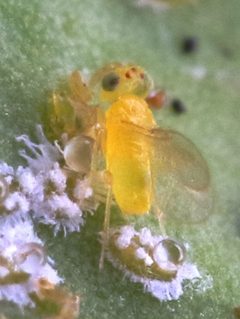
are small, -like insects approximately 1.5 mm in length with white, powdery wings held roof-like over the body. The nymphs are oval, flattened, and sedentary, producing conspicuous dense, white, woolly wax filaments that form tangled masses covering the colonies. The (last nymphal stage) has characteristic submarginal setae and an uninterrupted submarginal fold at the vasiform orifice. The woolly secretions can completely obscure the insects beneath, making infested leaves appear coated in white cottony masses.
Habitat
Found primarily in citrus groves and orchards, but also infests coffee plantations, guava orchards, and other cultivated areas. Occurs in tropical, subtropical, and warm temperate regions. In natural settings, associated with plants in forest edges and disturbed . Thrives in sheltered microclimates within tree , with nymphal highest on middle and lower canopy levels.
Distribution
Probably native to the Neotropics; now distributed globally. Present in Africa (Algeria, Angola, Benin, Congo, Egypt, Ethiopia, Gambia, Kenya, Malawi, Mauritius, Morocco, Nigeria, Reunion, Rwanda, Sao Tome and Principe, South Africa, St Helena, Tanzania, Togo, Tunisia, Uganda, Zambia), Asia (China, Hong Kong, India, Iran, Israel, Japan, Lebanon, Philippines, Singapore, Taiwan, Turkey), Europe (Croatia, Cyprus, France, Greece, Italy, Malta, Montenegro, Portugal, Spain, UK), North America (Mexico, USA: Arizona, California, Florida, Hawaii, Texas), Central America and Caribbean (Bahamas, Barbados, Belize, Rica, Cuba, Dominica, Dominican Republic, El Salvador, Guadeloupe, Haiti, Jamaica, Martinique, Panama, Puerto Rico, St Kitts-Nevis, Trinidad and Tobago), South America (Argentina, Brazil, Chile, Colombia, Ecuador, French Guiana, Guyana, Paraguay, Peru, Suriname, Venezuela), and Oceania (French Polynesia).
Seasonality
Reproduces year-round in tropical and subtropical climates with overlapping . In Mediterranean climates, have been captured on yellow sticky traps from May through mid-December, with winter consisting primarily of third and fourth instar nymphs. In Chile's Atacama Desert, all life stages occur throughout the year. Population peaks vary by region and are influenced by temperature and plant .
Diet
Phloem-feeding that extracts plant sap from vascular tissue. Feeds on a wide range of host plants including Citrus (primary host), coffee (Coffea spp.), guava (Psidium guajava), mango (Mangifera indica), banana (Musa paradisiaca), eggplant (Solanum melongena), and various other cultivated and wild plants.
Host Associations
- Citrus - primary Most economically important ; heavy cause leaf drop, reduced fruit quality, and development from honeydew
- Coffea - Coffee plantations affected in multiple regions
- Psidium guajava - Guava orchards heavily infested in India and other regions
- Mangifera indica - Mango affected in tropical regions
- Musa paradisiaca - Banana reported as in distribution records
- Solanum melongena - Eggplant among vegetable
Life Cycle
Hemimetabolous development with , four nymphal instars, and stages. Eggs are laid on leaf undersides, often in circular patterns. First instar nymphs () are mobile and seek feeding sites; subsequent instars become and remain fixed in place. The fourth instar is the , a non-feeding transitional stage. Nymphs produce dense woolly wax filaments beginning in early instars. Development time varies with temperature; multiple overlapping occur annually in favorable climates. All life stages may be present simultaneously on infested plants.
Behavior
Nymphs are sedentary after the first instar, remaining fixed to leaf undersides while feeding and producing protective wax filaments. are weak fliers that disperse short distances; they are attracted to yellow sticky traps. The exhibits behavioral patterns typical of whiteflies. Under laboratory conditions, adults show behavioral responses to volatile organic compounds emitted by Citrus plants, suggesting olfactory-mediated host location. Nymphal colonies form dense on leaf undersides, with higher on middle and lower levels compared to tree tops.
Ecological Role
Herbivore that functions as a significant agricultural pest, causing direct damage through sap extraction and indirect damage through honeydew that supports growth, reducing . Serves as for multiple that regulate in natural and agricultural . The hyperparasitoid Signiphora species can disrupt by parasitizing primary parasitoids. Honeydew production supports associations and secondary fungal .
Human Relevance
Major economic pest of citrus and other crops worldwide. Causes direct damage through feeding, indirect damage through development on honeydew, and reduces fruit quality and yield. Chemical control is often ineffective due to waxy nymphal coverings; relies heavily on using introduced , particularly Cales noacki. First detected in new regions triggers and efforts. Successful biological control programs have been implemented in France, Italy, Greece, Tanzania, and other regions using Cales noacki and other parasitoids.
Similar Taxa
- Aleurothrixus aepimCongeneric with similar woolly appearance; distinguished by puparial and associations
- Bemisia tabaciAnother whitefly pest of similar size and appearance; lacks woolly wax filaments and has different wing posture and puparial structure
- Aleurodicus dispersusSpiraling whitefly that produces wax but in spiral patterns rather than dense woolly masses; different puparial
- Dialeurodes citriCitrus whitefly with similar range; nymphs produce less conspicuous, flatter wax secretions without woolly texture
More Details
Biological Control History
Cales noacki was first released in France in 1970 for control, later introduced to Italy (1984), Greece (1991), and Tanzania (1999). Establishment success varies by region; in Italy it showed better than in some other areas. Recent surveys (2024-2025) in Italy documented additional Eretmocerus paulistus and Signiphora xanthographa, with the latter representing a new record for European fauna as a hyperparasitoid.
Parasitoid Complex
Documented include Cales noacki (primary parasitoid, most widely used), Amitus spiniferus, Eretmocerus paulistus, Eretmocerus naranjae (described from Mexico), Encarsia cubensis (recently recorded in India with >70% ), and the hyperparasitoids Signiphora (S. xanthographa, S. flavella). Parasitism rates vary dramatically by region and management type, from below 15% in some Chilean orchards to over 70% where effective is established.
Taxonomic Notes
Originally described as Aleurodes floccosa by Maskell in 1896. Some literature references treat A. floccosus as part of a , with distribution maps noting 'Aleurothrixus floccosus complex' to accommodate potential cryptic diversity. The is the type species of the Aleurothrixus.
Sources and further reading
- BugGuide
- Wikipedia
- GBIF taxonomy match
- iNaturalist taxon
- NCBI Taxonomy
- Catalogue of Life
- 2022 Six-State Insect Collecting Trip iReport | Beetles In The Bush
- Aleurothrixus floccosus . [Distribution map].
- Aleurothrixus floccosus . [Distribution map].
- Aleurothrixus floccosus complex. [Distribution map].
- New data on the parasitization of Aleurothrixus floccosus (Maskell) (Hemiptera: Aleyrodidae) in Greece
- Life History, Seasonal Abundance, Host Range and Geographical Distribution of the Wooly Whitefly, Aleurothrixus floccosus (Maskell) (Homoptera:Aleyrodidae)
- Encounter with Encarsia cubensis, a new natural enemy of invasive woolly whitefly Aleurothrixus floccosus in India
- First Record of Aleurothrixus floccosus (Mask.) (Homoptera: Aleyrodidae) in Greece and Some Observations οn its Phenology
- Fluctuación poblacional y parasitismo de Aleurothrixus floccosus (Hemiptera: Aleyrodidae) en cítricos del Desierto de Atacama, Chile
- Especies de Eretmocerus Haldemn (Hymenoptera: Aphelinidae) - parasitoides de Aleurothrixus floccosus (Maskell) (Homoptera: Aleyrodidae) de México, con la descripción de una nueva especie
- Distribution of Woolly Whitefly <i>Aleurothrixus floccosus</i> Maskell on Guava from Tamil Nadu
- BIOLOGICAL CONTROL OF CITRUS WOOLLY WHITE FLY ALEUROTHRIXUS FLOCCOSUS MASK (HOMOPTERA: ALEYRODIDAE) BY CALES NOACKI HOW (HYMENOPTERA: APHELINIDAE) IN SOME TANZANIAN SMALL-SCALE CITRUS ORCHARDS
- Studies on Aleurothrixus floccosus (Maskell) (Homoptera, Aleyrodidae) and its parasitoid, Cales noacki Howard (Hymenoptera, Aphelinidae) in the East Mediterranean Region of Turkey
- Behavioral responses of the woolly whitefly Aleurothrixus floccosus (Hemiptera: Aleyrodidae) to volatile organic compounds emitted from Citrus at laboratory conditions
- Life table parameters of the woolly whitefly Aleurothrixus floccosus (Hemiptera: Aleyrodidae) and its parasitoid Cales noacki (Hymenoptera: Aphelinidae)
- The Parasitoid Complex of Aleurothrixus floccosus (Hemiptera: Aleyrodidae) in the Citrus Groves of Central–Southern Italy