
Zicrona caerulea
(Linnaeus, 1758)
Blue Shieldbug, blue shield bug
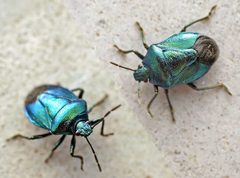
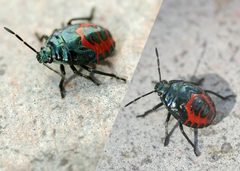
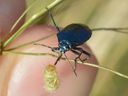
Zicrona caerulea is a small predatory shield bug in the Pentatomidae, Asopinae. measure 5–8 mm and display a striking uniform metallic blue-green coloration, with immatures showing red with black markings. This is a documented of leaf beetles (Altica spp.), larvae, and caterpillars, though it has also been observed feeding on plants. It overwinters as an adult and produces new adults from July onwards.
Pronunciation
How to pronounce Zicrona caerulea: /zɪˈkroʊnə saɪˈruːliə/
These audio files are automatically generated. While they are not always 100% accurate, they are a good starting point.
Identification
Distinguished from other shield bugs by its small size (5–8 mm) and uniform metallic blue-green coloration in . The red with black markings in stages is distinctive. Similar metallic-colored in other (e.g., some leaf beetles) lack the shield-shaped body form. Within Pentatomidae, the combination of small size, uniform blue-green color, and predatory habits ( Asopinae) separates it from larger or differently colored shield bugs.
Images
Habitat
Low vegetation in moors, heaths, damp grassland, and forest edges. Associated with herbaceous vegetation where prey items occur.
Distribution
Eurasia and North America. Recorded from Quebec, Canada (rediscovered 1933 after apparent absence), Belgium, and across temperate regions of both continents. GBIF records confirm presence in North America and Europe.
Seasonality
. laid in spring. New present from July onwards. Overwinters as adult.
Diet
of leaf beetles in Altica, larvae of various beetles, and caterpillars of . Also feeds on plants, indicating facultative plant-feeding .
Host Associations
- Altica spp. - preyleaf beetles
- Hostounsky sp. nov. - first recorded in this
Life Cycle
. laid in spring. Nymphal development leads to beginning July. Overwinters as adult. stages have red with black markings, transitioning to metallic blue-green in adults.
Ecological Role
in herbaceous vegetation , contributing to control of leaf beetle and caterpillar . Facultative plant-feeding may provide alternative food source when prey scarce.
Human Relevance
Documented as useful of agricultural pests including leaf beetles. Potential value in contexts, though not widely utilized.
Similar Taxa
- Other Pentatomidae (non-Asopinae)Most shield bugs are phytophagous; Z. caerulea distinguished by predatory habits and metallic coloration
- Other Asopinae speciesSome predatory shield bugs share habits but differ in size, coloration, or pattern
Sources and further reading
- BugGuide
- Wikipedia
- GBIF taxonomy match
- iNaturalist taxon
- NCBI Taxonomy
- A Summit to Save the Butterflies | Bug Squad
- Bees vs wasps: what's the difference? - Buglife Blog - Buglife
- Tingidae | Beetles In The Bush
- Beauties in the Bog - Buglife Blog - Buglife
- Provisional checklist of European butterfly larval foodplants
- Redécouverte de la punaise Zicrona caerulea (Linnaeus, 1758) (Hemiptera : Pentatomidae) au Québec
- The first record of a hostounsky sp. nov. Infection in the blue shieldbug, Zicrona caerulea Linnaeus, 1758 (Hemiptera: Pentatomidae)