
Altica
Geoffroy, 1762
Metallic Flea Beetles
Species Guides
24- Altica ambiens(Alder Flea Beetle)
- Altica betulae
- Altica bimarginata(willow flea beetle)
- Altica caurina
- Altica chalybea(Grape Flea Beetle)
- Altica corni(dogwood flea beetle)
- Altica foliaceae(apple flea beetle)
- Altica gloriosa
- Altica guatemalensis
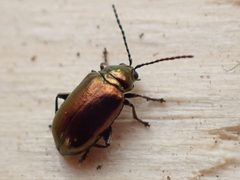
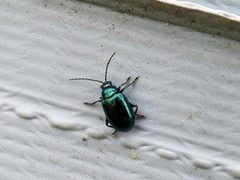
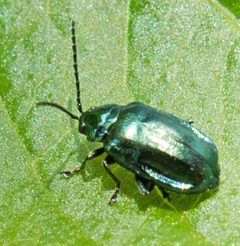
Altica is a large of flea beetles comprising approximately 300 distributed nearly worldwide. The genus name derives from Greek 'haltikós' meaning 'jumper,' referring to the beetles' ability to jump when disturbed. Species are small, metallic blue-green to bronze beetles that are morphologically similar and often distinguished only by male genitalia. Both larvae and adults are phytophagous, with most species showing strong plant specificity. The genus is best represented in the , with significant diversity in the Nearctic and Palearctic regions.
Pronunciation
How to pronounce Altica: //ˈæl.tɪ.kə//
These audio files are automatically generated. While they are not always 100% accurate, they are a good starting point.
Identification
within Altica are notoriously difficult to distinguish based on external alone. Costate (ridged) patterns can assist in grouping species, but definitive identification typically requires examination of the male or female secondary genital structures (styles and spiculum ventrale). For females of some regional faunas, keys based on secondary genital characters have been developed. The metallic coloration and jumping ability help distinguish the from other small leaf beetles, but species-level identification is challenging without dissection.
Images
Appearance
Small beetles, typically 3-5 mm in length, with compact oval bodies. Coloration is metallic, ranging from blue-green to bronze or coppery. are thread-like and moderately long. Hind are enlarged, adapted for jumping. are smooth or may have costate (ridged) patterns in some . is minimal externally; species identification often requires examination of male or female secondary genitalia.
Habitat
Highly variable across , reflecting plant specificity. Found in supporting their specific host plants, including sand dunes, wetlands, grasslands, forests, and agricultural or horticultural settings. Some species are associated with aquatic or semi-aquatic environments where their host plants grow.
Distribution
Nearly worldwide distribution. Best represented in the . Well represented in the Nearctic and Palearctic regions. Occurs also in the Afrotropic, Indomalaya, and Australasia regions. Individual ranges vary from restricted to widespread.
Seasonality
Activity patterns vary by and latitude. are generally active during the growing season of their plants. Some species show distinct seasonal peaks corresponding to host plant . In temperate regions, adults typically overwinter and become active in spring; multiple may occur in warmer climates.
Diet
Phytophagous. Both larvae and feed on plant foliage. plant specificity varies by : some are oligophagous on related plant , others are more specialized. Documented host plant include Onagraceae, Rosaceae (especially Rubus), Lythraceae, Salicaceae, Asteraceae (Cirsium, Carduus), and Ericaceae (Vaccinium).
Host Associations
- Oenothera spp. - plantPrimary for Altica litigata and other ; includes weedy and cultivated evening primroses
- Lagerstroemia spp. - plantCrapemyrtle, important for A. litigata in southern U.S. nurseries
- Salix cordata - plantSand-dune willow, for A. subplicata
- Vaccinium angustifolium - plantLowbush blueberry, for A. sylvia
- Carduus nutans - plantMusk thistle, primary for A. carduorum
- Cirsium arvense - plantCanada thistle, for A. carduorum
- Rubus spp. - plant plant for Holarctic
- Ludwigia spp. - plantAquatic/semi-aquatic plants for A. litigata
- Vitis vinifera - plantGrapevine, documented for A. aenescens in Kashmir viticulture
Life Cycle
Holometabolous development with , larval, pupal, and stages. Eggs are laid on or near plants. Larvae are typically soil-dwelling or feed on host plant foliage, depending on . Larval development includes three instars; capsule width measurements can be used to determine instar, though these may vary with ecological conditions. occurs in soil or leaf litter. Development time is strongly temperature-dependent, with optimal ranges typically between 20-30°C for most studied species. time varies from single to multiple generations per year depending on climate and species.
Behavior
are capable of jumping considerable distances relative to their body size using their enlarged hind legs, a defensive escape response when approached. Both adults and larvae feed on plant foliage, often skeletonizing leaves. Feeding activity can be intense, with adults sometimes congregating on preferred host plants. Some show preference for younger or smaller host plants within a .
Ecological Role
Herbivores that can significantly impact plant through defoliation. Some act as engineers by influencing plant composition and patterns—heavy herbivory on host plants can release resources for competing plant species. Several species have been investigated or employed as agents for weeds (e.g., A. carduorum for thistles). Some species are economic pests of ornamental and agricultural plants.
Human Relevance
Several are economically significant pests. Altica litigata is an important pest of crapemyrtles in southern U.S. container nurseries, causing substantial defoliation. Some species damage other ornamental or cultivated plants. Conversely, A. carduorum and related species have been evaluated and released as agents for thistles (Carduus, Cirsium). The is frequently encountered by entomologists and naturalists due to its abundance and distinctive appearance.
Similar Taxa
- GraptoderaFormerly considered distinct but now synonymized with or closely related to Altica; some transferred between based on revised classification
- Other Galerucinae generaSimilar body form and habits, but Altica is distinguished by the combination of small size, metallic coloration, enlarged hind for jumping, and specific genitalic structures
More Details
Taxonomic challenges
The presents significant taxonomic difficulties due to morphological similarity among . The revision of costate North American species by LeSage (1995) represents a major contribution, but many species remain difficult to identify without specialized examination. The use of molecular techniques, including sequencing (e.g., A. lythri), may assist future taxonomic work.
Research importance
Altica have served as model organisms for studies of plant specificity, herbivore-plant , efficacy, and climate-herbivore interactions. The detailed study of A. subplicata effects on sand dune demonstrates the potential for these beetles to influence -level ecological patterns.
Sources and further reading
- BugGuide
- Wikipedia
- GBIF taxonomy match
- iNaturalist taxon
- NCBI Taxonomy
- Catalogue of Life
- Scarabaeidae | Beetles In The Bush | Page 3
- HOST SPECIFICITY OF ALTICA CARDUORUM GUER. (COLEOPTERA: CHRYSOMELIDAE)
- Investigating the Enigmatic and Invasive Entomofaunal Diversity of Temperate Viticulture: First Record of the Nearctic buffalo treehopper <i>Stictocephala bisonia</i> (Kopp & Yonke) and a Previously Undocumented <i>Altica</i> Species (<i>Altica aenescens</i>) (Weise, 1888) from India
- Effect of Temperature and Host Plant on Survival and Development of Altica litigata Fall
- Factors affecting head capsule development in field populations ofAltica sylvia(Coleoptera: Chrysomelidae)
- ALTICA, COAPEXCO, AND THE ROLE OF MIDDLEMEN IN FORMATIVE OBSIDIAN EXCHANGE
- Larval Morphology and Biology of a North American and an Israeli Altica Species (Coleoptera: Chrysomelidae: Alticinae)
- Biology of the flea beetle,Altica carduorum [Col.: Chrysomelidae] on Canada thistle (Cirsium arvense) in South Dakota
- Identification of females of the Finnish species of <i>Altica Müller</i> (Coleoptera, Chrysomelidae)
- REVISION OF THE COSTATE SPECIES OFALTICAMÜLLER OF NORTH AMERICA NORTH OF MEXICO (COLEOPTERA: CHRYSOMELIDAE)
- Effects of a Specialist Herbivore (Altica Subplicata) on Salix Cordata and Sand Dune Succession
- Effects of Microclimate and Plant Characteristics on the Distribution of a Willow Flea Beetle, Altica subplicata
- The genome sequence of a flea beetle, Altica lythri Aubé, 1843.