
Melacoryphus admirabilis
(Uhler, 1872)
Admirable Seed Bug
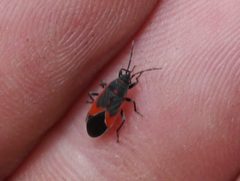
Melacoryphus admirabilis is a in the Lygaeidae, native to the Nearctic region of North America. The is closely related to other soapberry bugs and shares ecological associations with plants in the family Sapindaceae. It occurs in the southwestern United States and Mexico, typically in warm, arid . Like other members of its , it feeds on seeds and plant fluids. The species is occasionally encountered in large .
Pronunciation
How to pronounce Melacoryphus admirabilis: /mɛləkəˈrɪfəs ædˌmɪˈræbəlɪs/
These audio files are automatically generated. While they are not always 100% accurate, they are a good starting point.
Images
Habitat
Warm, arid regions of the southwestern United States and adjacent Mexico. Associated with supporting plants in the Sapindaceae, particularly soapberry trees.
Distribution
Southwestern United States (Arizona, southern California, New Mexico, Texas) and Mexico. Records indicate occurrence in the Nearctic region excluding the Western Cordillera and Beringia.
Diet
Feeds on seeds and fruits of plants in the Sapindaceae, particularly soapberry trees (Sapindus ). Has been observed feeding on flower buds, oozing sap, and dead insects.
Host Associations
- Sapindus saponaria - primary soapberry tree, primary seed
- Sapindaceae - -level associationseeds and fruits of soapberry plants
Life Cycle
(hemimetabolous) with , nymph, and stages. Nymphs pass through five instars before reaching adulthood. Multiple per year in warm climates, with adults and nymphs capable of in sheltered locations.
Behavior
Forms large , particularly when plants are fruiting. mate in 'tail-to-tail' position. Females signal unreceptivity to mating by stridulating—rubbing lateral edges of the against thoracic segments. Both nymphs and adults seek shelter in cracks, crevices, and protected during cold periods.
Ecological Role
Seed of Sapindaceae, potentially influencing plant recruitment and distribution. Serves as prey for various vertebrate and predators in arid .
Human Relevance
Occasionally enters buildings seeking shelter, rendering it a minor nuisance pest in some areas. Not considered economically significant.
Similar Taxa
- Jadera haematolomaBoth are 'soapberry bugs' in the Lygaeidae with similar gray and red coloration, association with Sapindaceae , and aggregating . Jadera haematoloma has more extensive red markings on the dorsum and red ; Melacoryphus admirabilis is distinguished by structural characters of the and .
- Boisea trivittataBoxelder bug shares similar size, color pattern (dark with red markings), and nuisance pest status. Distinguished by association with Acer (boxelder) rather than Sapindus, and by structural characters of the scutellum and wing venation.
- Melacoryphus lateralis with similar and appearance. Distinguished by differences in pronotal structure and color pattern details.