
Padaeus trivittatus
Stål, 1872
boxelder bug
Padaeus trivittatus, commonly known as the boxelder , is a true bug in the Pentatomidae. and nymphs feed primarily on seeds of boxelder, maples, and ash trees. The is notable for aggregating in large numbers on sunny building exteriors in autumn and seeking winter shelter in homes and structures. It completes one to three per year depending on geographic location. Despite its nuisance status as a home invader, it does not bite, sting, or reproduce indoors.
Pronunciation
How to pronounce Padaeus trivittatus: //pəˈdiːəs ˌtrɪvɪˈtɑːtəs//
These audio files are automatically generated. While they are not always 100% accurate, they are a good starting point.
Identification
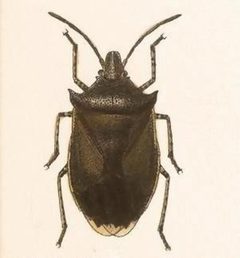
have a distinctive black body with three red longitudinal stripes on the pronotum and red margins on the wings. Nymphs are wingless with black legs, short wing pads, and a red exposed that becomes covered by black wing pads as they mature through successive . The beak-like is tucked between the legs when not feeding. Similar red-and-black patterning occurs in other boxelder , but P. trivittatus is distinguished by its specific association with boxelder and maple seeds in North America.
Images
Habitat
Found in landscapes with boxelder, maple, and ash trees, particularly female trees that produce seeds. Overwinters in loose bark, hollow trees, rock crevices, brush tangles, and human structures including beneath siding, around window frames, and in foundation cracks.
Distribution
North America and Middle America. Present throughout much of the United States and Canada, with highest densities in regions with abundant boxelder and maple trees.
Seasonality
Active from spring through autumn. Emerges from sites when temperatures reach the upper 60s–70s°F (approximately 20–25°C). Peak on buildings occurs in October and November in central Maryland as seek winter shelter. Inactive during cold winter periods but becomes restless and visible indoors when temperatures warm.
Diet
Seeds of boxelder (Acer negundo), silver maple, red maple, and ash trees. Also feeds on sap and seeds of plum, cherry, and various other trees, shrubs, and vines. Has been observed consuming bird droppings, likely to obtain minerals or other nutrients.
Host Associations
- Acer negundo - feeds onprimary ; seeds
- Acer saccharinum - feeds onseeds
- Acer rubrum - feeds onseeds
- Fraxinus - feeds onseeds
Life Cycle
Females deposit 200–300 in clusters on tree bark, leaves, ground substrates, and building surfaces. Eggs hatch in several weeks. Wingless nymphs feed on plant tissues through summer, molting multiple times with wing pads elongating at each until covering the at adulthood. One to three completed per year depending on geographic location.
Behavior
Aggregates in large numbers on sunny south-facing building surfaces to thermoregulate. Enters homes through gaps in siding, foundation cracks, and beneath poorly sealed doors. Does not reproduce indoors. When disturbed or crushed, may produce staining fluids. Mating pairs sometimes remain attached for extended periods with the male following the female.
Ecological Role
Seed of boxelder, maple, and ash. levels fluctuate annually, possibly influenced by seed crop abundance, drought conditions affecting fungal , or predator activity.
Human Relevance
Considered a nuisance pest due to autumn and winter home invasions. Does not bite, sting, or damage structures. Crushing on interior surfaces produces stains. Management involves sealing entry points, removing near structures, and in some cases removing trees. Vacuum removal and release at a distance is a recommended control method.
Similar Taxa
- Boisea rubrolineataSimilar red-and-black coloration and boxelder ; distinguished by geographic range and subtle pattern differences
- Jadera haematolomaRed-shouldered bug with similar seed-feeding habits and building-aggregating ; lacks the three longitudinal stripes on pronotum
Misconceptions
Often mistakenly believed to bite, sting, or reproduce indoors; actually harmless to humans and pets and does not breed within structures. Crushing is sometimes attempted as control, which causes staining rather than solving the problem.
Sources and further reading
- BugGuide
- GBIF taxonomy match
- iNaturalist taxon
- Boxelder bungalow: Boxelder bugs, Boisea trivittatus — Bug of the Week
- Boxelder bungalow - Boxelder bugs, Boisea trivittatus — Bug of the Week
- Banneker’s boxelder bugs, Boisea trivittatus — Bug of the Week
- Home Invaders IV - Attack of the red and black, Boxelder bugs, Boisea trivittatus — Bug of the Week
- Boxelder bugs on the move: Boxelder bugs, Boisea trivittatus — Bug of the Week
- Wake-up call for boxelder bugs: Boisea trivittatus — Bug of the Week