
Boisea trivittata
(Say, 1825)
eastern boxelder bug, box bug, maple bug, adobe bug
Boisea trivittata, commonly known as the eastern boxelder , is a North American true bug in the Rhopalidae. Despite being classified as 'scentless plant bugs,' this produces defensive monoterpene hydrocarbons that deter . are approximately 12-13 mm long with dark brown or black coloration marked by distinctive red wing and abdominal markings. The species undergoes , with bright red nymphs maturing to winged adults before winter. It is primarily associated with boxelder trees (Acer negundo), though it also occurs on other maples and ash trees.
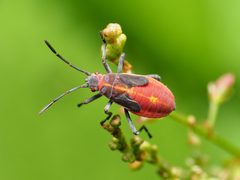
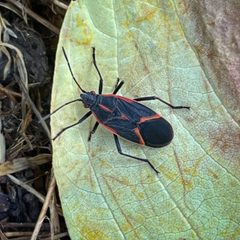
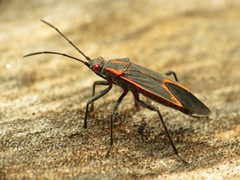
Pronunciation
How to pronounce Boisea trivittata: //ˈbɔɪsea traɪvɪˈtɑːtə//
These audio files are automatically generated. While they are not always 100% accurate, they are a good starting point.
Identification
Distinguished from the western boxelder (Boisea rubrolineata) by geographic range—east of the Rocky Mountains for B. trivittata, west of the Continental Divide for B. rubrolineata. The red coloration pattern differs slightly between . May be confused with Jadera, Pyrrhocoris, Melacoryphus, or Lygaeus milkweed bugs, but the combination of black body with red wing and specific tree association helps identify B. trivittata. Unlike stink bugs (Pentatomidae), it lacks the large triangular scutellum and shield-shaped body. Unlike the brown marmorated stink bug (Halyomorpha halys), it has more extensive red markings and a different body shape.
Images
Appearance
measure 12-13 mm in length with a flattened, elongate-oval body. The surface is dark brown to black with prominent red markings: red wing ( and ), red lateral margins on the pronotum, and red abdominal stripes. The are dark red. Nymphs are bright red with black markings, wingless, and smaller than adults. are four-segmented. The scutellum is triangular and black. Wings are membranous at the tips with visible venation.
Habitat
Primarily associated with boxelder trees (Acer negundo), especially female trees that produce seeds. Also found on other maple (Acer spp.) and ash trees (Fraxinus spp.). Overwinters in natural shelters including rock piles, tree trunks, and plant debris with strong sun exposure. Frequently aggregates on south- and west-facing surfaces of buildings, including residences and commercial structures, seeking entry points for indoor .
Distribution
Native to eastern North America. Range includes eastern United States, southern Canada, Mexico, and south to Guatemala. Introduced and established as in central Chile (first detected 2020, especially in Santiago). Reports from South Africa likely represent misidentifications of the related Boisea fulcrata.
Seasonality
emerge from sites in spring as temperatures increase. Reproductive season extends through summer. Nymphs develop through late summer, with most reaching adulthood before cold weather. Late summer to early fall: nymphs and adults cease feeding and depart trees, forming . Fall: mass aggregation on warm surfaces seeking overwintering shelter. Winter: inactive overwintering in protected locations. Warm winter days may trigger temporary .
Diet
herbivore feeding almost entirely on developing seeds of boxelder, maple, and ash trees. and nymphs also suck leaf sap, though seeds are preferred. Not known to feed during winter .
Host Associations
- Acer negundo - primary boxelder tree, especially female trees with seeds
- Acer spp. - secondary other maple
- Fraxinus spp. - secondary ash trees
Life Cycle
(hemimetabolous). laid on trees, often on leaves, stems, or seed pods. Nymphs pass through five instars, feeding on host plant seeds and leaves. Nymphs bright red, gradually developing darker markings and wing pads. appear in late summer before . Single per year in northern range; possibly partial second generation in southern areas. Overwintering occurs as adults in aggregated groups in protected locations.
Behavior
Forms large, conspicuous on warm surfaces in fall, especially on south- and west-facing building walls, rocks, and trees. Aggregation mediated by and chemical cues. Defensive behavior: releases pungent monoterpene hydrocarbons when disturbed to deter . Allows formation of visible aggregations without risk. capable of but often walk to aggregation sites. Indoor individuals may become active during warm periods, potentially staining surfaces with excreta.
Ecological Role
Generally causes minimal damage to trees despite large . herbivore with limited impact on plant health. Serves as prey for some spiders; chemical defenses deter most vertebrate . populations in Chile represent novel ecological interaction with ornamental maple trees.
Human Relevance
Considered a nuisance pest when aggregating on buildings or entering homes in large numbers. Does not bite, sting, or transmit . Indoor excreta may stain upholstery, carpets, and drapes. Occasionally feeds on houseplants if trapped indoors. Not classified as an agricultural pest, though incidental feeding on fruits in fall can cause minor cosmetic damage. Control through exclusion (sealing entry points, repairing weatherstripping) preferred over chemical treatment; removal of trees effective but ecologically undesirable.
Similar Taxa
- Boisea rubrolineataWestern boxelder ; distinguished by geographic range (west of Continental Divide) and slightly different red coloration pattern
- Jadera spp.Similar red and black coloration; distinguished by different body shape and associations (often goldenrain tree)
- Lygaeus kalmiiSmall milkweed bug; similar warning coloration but feeds on milkweed seeds, has different markings
- Halyomorpha halysBrown marmorated stink bug; similar fall but has shield-shaped body, less red coloration, and produces characteristic odor
Misconceptions
Incorrectly called 'stink bugs'—actually belongs to Rhopalidae ('scentless plant bugs'), though it does produce defensive compounds. Often perceived as dangerous or -carrying; actually harmless to humans and pets. Misconception that indoor presence indicates breeding indoors; they do not reproduce inside buildings.
More Details
Antennal Sensilla
Scanning electron microscopy has identified seven categories of antennal (20 subtypes) in : sensilla trichodea, basiconica, chaetica, campaniformia, coeloconica, ampullacea, and bell-mouthed. Mechanoreceptors dominate the scape, , and basiflagellomere; are concentrated on the distiflagellomere. Two patches of sensilla coeloconica on the outer lateral pedicel and basiflagellomere may function in detecting .
Etymology
Specific epithet 'trivittata' derives from Latin tri (three) + vittata (banded), referring to the three longitudinal red stripes on the .
Invasive Status
Established in central Chile since 2020, associated with ornamental maple plantings in Santiago residential areas. Represents first documented invasion outside native range.
Sources and further reading
- BugGuide
- Wikipedia
- GBIF taxonomy match
- iNaturalist taxon
- NCBI Taxonomy
- Catalogue of Life
- Insect FAQs | Entomology Research Museum
- Bug Eric: Indoor Insects of Autumn (part 2 of 4)
- Bug Eric: December 2012
- Bug Eric: 2009
- Bug Eric: Small Milkweed Bug
- Bug Eric: Strange Flies on a Fish Carcass
- Mapping Antennal Sensilla of Boxelder Bugs (Boisea trivittata) as the First Step in Understanding Overwintering Aggregation Behavior