
Rhopalidae
Amyot & Serville, 1843
Scentless Plant Bugs
Subfamily Guides
2- Rhopalinae(scentless plant bugs)
- Serinethinae(soapberry bugs)
, commonly known as scentless plant bugs, is a of true bugs in the order Hemiptera. The family comprises approximately 30 and over 240 worldwide. Members are distinguished from related coreids by the absence of well-developed , and from similar lygaeids by the numerous in the hemelytral . Most species feed on plants, with some exhibiting specificity on particular plant families. The family includes several species that aggregate in large numbers and occasionally enter buildings, such as boxelder bugs (Boisea spp.) and red-shouldered bugs (Jadera haematoloma).
Pronunciation
How to pronounce Rhopalidae: //roʊˈpælɪˌdiː//
These audio files are automatically generated. While they are not always 100% accurate, they are a good starting point.
Identification
can be distinguished from the superficially similar Coreidae (leaf-footed bugs) by the absence of well-developed —coreids possess prominent metathoracic scent glands that rhopalids lack or have in reduced form. From Lygaeidae (seed bugs), particularly the Orsillinae, rhopalids differ by having many in the of the ; orsillines have few veins in this region. Within the family, can be separated by plant associations, body proportions, and subtle structural characters of the , pronotum, and male genitalia. -level identification often requires examination of genitalic structures and is challenging without reference specimens.
Images
Appearance
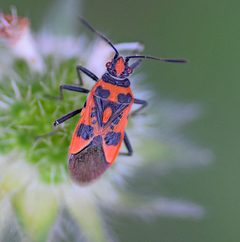
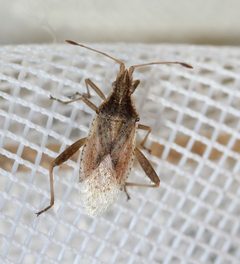
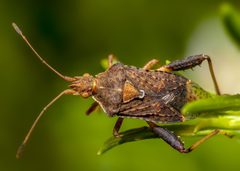
Rhopalids are generally small to medium-sized true bugs, typically smaller and lighter-colored than coreids. The body is usually slender with long . The have a leathery basal portion and a membranous portion with numerous —a key diagnostic feature distinguishing them from orsilline lygaeids. Coloration varies widely: some are drab brown or gray, while others display bold aposematic patterns of red, orange, and black. Nymphs lack wings and often show different color patterns than , frequently with brighter abdominal colors exposed in early instars.
Habitat
Rhopalids occupy diverse associated with their plants. Most live principally on herbaceous vegetation and weeds. Some, including boxelder bugs, are arboreal and associated with trees. Species that aggregate for seek sheltered such as under bark, in woodpiles, in leaf litter, or in rock crevices. A few species have adapted to urban environments where their host plants are cultivated as ornamentals.
Distribution
Worldwide distribution with greatest diversity in temperate and tropical regions. The is well-represented in North America, Central and South America, Europe, Asia, Africa, and Australia. Specific distribution varies by : Boisea (boxelder bugs) occurs in North America; Jadera (red-shouldered bugs) ranges from the southern United States through Central America and the Caribbean to South America, with expanding northern range; Niesthrea occurs from New York to Florida and west to California; Chorosoma and related genera occur across the Palearctic and into China. Fossil rhopalids are known from the Middle Jurassic of Inner Mongolia.
Seasonality
Activity patterns vary by and latitude. In temperate regions, emerge in spring (April–May) and build through multiple during the growing season. Autumn (September–October) is characterized by as adults seek shelters. In southern latitudes, some species produce three to four generations annually; fewer generations occur farther north. Overwintering occurs as adults in protected locations.
Diet
All are phytophagous (plant-feeding). Feeding occurs on various plant parts including seeds, developing fruits, flower buds, foliage, and sap. Some are highly -specific: Niesthrea louisianica feeds primarily on plants in the Malvaceae (hibiscus, cotton, okra, velvetleaf); Jadera haematoloma specializes on seeds of Sapindaceae (soapberries, golden rain tree); Boisea spp. feed on seeds of Aceraceae (maples) and related trees. Other species have broader host ranges. Nymphs and feed similarly, using to extract plant fluids.
Host Associations
- Malvaceae - primary Niesthrea louisianica on hibiscus, cotton, okra, velvetleaf (Abutilon theophrasti)
- Sapindaceae - primary Jadera haematoloma on soapberries, golden rain tree (Koelreuteria paniculata)
- Aceraceae - primary Boisea spp. on boxelder, maples, and related trees
- weeds and herbaceous vegetation - general Many rhopalid on diverse herbaceous plants
Life Cycle
Rhopalids undergo simple (incomplete) with three life stages: , nymph, and . Females deposit eggs in small batches on plant foliage, flower buds, bracts, or seed . Egg batches may contain up to 36 eggs, with lifetime reaching 400–800 eggs per female. Eggs hatch in approximately one to two weeks. Nymphs pass through five instars, each progressively larger, with wing pads developing in later instars. Development from egg to adult requires little more than a month under favorable summer conditions. The final produces a winged, sexually mature adult. Multiple occur annually in favorable climates; adults of the final generation overwinter.
Behavior
Several rhopalid exhibit conspicuous , particularly in autumn when congregate in large numbers on plants and buildings before seeking shelters. Mating occurs with individuals positioned tail-to-tail. Females of some species signal unreceptivity to males by stridulation—rubbing abdominal segments against the to produce sound. Some species are known to enter buildings in fall, becoming nuisance pests. Defensive behaviors vary: some species produce exocrine chemicals from metathoracic and abdominal glands despite the 'scentless' , while others rely on aposematic coloration. Aggregations may serve multiple functions including , deterrence, and mate location.
Ecological Role
Rhopalids function primarily as herbivores in terrestrial . Some play notable roles in : Niesthrea louisianica has been investigated and deployed for control of the weed velvetleaf (Abutilon theophrasti), attacking seeds and reducing weed . This species may also pathogenic fungi (Fusarium, Alternaria) that further damage weed seeds. As prey, rhopalids serve as food for various including spiders, tachinid flies (Leucostoma spp.), and scelionid (Telenomus spp. as ). The abundant of some species provide concentrated food resources for vertebrate predators. Seed-feeding activities may influence plant , though most species cause minimal economic damage to cultivated plants.
Human Relevance
Most are not economically important. A few are considered nuisance pests when they aggregate on buildings and occasionally enter structures in autumn. Boxelder bugs (Boisea trivittata and B. rubrolineata) and red-shouldered bugs (Jadera haematoloma) are the most frequently reported in this context. Their presence indoors is temporary and they do not reproduce or feed inside; they pose no health risk and cause no structural damage. Control is best achieved by exclusion—sealing entry points, repairing screens, and maintaining weatherstripping. Some species have been intentionally released for biological weed control. The has minor significance in and ecological research.
Similar Taxa
- CoreidaeLeaf-footed bugs share general body plan but possess well-developed and often have expanded hind tibiae; rhopalids lack these features and have more numerous hemelytral
- Lygaeidae (Orsillinae)Orsilline seed bugs resemble small rhopalids but have few in the hemelytral ; rhopalids have many veins in this region
- PentatomidaeStink bugs have distinctive shield-shaped body and prominent ; rhopalids are more slender and lack the shield shape
Misconceptions
The 'scentless plant bugs' is misleading for some . While the generally lacks the well-developed of Coreidae, some species—including Niesthrea louisianica—possess functional metathoracic and abdominal glands that produce defensive exocrine compounds. Additionally, despite being called 'plant bugs,' are distinct from the family Miridae, which are also commonly called plant bugs. The historical synonym 'Corizidae' occasionally appears in older literature.
More Details
Historical taxonomy
The was formerly known as Corizidae in older literature; this name is now obsolete.
Fossil record
The oldest described fossil rhopalids are from the Middle Jurassic (approximately 165 million years ago) of Inner Mongolia, China, discovered in the Haifanggou Formation.
Biological control applications
Niesthrea louisianica has been mass-reared and released in the Midwestern United States specifically for of velvetleaf, with documented reductions in weed seed viability near release points.
Climate change effects
Several rhopalid , notably Jadera haematoloma, have shown northward range expansion in recent decades, attributed to milder winter temperatures associated with climate change.
Sources and further reading
- BugGuide
- Wikipedia
- GBIF taxonomy match
- iNaturalist taxon
- NCBI Taxonomy
- Catalogue of Life
- Bug Eric: Hibiscus Scentless Plant Bug Life Cycle
- The Nationals aren’t the only ones wearing red at Navy Yard: Get ready for red-shouldered bugs, Jadera haematoloma — Bug of the Week
- From the Bug of the Week mailbag – Rose of Sharon on the menu for the hibiscus scentless plant bug, Niesthrea louisianica — Bug of the Week
- Bug Eric: Indoor Insects of Autumn (part 2 of 4)
- Bug Eric: 2009
- Bug Eric: Red-shouldered Bug
- A review of the species of the tribe Chorosomatini of China (Hemiptera: Heteroptera: Rhopalidae)
- Hemiptera of lraq. ll. Cydnidae, Thaumastellidae, Pentatomidae, Stenocephalidae, Coreidae, Alydidae, Rhopalidae, and Pyrrhocoridae
- The genus Xenogenus Berg, 1883 (Heteroptera: Rhopalidae) in Chile