
Lygaeus
Fabricius, 1794
seed bugs, milkweed bugs
Species Guides
5- Lygaeus analis
- Lygaeus kalmii(Small Milkweed Bug)
- Lygaeus reclivatus(Southern Small Milkweed Bug)
- Lygaeus truculentus
- Lygaeus turcicus(False Milkweed Bug)
Lygaeus is a of seed bugs in the Lygaeidae, containing over 60 described . Members are characterized by aposematic coloration—typically combinations of red, black, gray, and white—that advertises chemical defenses. Several species, notably L. kalmii (small milkweed ), sequester cardiac glycosides from plants, rendering them unpalatable to . The genus exhibits diverse feeding strategies ranging from seed-feeding specialization to opportunistic scavenging.

Pronunciation
How to pronounce Lygaeus: //laɪˈdʒiːəs//
These audio files are automatically generated. While they are not always 100% accurate, they are a good starting point.
Identification
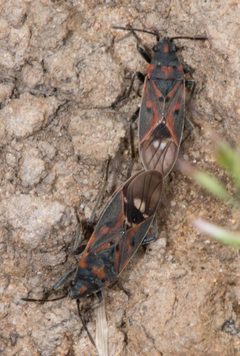
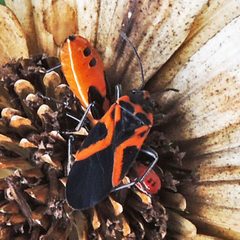
Distinguished from similar Lygaeidae by pattern: L. kalmii shows red basal spot or vertical bar on head versus Y-shaped marking in L. turcicus. L. turcicus lacks white markings on black of forewing present in L. kalmii. Separation from Oncopeltus (large milkweed bug) requires examination of size, color pattern details, and wing venation.
Images
Appearance
Small to medium-sized true bugs, typically 10-11 mm in body length. Coloration is strikingly aposematic: bright red, black, gray, and white patterns. Forewings () with membranous tips. markings vary by : L. kalmii has a red basal spot or vertical bar; L. turcicus has a Y-shaped marking. Nymphs lack fully developed wings, showing progressive wing bud development through instars.
Habitat
Associated with seed-bearing vegetation, particularly milkweeds (Asclepias spp.) for some . Found in open fields, meadows, roadsides, and urban vacant lots. L. kalmii occurs across virtually entire U.S. and adjacent southern Canada. Some species show plant specificity: L. turcicus feeds exclusively on false sunflower (Heliopsis helianthoides).
Distribution
Holarctic distribution with strong representation in North America and Europe. L. kalmii: nearly entire United States and southern Canada. L. equestris: Europe and Asia. Individual ranges vary; some have restricted distributions while others are widespread.
Seasonality
of L. kalmii overwinter and emerge on warm winter days. Activity year-round in mild climates. Peak abundance late summer and early autumn for milkweed-associated . Nymphal stages present during growing season when seeds are available.
Diet
Primarily seed-feeders. L. kalmii nymphs feed preferentially on milkweed seeds (Asclepias spp.), sequestering cardiac glycosides. are dietary : feed on nectar, seeds of composites (Asteraceae), oleander, and opportunistically scavenge dead insects. L. equestris shows ontogenetic dietary shift, preferring Cynanchum vincetoxicum seeds across all life stages with secondary use when primary host unavailable.
Host Associations
- Asclepias spp. - primary for nymphal development, source of defensive compoundsmilkweeds; cardiac glycosides sequestered by L. kalmii
- Heliopsis helianthoides - obligate exclusive for L. turcicus (false milkweed )
- Cynanchum vincetoxicum - preferred primary food plant for L. equestris across all life stages
- Nerium oleander - secondary landscape plant regularly used by L. kalmii
Life Cycle
Hemimetabolous development: → five nymphal instars → . Nymphs develop wing buds progressively, with full wings formed at adult . L. kalmii overwinters as adult in sheltered locations. resumes with warming temperatures. Females may lay hundreds of eggs; L. equestris can produce hatchable eggs on diverse diets though varies with food quality.
Behavior
L. equestris females perform 'rocking' during copulation—rhythmic dorsoventral body movements that influence copulation duration, with rocking pairs showing reduced variance in mating duration. Mating occurs in end-to-end position. L. kalmii aggregate on plants and show opportunistic scavenging on carrion. Defensive behavior: chemical renders individuals unpalatable; aposematic coloration advertises .
Ecological Role
Seed on plants, potentially influencing plant . L. equestris implicated in achene greening damage to sunflower crops. Participates in Müllerian mimicry complexes with other milkweed-feeding insects (monarch butterfly, milkweed tussock moth, Oncopeltus fasciatus) sharing cardiac glycoside defenses. Serves as host for trypanosomatid (Blastocrithidia familiaris in L. pandurus).
Human Relevance
L. equestris recognized as pest of confectionery sunflower hybrids causing achene greening. Some considered beneficial as non-pest insects that contribute to biodiversity and serve as models for chemical research. No significant medical or veterinary importance; cardiac glycosides sequestered by pose theoretical risk to vertebrates but no documented cases of poisoning.
Similar Taxa
- Oncopeltus fasciatusLarge milkweed bug—similar coloration and use but larger size (~12-16 mm), different wing pattern with broad black bands, undergoes long-distance unlike L. kalmii
- Lygaeus turcicusFalse milkweed —distinguished by Y-shaped marking, absence of white markings on forewing , exclusive association with Heliopsis helianthoides rather than milkweeds
Misconceptions
'milkweed ' for L. kalmii is misleading— are dietary , not milkweed . Only nymphs show strong milkweed association. The is not an obligate feeder on milkweed as commonly assumed.
More Details
Chemical ecology
L. kalmii sequesters cardiac glycosides in specialized compartments along and edges. These poisons provide defense against vertebrate and most predators. Research by Sean Duffey established biophysical mechanisms of in this .
Reproductive isolation
L. equestris and L. simulans show asymmetric prezygotic isolation: female L. equestris hybridizes with male L. simulans but not reciprocally. A single locus influences hybridization rate and multiple traits.
Migration behavior
Unlike Oncopeltus fasciatus which undergoes long-distance , L. kalmii is resident year-round, locally and showing minimal .
Sources and further reading
- BugGuide
- Wikipedia
- GBIF taxonomy match
- iNaturalist taxon
- NCBI Taxonomy
- Catalogue of Life
- A Unique Connection and a Living Legacy | Bug Squad
- Bugs in orange and black: A spooky Halloween trick or treat for predators - Small and large milkweed bugs, 'Lygaeus kalmii' and 'Oncopeltus fasciatus' — Bug of the Week
- Bugs in orange and black: A spooky Halloween trick for predators, Small and large milkweed bugs, Lygaeus kalmii and Oncopeltus fasciatus — Bug of the Week
- Bug Eric: Small Milkweed Bug
- Bug Eric: Beetles from Bones
- Botanizing at Creve Coeur Lake | Beetles In The Bush
- Relationship between rocking behaviour and copulation termination in Lygaeus equestris
- A CONTROVERSIAL NOTE ON SOME SPECIES OF LYGAEUS (HEMIPTERA, LYGAEIDAE)
- Distribution, Feeding Habits and Dispersal of Lygaeus equestris (Heteroptera) Larvae in Relation to Food Supply
- THE DISTRIBUTION AND FORMS OF LYGAEUS KALMII STAL, WITH REMARKS ON INSECT ZOOGEOGRAPHY (HEMIPTERA, LYGAEIDAE)
- Population Dynamics of a Seed Feeding Bug, Lygaeus Equestris. 1. Habitat Patch Structure and Spatial Dynamics
- New data on the biology of the red spotted bug (spilostethus [=lygaeus] equestris L. het, lygaeidae) causing the achene greening in confectionery sunflower hybrids
- First records of Lygaeus simulans Deckert, 1985 for Albania (Hemiptera: Heteroptera: Lygaeidae: Lygaeinae)
- Laboratory Studies on the Feeding Preference and Feeding Behaviour in Lygaeus equestris (L.) (Het. Lygaeidae)1
- Host-associated fitness trade-offs do not limit the evolution of diet breadth in the small milkweed bug Lygaeus kalmii (Hemiptera: Lygaeidae)
- Size, Life History and Responses to Food Shortage in Two Geographical Strains of a Seed Bug Lygaeus equestris
- A single pleiotropic locus influences the rate of hybridization between two sibling species of Lygaeus bugs
- Laboratory Studies on the Effects of Different Natural Foods on the Reproductive Biology of Lygaeus equestris (L.) (Het. Lygaeidae)
- Data to the Biology of the Red Spotted Bug (Spilostethus [= Lygaeus] equestris L., Het., Lygaeidae) Causing the Achene Greening of Alimentary Cross-Bred Sunflower
- Host—parasite relationships ofBlastocrithidia familiarisinLygaeus pandurusScop. (Hemiptera: Lygaeidae)
- Male Mating Behaviour Is Shaped by Previous Experience of Both Conspecific and Heterospecific Females in the Seed Bug Lygaeus Simulans.