
Oncopeltus
Stål, 1868
large milkweed bugs
Species Guides
8- Oncopeltus aulicus
- Oncopeltus cayensis(Keys Milkweed Bug)
- Oncopeltus cingulifer
- Oncopeltus fasciatus(Large Milkweed Bug)
- Oncopeltus guttaloides
- Oncopeltus sandarachatus
- Oncopeltus sanguineolentus(Blood-colored Milkweed Bug)
- Oncopeltus sexmaculatus(six-spotted milkweed bug)
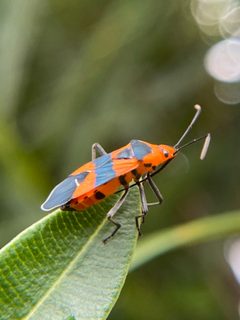
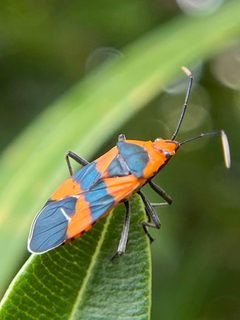
Oncopeltus is a of seed bugs in the Lygaeidae containing at least 40 described . The genus is best known for the (), a widely studied species that feeds on milkweed seeds and exhibits striking aposematic orange and black coloration. Members of this genus are specialized feeders on plants in the family Apocynaceae, particularly milkweeds (Asclepias), and have evolved the ability to sequester toxic cardiac glycosides from their plants for defense. Several species undergo between northern breeding grounds and southern areas.
Pronunciation
How to pronounce Oncopeltus: /ˈɒŋkəˌpɛltəs/
These audio files are automatically generated. While they are not always 100% accurate, they are a good starting point.
Images
Habitat
Associated with plants in the Apocynaceae, particularly the Asclepiadoideae (milkweeds). occur in where plants grow, including meadows, prairies, roadsides, and gardens. The (O. fasciatus) colonizes milkweed plants in temperate North America, clustering on developing leaves and seed .
Distribution
Widespread in the Americas, with recorded from Argentina, Brazil, Canada, Mexico, and the United States. The has been documented in Argentinian provinces including Mendoza, Misiones, and Salta, and occurs across North America from southern Canada to southern states and Mexico where overwinter.
Seasonality
Activity patterns vary by and latitude. In temperate regions, the (O. fasciatus) arrives from southern grounds in late spring and early summer, with building through summer and early autumn. Southward is triggered by shortening day length, cooling temperatures, and declining plant quality.
Diet
Phytophagous; feeds on seeds and other tissues of plants in the Apocynaceae. The inserts a long slender beak into ripening seeds within developing pods, injects digestive , and sucks liquefied nutrients through its straw-like beak. Nymphs and consume milkweed seeds.
Host Associations
- Asclepias - primary milkweeds
- Mandevilla laxa - Apocynaceae; recorded for O. unifasciatellus in Argentina
- Mandevilla pentlandiana - Apocynaceae; recorded for O. unifasciatellus in Argentina
- Oxypetalum appendiculatum - Apocynaceae; recorded for O. unifasciatellus in Argentina
- Oxypetalum balansae - Apocynaceae; recorded for O. unifasciatellus in Argentina
- Oxypetalum pannosum - Apocynaceae; recorded for O. unifasciatellus in Argentina
- Oxypetalum teyucuarense - Apocynaceae; recorded for O. unifasciatellus in Argentina
- Gomphocarpus physocarpa - Apocynaceae; recorded for O. unifasciatellus in Brazil
Life Cycle
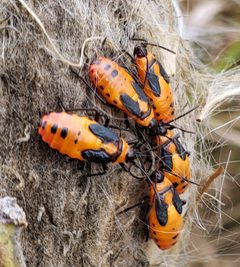
Females lay on plant surfaces. In , a single female may lay up to 2000 eggs during her lifetime. Eggs hatch into small orange and black nymphs that feed on host plant seeds. Nymphs develop through multiple instars with visible black wing buds that enlarge with each . emerge with fully formed wings. The microbiome varies across life stages, with egg stages showing the greatest bacterial diversity including expansion of Comamonadaceae.
Behavior
Exhibits migratory in temperate . activity peaks approximately 8 days after the final , with individual capable of covering 100 kilometers or more during their lifetime. Behavioral exists with distinct 'flyers' and 'non-flyers'; females show higher rates of long-duration flight than males. Virgins of both sexes appear more active in long flights than individuals with continuous contact with the opposite sex. Southward is triggered by environmental cues including shortening and declining quality, mediated by titers that suppress and promote flight.
Ecological Role
Acts as a herbivore on milkweeds and related Apocynaceae. Through of cardiac glycosides from plants, participates in Müllerian mimicry complexes with other aposematic milkweed-feeding insects including . These sequestered compounds provide chemical defense against vertebrate .
Human Relevance
Widely used as a model organism in entomological and physiological research, particularly studies of insect , hormonal regulation of , chemical , and microbiome dynamics. The is familiar to gardeners and naturalists as a conspicuous inhabitant of milkweed plants. Not considered an agricultural pest.
Similar Taxa
- Lygaeus kalmiiAlso a milkweed-feeding in Lygaeidae that sequesters cardiac glycosides; studied alongside by chemical ecologists including Sean Duffey
- Labidomera clivicollisMilkweed leaf beetle that shares orange and black aposematic coloration and milkweed association, but is a (Coleoptera) rather than true , and practices rather than sequestering cardiac glycosides
- Danaus plexippusMonarch butterfly that shares milkweed plants, orange and black warning coloration, and cardiac glycoside ; co-occurs in Müllerian mimicry ring
More Details
Model organism status
has been extensively used in research on insect physiology, reproductive endocrinology, and chemical . Studies have examined regulation of and , flight capacity and behavioral , and microbiome dynamics across life stages.
Chemical defense research
Research by chemical ecologist Sean Duffey and colleagues revealed that employs a biophysical system for sequestering cardiac glycosides from milkweeds, contributing to understanding of plant-insect chemical interactions.
Microbiome characteristics
The milkweed microbiome includes 28 core bacterial . Notably, Rhizobium is a consistent constituent despite the insect's lack of nitrogen metabolism components in its , suggesting potential nutritional . The stage exhibits the greatest bacterial diversity, with maternal-to-embryo transmission including both superficial and transovarially transmitted bacteria.
Sources and further reading
- BugGuide
- Wikipedia
- GBIF taxonomy match
- iNaturalist taxon
- NCBI Taxonomy
- Catalogue of Life
- A Unique Connection and a Living Legacy | Bug Squad
- What do insects do in winter? Migrants in the DMV: Common Buckeye, Junonia coenia, Variegated Fritillary, Euptoieta Claudia, Painted Lady, Vanessa cardui, Large Milkweed bug, Oncopeltus fasciatus — Bug of the Week
- Bugs in Orange and Black: Monarch Butterfly, Milkweed Leaf Beetle, Milkweed Bug, and Milkweed Tiger Moth — Bug of the Week
- Bugs in Orange and Black II: Large milkweed bug, Oncopeltus fasciatus — Bug of the Week
- Orange and Black II: Milkweed leaf beetle, Labidomera clivicollis; Oleander aphid, Aphis nerii; Milkweed Bug, Oncopeltus fasciatus; Monarch, Danaus plexippus — Bug of the Week
- Bugs in orange and black - Monarch butterfly, Danaus plexippus Milkweed Bug - Oncopeltus fasciatus; Milkweed tiger moth, Euchaetes egle — Bug of the Week
- The Influence of Calamus Oil and Asarone Analogues on the Reproduction of Oncopeltus fasciatus (Dallas)
- New data on Oncopeltus (Erythrischius) unifasciatellus Slater, 1964 (Hemiptera: Heteroptera: Lygaeidae) in Argentina and Brazil
- Juvenoid Stimulation of Egg Production in Oncopeltus fasciatus1 on Non-Host Diets
- Intraspecific microbiome dynamics across the life cycle of the milkweed bug Oncopeltus fasciatus
- Hormonal Regulation of Reproduction in the Milkweed Bug, Oncopeltus fasciastus (Dallas)
- Some Factors Affecting Flight Activity in Individual Milkweed Bugs (Oncopeltus)