
Nabis flavomarginatus
Scholtz, 1847
Broad Damsel Bug
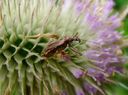
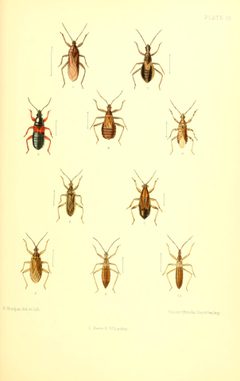
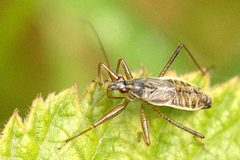
Nabis flavomarginatus is a small predatory true in the Nabidae, commonly known as the Broad . It exhibits a Holarctic distribution spanning northern Europe, Siberia, Central Asia, East Asia, and North America including Alaska, Canada, and Greenland. The inhabits wet, open grassland with high proportions of grasses, sedges, and rushes, and shows a preference for cooler microclimates compared to other Nabinae. It is an effective in agricultural and natural systems, with cicadas documented as frequent prey.
Pronunciation
How to pronounce Nabis flavomarginatus: /ˈneɪbɪs flævoʊˌmɑːrdʒɪˈneɪtəs/
These audio files are automatically generated. While they are not always 100% accurate, they are a good starting point.
Identification
Nabis flavomarginatus can be distinguished from similar damsel bugs by its association with wet, open dominated by Poaceae, Cyperaceae, and Juncaceae. Unlike many , it prefers cooler microclimatic conditions. The may be confused with other Nabis species, particularly N. flavomaculatus (note: the Wikipedia source contains apparent confusion between these names, with 'flavomaculatus' appearing in the habitat section despite the article title). Separation from other small predatory Hemiptera such as Miridae requires examination of wing venation: damsel bugs lack the '' (a pronounced notch in the forewing margin where the leathery meets the membranous tip) that characterizes plant bugs. From assassin bugs (Reduviidae), which share the short rostrum, damsel bugs are distinguished by smaller size (under 12 mm) and more slender build.
Images
Habitat
Wet, open with high proportions of grasses (Poaceae), sedges (Cyperaceae), and rushes (Juncaceae). In Western and Central Europe, occurs in boreomontane zones up to 2200 meters elevation in the Alps. The prefers microclimatic conditions with lower temperatures than most other Nabinae species. Rare in half-shady places.
Distribution
Holarctic distribution. Europe: northern and eastern regions, absent from southwest and south. Palearctic Asia: extends eastward through Siberia and Central Asia to northern China, Japan, and Korea. Nearctic: common in Alaska, Canada, and Greenland; first recorded in the continental United States (Maine) in 1989. In Greenland, occurs conspicuously in the former Viking settlement area, with speculation of early medieval introduction by Norse settlers.
Seasonality
Overwinters as . Nymphs appear from May. occur from June/July to October, with timing varying by altitude. Late in the season, only females are observed.
Diet
Non-specific prey spectrum, with cicadas documented as frequent prey corresponding to availability. of small insects in the herbaceous layer.
Life Cycle
stage overwinters. Nymphal development occurs from May, with emerging June/July through October. Altitude affects timing of adult appearance. Late-season become female-biased.
Behavior
. Capable of subduing prey larger than itself. Occurs primarily in the herbaceous layer. Attracted to artificial lights at night, possibly to prey on other insects drawn there.
Ecological Role
in wet grassland and agricultural . Economically important for biological pest control in agricultural systems.
Human Relevance
Considered economically important as a natural enemy of agricultural pests. First U.S. record in Maine in 1989 represents a range expansion of potential interest to entomologists tracking climate-related distribution changes.
Similar Taxa
- Nabis flavomaculatusSource text contains apparent nomenclatural confusion, with 'flavomaculatus' appearing in section despite article title; may represent distinct or historical synonymy requiring verification
- Other Nabis speciesShare similar and predatory habits; require preference and microclimatic associations for field identification
- Miridae (plant bugs)Similar size and general form; distinguished by presence of in forewing and plant-feeding habits versus predatory
- Reduviidae (assassin bugs)Share short rostrum and predatory habit; distinguished by larger size and more robust build