
Leptophlebia cupida
(Say, 1823)
Early Brown Spinner, Black Quill
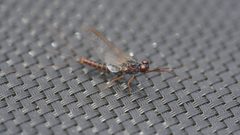
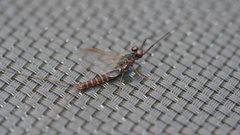
Leptophlebia cupida is a pronggilled mayfly native to North America, commonly known as the early brown spinner or black quill. The species exhibits a with during summer months. Nymphs develop through approximately 20-34 instars over 10 months, with occurring from late April to mid-May. are short-lived, non-feeding, and mate in swarms near streams.
Pronunciation
How to pronounce Leptophlebia cupida: /lɛptoʊˈfliːbiə ˈkjuːpɪdə/
These audio files are automatically generated. While they are not always 100% accurate, they are a good starting point.
Identification
Pronggilled mayfly with characteristic gill structure of Leptophlebiidae; emerge in spring (late April to mid-May), earlier than many sympatric ; males emerge slightly before females (protandry). Specific diagnostic morphological features not detailed in available sources.
Images
Habitat
Lotic freshwater environments including small streams and rivers; studied in brown-water streams of Alberta and clear-water streams in southwestern Ontario. Nymphs inhabit stream substrates during development.
Distribution
North America; documented from southwestern Ontario, Alberta, and eastern North American localities. GBIF records indicate presence across the Nearctic region.
Seasonality
occurs from late April to mid-May; nymphs present year-round with most growth occurring in late winter and spring; through summer months.
Diet
Nymphs are fine particle , ingesting approximately 96% detritus and 4% diatoms with average particle size of 38 μm. do not feed.
Life Cycle
(one per year). enter until late summer. Nymphs progress through 20-34 instars over approximately 10 months; development rate correlated with cumulative degree days (water temperature) rather than calendar days. Most growth occurs in late winter and spring. short-lived with no feeding stage.
Behavior
Mating occurs in swarms near streams. Females oviposit by dipping into water. Males exhibit protandry, emerging slightly earlier than females. Nymphs show physiological sensitivity to rapid environmental changes during spring snowmelt, experiencing cation loss prior to mortality.
Ecological Role
Nymphs function as and grazers in stream , processing fine particulate organic matter. Serves as prey for fish and other aquatic .
Human Relevance
Used as for stream health and water quality; studied for physiological responses to acidification and metal during spring snowmelt events.
Sources and further reading
- BugGuide
- Wikipedia
- GBIF taxonomy match
- iNaturalist taxon
- NCBI Taxonomy
- Catalogue of Life
- Biology of the mayfly Leptophlebia cupida (Say) (Ephemeroptera: Leptophlebiidae)
- Factors Affecting Survival and Cation Concentration in the Blackflies Prosimulium fuscum/mixtum and the Mayfly Leptophlebia cupida during Spring Snowmelt