
Leptophlebia
Westwood, 1840
Early brown spinner, Sepia dun, Claret dun
Species Guides
4- Leptophlebia cupida(Early Brown Spinner)
- Leptophlebia intermedia
- Leptophlebia nebulosa(prong-gilled mayfly)
- Leptophlebia pacifica
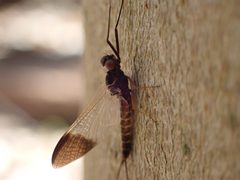
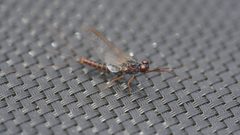
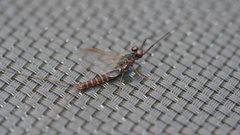
Leptophlebia is a of mayflies in the Leptophlebiidae, comprising approximately 11 described distributed across the Northern Hemisphere. Nymphs are primarily that inhabit lentic waters, slow-flowing streams, and floodplain wetlands, with documented movements between river channels and temporary wetland . Several species, including L. vespertina and L. cupida, have been studied as model organisms for understanding plasticity, acid , and river-floodplain connectivity in freshwater .
Pronunciation
How to pronounce Leptophlebia: //ˌlɛptoʊˈfliːbiə//
These audio files are automatically generated. While they are not always 100% accurate, they are a good starting point.
Identification
Distinguished from other leptophlebiid by combination of nymphal gill structure and wing venation; -level identification requires examination of genitalia and detailed wing characteristics. L. vespertina and L. marginata can be separated by size (L. marginata larger) and timing (L. marginata emerges earlier) when sympatric. L. cupida identifiable by association with brown-water streams and distinctive early-season emergence.
Images
Habitat
Lentic waters including lakes and ponds with phreatic groundwater supply; slow-flowing streams and river margins; temporary floodplain wetlands during winter and spring. Nymphs colonize with fine sediments, detrital accumulations, and submerged vegetation. Some exhibit seasonal habitat shifting between main river channels and floodplain wetlands.
Distribution
Holarctic distribution with records from North America (including Vermont, Alberta, and southeastern USA), Europe (UK, France, Scandinavia, Central Europe), and Asia (China). Specific documented localities include: Lake Conzieu and Rhône/Ain river channels (France); Llyn Dinas (North Wales); Bigoray River (Alberta, Canada); Credit River (Ontario, Canada); Heizhuchong stream (Hubei, China); various lakes and streams in Denmark, Norway, and Sweden.
Seasonality
with -specific periods. L. vespertina: emergence in early May (France), continuing growth through winter with retardation in mid-summer. L. marginata: emerges earlier than L. vespertina in sympatric . L. cupida: early-season emergence ('early brown spinner'). Seasonal use includes winter-spring residence in floodplain wetlands with return to river channels.
Diet
Life Cycle
with continuous growth throughout winter. Nymphal development temperature-dependent: rate of progression correlated with cumulative degree days rather than calendar days. L. cupida has approximately 34 nymphal instars at 20°C in laboratory conditions, though no fixed final instar exists— can occur across several instars given appropriate environmental cues. determined directly in laboratory for L. vespertina. with short lifespan.
Behavior
Nymphs exhibit active movements against water flow and dramatic drift events between river channels and floodplain wetlands following flooding (documented drift rates up to 47,600 individuals/trap/hour). Nymphs tolerate short-term drying (up to 12 days documented). between habitats entails costs including daylight movement against flows with elevated risk. Suboptimal performance at southern range limits suggested for some .
Ecological Role
Important in freshwater , processing fine particulate organic matter. Serves as bioindicator for lentic or slowly flowing with phreatic water supply (L. vespertina specifically). Contributes to river-floodplain nutrient and energy transfer through seasonal habitat shifting. Prey item for fish and amphibian ; nymphs in floodplain wetlands exploit largely fishless habitats.
Human Relevance
Used as model organism in studies of acidification effects on freshwater ; L. vespertina demonstrated acid with affected by indirect ecological feedbacks rather than direct stress. Important for understanding climate change impacts on aquatic insects through temperature-size rule documentation. Supports fly-fishing interest through of 'dun' forms (claret dun, sepia dun, early brown spinner).
Similar Taxa
- SiphlonurusCo-occurs in floodplain and exhibits similar seasonal habitat shifting ; distinguished by different nymphal and characteristics.
- EphoronRelated burrowing with different microhabitat use (tubular burrows in silt associated with stones in rapids); nymphal and distinct from Leptophlebia.
- EphemeraCo-occurs in some (e.g., Chinese streams) but typically larger with different burrowing and cycle timing; distinguished by nymphal gill structure and size.
More Details
Acid Tolerance Research
L. vespertina has been extensively studied as an acid-tolerant . Research in Central European lakes demonstrated that environmental stressors affect reproductive output indirectly through -dependent effects and food quality rather than direct physiological stress, with denser in more acidic sites but individuals smaller with lower .
River-Floodplain Connectivity
Research in southeastern USA documented massive nymphal movements between rivers and floodplains, with higher growth rates in floodplain despite few apparent environmental advantages. This challenges assumptions about habitat quality and suggests evolutionary or -avoidance explanations for the .
Temperature-Size Rule
L. vespertina demonstrates the temperature-size rule, with larvae from colder sites being larger, indicating important role of thermal regime in determining body size and subsequent reproductive output.
Sources and further reading
- BugGuide
- Wikipedia
- GBIF taxonomy match
- iNaturalist taxon
- NCBI Taxonomy
- Catalogue of Life
- Some Aspects of the Ecology of Leptophlebia Vespertina (L.) (Ephemeroptera: Leptophlebiidae)
- Biology of the mayfly Leptophlebia cupida (Say) (Ephemeroptera: Leptophlebiidae)
- LIFE HISTORY NOTES ON EPHORON, POTAMANTHUS, LEPTOPHLEBIA AND BLASTURUS WITH DESCRIPTIONS (EPHEMEROPTERA)
- The distribution, life cycle and production of Leptophlebia vespertina (L.) (Ephemeroptera) in a lowland lake
- Benefits and costs ofLeptophlebia(Ephemeroptera) mayfly movements between river channels and floodplain wetlands
- Environmental stressors alter multiple determinants of individual reproductive output in the acid‐tolerant mayfly Leptophlebia vespertina
- The life cycles of Leptophlebia vespertina (L.) and L. marginata (L.) (Ephemeroptera) in Llyn Dinas, North Wales
- Life cycle and secondary production of two mayflies Leptophlebia sp. and Ephemera sp. in Heizhuchong stream, Hubei, China
- Factors Affecting Survival and Cation Concentration in the Blackflies Prosimulium fuscum/mixtum and the Mayfly Leptophlebia cupida during Spring Snowmelt