
Salpingogaster
Schiner, 1868
Species Guides
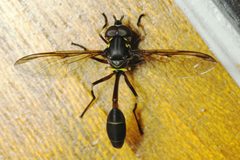
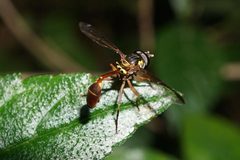
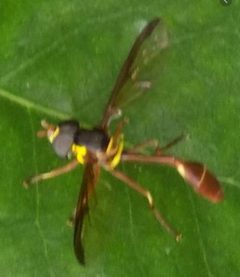
1- Salpingogaster punctifrons(Rusty-tailed Spittlebug-killer)
Salpingogaster is a of hoverflies ( Syrphidae) containing at least 30 described . At least one species, S. nigra, has been documented as a of froghopper nymphs (Hemiptera: Cercopidae) in pasture . The genus belongs to the tribe Syrphini within the Syrphinae.
Pronunciation
How to pronounce Salpingogaster: /sælˌpɪŋɡoʊˈɡæstər/
These audio files are automatically generated. While they are not always 100% accurate, they are a good starting point.
Identification
Members of Salpingogaster can be distinguished from other Syrphini by the combination of an elongated, somewhat constricted and characteristic wing venation patterns typical of the tribe. -level identification requires examination of male genitalia and facial . The superficially resembles some Bacchini but lacks the distinctive facial found in that tribe.
Images
Habitat
Pasture and grassland environments have been documented for S. nigra; preferences for other remain insufficiently studied.
Distribution
The occurs in the Neotropical region. S. nigra has been recorded from Colombia. Full distributional data for the genus is incomplete.
Diet
S. nigra is a of froghopper nymphs (Aeneolamia varia and Zulia pubescens). Dietary habits of other Salpingogaster are unknown.
Host Associations
- Aeneolamia varia - -preyfroghopper nymphs consumed by S. nigra larvae
- Zulia pubescens - -preyfroghopper nymphs consumed by S. nigra larvae
Life Cycle
For S. nigra: total development from to averages 27.4 days at 27°C (egg: 2.7 days; larva: 9.7 days across three instars; pupa: 9.7 days; adult: 5.3 days). Larvae consume 14–20 nymphs during development. data for other is unavailable.
Behavior
S. nigra larvae are active of froghopper nymphs. have been observed responding to olfactory cues from plants or prey, though specific behavioral details remain limited.
Ecological Role
S. nigra functions as a agent of pasture pest froghoppers. The ecological roles of other Salpingogaster are undocumented.
Human Relevance
S. nigra has been investigated as a natural enemy for management of froghopper pests in tropical pastures. No other documented human interactions.
Similar Taxa
- BacchaBoth have elongated , but Baccha possesses a prominent facial absent in Salpingogaster.
- SphaerophoriaSimilar slender body form, but Sphaerophoria typically show more pronounced in length and lack the constricted abdominal appearance of Salpingogaster.
- MeliscaevaOverlaps in general Syrphini ; Meliscaeva often display distinct thoracic color patterns and different male genitalia structure.
More Details
Research limitations
Most biological knowledge derives from a single (S. nigra) studied in Colombian pastures. The remaining ~29 species lack published biological data.
Taxonomic history
The was established by Schiner in 1868. -level has received limited modern revision.