
Salpingogaster punctifrons
Curran, 1929
Rusty-tailed Spittlebug-killer
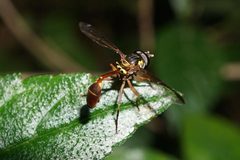
Salpingogaster punctifrons is a rare and elusive syrphid fly known from limited observations in Florida. The exhibits of mud dauber , with distinctive elongated abdominal that sets it apart from typical hoverflies. Its references predatory toward spittlebug nymphs.
Pronunciation
How to pronounce Salpingogaster punctifrons: //ˌsæl.pɪŋ.ɡoʊˈɡæs.tər ˌpʌŋk.tɪˈfrɒnz//
These audio files are automatically generated. While they are not always 100% accurate, they are a good starting point.
Identification
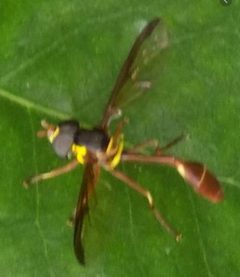
Distinguished from other hoverflies by the elongated first abdominal tergite, which produces a narrow-waisted profile similar to mud dauber (Sphecidae). Most syrphid flies have a more compact, rounded . The red, black, and yellow color pattern combined with this unusual body shape should separate it from other Florida syrphids. Observations are scarce, making field identification challenging.
Images
Appearance
Medium-sized fly with red, black, and yellow coloration. The first abdominal tergite is notably elongated, a departure from the compact abdominal structure typical of most hoverflies. This elongation creates a -waisted appearance resembling that of sphecid wasps. Wing venation and other structural features consistent with Syrphidae.
Habitat
Found in subtropical environments of South and Central Florida. Specific microhabitat preferences are poorly documented due to limited encounter rates.
Distribution
to Florida, USA, with records restricted to South and Central Florida. No confirmed records from other states or countries.
Diet
Larvae are predatory on spittlebug nymphs (Cercopoidea). feeding habits are unknown but likely include nectar and pollen like other syrphid flies.
Host Associations
- Spittlebugs (Cercopoidea) - preyLarval food source; specific not documented
Life Cycle
Complete with , larva, pupa, and stages. Larvae are ground-dwelling or found in vegetation where they hunt spittlebug nymphs. Detailed is undocumented.
Behavior
are rarely encountered, suggesting either genuinely low abundance, cryptic habits, or activity patterns that avoid human observation. The -mimicking likely provides protection from .
Ecological Role
Larval on spittlebugs may contribute to of these sap-feeding insects. pollination services are presumed but unquantified.
Human Relevance
No documented economic or medical importance. Of interest to dipterists due to rarity and distinctive . The 'Rusty-tailed Spittlebug-killer' suggests potential value in contexts, though this has not been formally evaluated.
Similar Taxa
- Mud dauber wasps (Sphecidae, e.g., Trypoxylon, Sceliphron)Convergent elongation of first abdominal tergite creates nearly identical body profile; distinguished by single pair of wings, , and other dipteran features
- Other Syrphidae (most genera)Typical hoverflies have compact, rounded without the elongated petiole-like first tergite
- Other Salpingogaster species-level characters shared; specific distinction requires examination of punctation patterns on and other fine morphological details
More Details
Taxonomic history
Described by Charles Howard Curran in 1929. The Salpingogaster is small and morphologically distinctive within Syrphinae.
Conservation status
Not formally assessed. Extremely limited observation record (38 iNaturalist observations as of source date) suggests either genuine rarity or difficulty of detection.