
Sphaerophoria
Le Peletier & Audinet-Serville, 1828
globetails
Species Guides
5- Sphaerophoria contigua(Tufted Globetail)
- Sphaerophoria novaeangliae(Black-striped Globetail)
- Sphaerophoria philanthus(Black-footed Globetail)
- Sphaerophoria pyrrhina(Violaceous Globetail)
- Sphaerophoria sulphuripes(Forked Globetail)
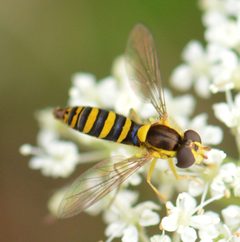
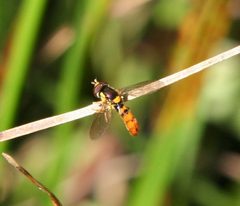
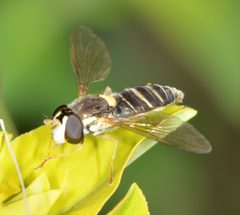
A of hoverflies (Syrphidae) with over 70 described worldwide. are slender, 5.6–12 mm long, with bright yellow markings on the and . Males possess disproportionately large, hemispherical terminalia that inspired the 'globetails.' The genus is common in North America, Europe, Asia, and Australia.
Pronunciation
How to pronounce Sphaerophoria: /ˌsfɛroʊˈfoʊriə/
These audio files are automatically generated. While they are not always 100% accurate, they are a good starting point.
Identification
Males have a yellow (rarely with black spots above ) and extremely large, hemispherical terminalia. Females have a black stripe on the frons. The is usually yellow with black markings and bears a prominent that recedes only slightly to the lower facial margin. are bare. The is black with a wide yellow stripe that either terminates at the transverse or extends to the scutellum. are black with bright yellow patterns. The anepisternum is bare. Upper and lower katepisternal hair patches are distinct; the upper patch extends ventrally in a triangular shape about three-quarters of the distance to the lower margin. Meron and metapleuron are hairless; metasternum has some hair. Small bare areas occur on the basal one-third of the wing . Male is slender, unmargined, parallel-sided or slightly constricted near the middle, with the fifth segment on the right side bearing a bluntly rounded extension. Female abdomen is parallel or slightly widened in the middle. Male genitalia: epandrium very large, almost as wide as segment 5, slightly longer than wide, posterior slightly wider; usually enclosed in sclerotized epandrial layer; surstylus divided into three lobes with lobe swollen at top, round, with thick mass of long coarse yellow hairs, and lobe flattened, sometimes elongate, often split at tip.
Images
Distribution
Worldwide; common in North America, Europe, Asia, and Australia. Distribution records include Denmark, Norway, Sweden, and Vermont (USA).
Diet
Larvae are aphidophagous when known. feed on pollen, nectar, and honeydew; females require pollen for ovarian maturation.
Behavior
hover over flowers before landing. Both sexes mate multiple times with copulation lasting 3–8 minutes. Females lay 1–3 per colony in nature, typically on the undersides of leaves or buds with aphids; oviposition takes approximately 3–5 seconds per egg.
Ecological Role
Larvae are important natural of aphids. A single larva may consume 100–400 aphids before , though this varies with relative sizes of predator and prey. contribute to pollination while foraging for nectar and pollen.
Human Relevance
Recognized as agents for pests in agricultural systems. Sphaerophoria macrogaster has been studied specifically for of Myzus persicae (green peach aphid) in tobacco production.
Similar Taxa
- ScaevaBoth are yellow-and-black striped syrphid flies, but Scaeva has distinct facial markings and lacks the male's enlarged terminalia characteristic of Sphaerophoria.
- EupeodesSimilar color pattern and aphidophagous larvae, but Eupeodes males lack the hemispherical terminalia and have different abdominal shape.
- SyrphusBoth have yellow and black abdominal stripes, but Syrphus has different thoracic patterning and male genitalia structure.
Sources and further reading
- BugGuide
- Wikipedia
- GBIF taxonomy match
- iNaturalist taxon
- NCBI Taxonomy
- Catalogue of Life
- The Girl and the Bubble | Bug Squad
- It's Friday Fly Day! | Bug Squad
- It's Friday Fly Day! | Bug Squad
- STUDIES ON THE BIOLOGY OF SPHAEROPHORIA SCRIPTA L. (DIPTERA., SYRPHIDAE)
- Temperature-dependent development, predation, and life table of Sphaerophoria macrogaster (Thomson) (Diptera: Syrphidae) feeding on Myzus persicae (Sulzer) (Homoptera: Aphididae).