
Scaeva
Fabricius, 1805
Species Guides
2- Scaeva affinis(White-bowed Smoothwing)
- Scaeva selenitica(Yellow-bowed Smoothwing)
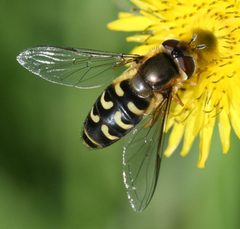
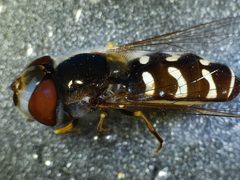
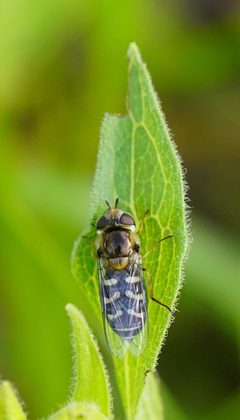
Scaeva is a of hoverflies ( Syrphidae) comprising approximately seven described distributed across the Palaearctic region. The genus has been subject to taxonomic revision alongside related genera Simosyrphus and Ischiodon. are , while larvae are predominantly aphidophagous . Scaeva pyrastri has been extensively studied for its potential against agricultural pests.
Pronunciation
How to pronounce Scaeva: //ˈskee.və//
These audio files are automatically generated. While they are not always 100% accurate, they are a good starting point.
Identification
Images
Habitat
Orchard including litchi and guava; agricultural and natural environments supporting . Scaeva latimaculata has been recorded from litchi orchards in the Shivalik Hills, Himachal Pradesh, India.
Distribution
Palaearctic region broadly; specific records include Denmark, Norway, Sweden, and the Shivalik Hills of Himachal Pradesh, India. Distribution records from GBIF indicate presence in Scandinavia.
Diet
Larvae are aphidophagous; Scaeva pyrastri larvae feed on cabbage aphid (Brevicoryne brassicae). feed on nectar and pollen; Scaeva pyrastri adults have been observed consuming honeydew.
Host Associations
- Brevicoryne brassicae - preycabbage aphid; primary prey for S. pyrastri larvae in laboratory studies
Life Cycle
For Scaeva pyrastri: total larval development 8.31 days; pre- stage 19.82 ± 0.25 days; adult female longevity 18.57 ± 0.37 days, male longevity 15.50 ± 0.17 days; pre-ovipositional period 4.25 ± 0.25 days, ovipositional period 8.50 ± 0.46 days, post-ovipositional period 3.25 ± 0.31 days; true time 28.86 ± 0.28 days; mean female 37.75 ± 1.16 . These parameters are derived from laboratory rearing on Brevicoryne brassicae.
Behavior
hover before landing on flowers. Scaeva pyrastri adults have been observed landing on lady beetles (Harmonia axyridis) to feed on honeydew accumulated on the 's from feeding. Larvae are active of aphids.
Ecological Role
Larvae function as agents of ; serve as of various crops. In orchard , syrphids including Scaeva contribute to pollination services during bloom periods.
Human Relevance
Scaeva pyrastri has been evaluated for of cabbage aphid in agricultural systems. contribute to crop pollination. The is not known to be a pest or .
Similar Taxa
- SimosyrphusClosely related ; taxonomic boundaries between Scaeva and Simosyrphus have been discussed by Láska et al. (2006)
- IschiodonClosely related ; included in taxonomic revision alongside Scaeva by Láska et al. (2006)
- EristalisBoth are hoverfly in Eristalinae versus Syrphinae; Eristalini members dominated litchi orchards while Syrphini (including Scaeva) showed different distribution patterns in comparative studies
More Details
Taxonomic note
The of Scaeva and related Simosyrphus and Ischiodon was revised by Láska et al. (2006), clarifying relationships within Syrphini.
Research context
Most detailed biological information available for the derives from laboratory studies of Scaeva pyrastri; field efficacy and natural history of other remain poorly documented.
Sources and further reading
- BugGuide
- Wikipedia
- GBIF taxonomy match
- iNaturalist taxon
- NCBI Taxonomy
- Catalogue of Life
- The Year 2017: 'Survival of the Flittest' | Bug Squad
- The Lady Beetle and the Syrphid Fly | Bug Squad
- It's Friday Fly Day! | Bug Squad
- Faunal Diversity and Abundance of Syrphids in Litchi and Guava Ecosystems, Including a New Record of Scaeva latimaculata (Brunetti, 1923) from the Shivalik Hills, Himachal Pradesh, India
- Biology, predatory potential and growth parameters of the syrphid fly, Scaeva pyrastri (L.) (Diptera: Syrphidae) feeding on the cabbage aphid, Brevicoryne brassicae (L.)
- <b>A record of Blue Posy <I>Drupadia scaeva cyara</I> (Hewitson, 1878) (Lycaenidae: Theclinae: Theclini) from Dibang Valley, Arunachal Pradesh, India</b>
- Molecular Characterization and Sex Distribution of Chemosensory Receptor Gene Family Based on Transcriptome Analysis of Scaeva pyrastri