
Scaeva selenitica
(Meigen, 1822)
Yellow-bowed Smoothwing
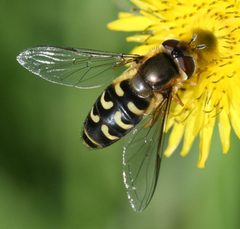
Scaeva selenitica is a large hoverfly in the Syrphidae, recognized by its distinctive yellow abdominal markings. are common flower visitors that feed on nectar and pollen, while larvae are on aphids. The species occurs across Europe, the eastern Palearctic, the Near East, and North Africa, inhabiting meadows and hedgerows.
Pronunciation
How to pronounce Scaeva selenitica: /ˈskiːvə sɪˈlɛnɪtɪkə/
These audio files are automatically generated. While they are not always 100% accurate, they are a good starting point.
Identification
Distinguished from the similar Scaeva pyrastri by its larger, yellow abdominal lunules; S. pyrastri has smaller, white markings. The yellowish-green scutellum and overall large size are additional field marks.
Images
Appearance
Large hoverfly measuring 12–15 mm in body length with wing length of 10.5–12 mm. is shiny black with sparse, fine light hair. Scutellum is yellowish-green. is dark black with three pairs of yellow comma-shaped markings (lunules). Legs are light brown-yellow in the middle, with darker femurs and feet.
Habitat
Meadows and hedgerows.
Distribution
Present in most of Europe, the eastern , the Near East, and North Africa.
Diet
feed on nectar and pollen of Asteraceae, Crataegus , Heracleum sphondylium, Rumex acetosa, Rumex obtusifolius, Stellaria holostea, Salix caprea, and Salix cinerea. Larvae feed on aphids.
Ecological Role
function as through flower visitation. Larvae serve as agents of .
Human Relevance
Larvae contribute to natural suppression in agricultural and garden settings. are common in meadows and hedgerows.
Similar Taxa
- Scaeva pyrastriDiffers in having smaller, white abdominal lunules rather than larger yellow ones.