
Scaeva affinis
Say, 1823
White-bowed Smoothwing
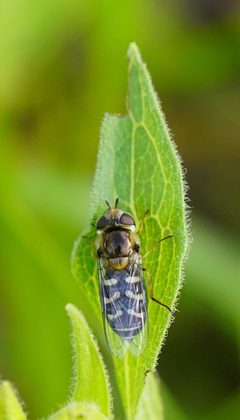
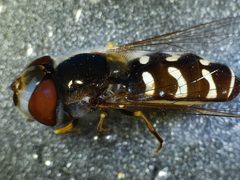
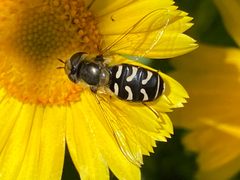
Scaeva affinis is a hoverfly native to western North America and the only Scaeva species regularly encountered in the . The species was first described by Thomas Say in 1823 from Arkansas specimens. It is believed to be migratory and is common in the western United States but rare in the east. The larval stage is a voracious of aphids.
Pronunciation
How to pronounce Scaeva affinis: /ˈsiːvə əˈfɪnɪs/
These audio files are automatically generated. While they are not always 100% accurate, they are a good starting point.
Identification
This is the only Scaeva likely to be encountered in the , making it distinguishable from other Scaeva species which are primarily Palearctic. The species was historically confused with Scaeva pyrastri but has been determined to be distinct.
Images
Distribution
Western North America. Common in the western United States, rare in the eastern United States. The is believed to be migratory.
Diet
Larvae feed voraciously on aphids.
Behavior
Believed to be migratory.
Ecological Role
Larval contributes to of aphid .
Similar Taxa
- Scaeva pyrastriHistorically combined with and then split from S. affinis; distinguished by geographic distribution (S. pyrastri is primarily Palearctic)
More Details
Taxonomic History
Originally described by Thomas Say in 1823 as ' black with three yellow lunules on each side...inhabits Arkansa.' Later combined with Scaeva pyrastri, then determined to be a distinct and split back off.
Sources and further reading
- BugGuide
- Wikipedia
- GBIF taxonomy match
- iNaturalist taxon
- NCBI Taxonomy
- Catalogue of Life
- The Year 2017: 'Survival of the Flittest' | Bug Squad
- Meet 'Mantis Master Keeper' Andrew Pfeifer | Bug Squad
- Saving the Rusty-Patched Bumble Bee | Bug Squad
- Take 2 on tropical tiger moths: Spotted oleander caterpillar moth, Empyreuma affinis — Bug of the Week
- Mason bees in peril when parasitic wasps arrive – Leucospid wasp, Leucospis affinis — Bug of the Week
- A Tick that Feeds on Birds May Increase the Range of Lyme Disease