
Sphaerophoria novaeangliae
Johnson, 1916
Black-striped Globetail
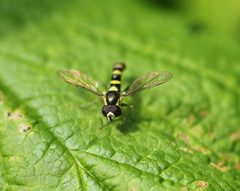
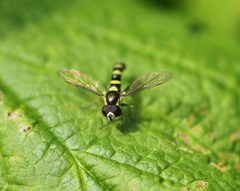
Sphaerophoria novaeangliae is a of syrphid fly, commonly known as the Black-striped Globetail. It belongs to a whose members are frequently observed hovering near flowers and are often mistaken for bees or due to their yellow and black coloration. The species was described by Johnson in 1916. As with other Sphaerophoria species, are that visit flowers for nectar and pollen.
Pronunciation
How to pronounce Sphaerophoria novaeangliae: /sfɛroʊˈfɔːriə noʊviːæŋˈɡliːiː/
These audio files are automatically generated. While they are not always 100% accurate, they are a good starting point.
Identification
Distinguished from bees by having only one pair of wings (hindwings reduced to ), large , and short . Separated from by the absence of a narrow petiole (wasp waist). Within Sphaerophoria, -level identification requires examination of male genitalia and subtle abdominal pattern differences; S. novaeangliae specifically has been noted for its black-striped appearance. The hover —stationary before landing—is characteristic of the .
Images
Appearance
have the characteristic syrphid body plan: large that nearly meet at the top of the , short with three segments, and a single pair of wings (a defining dipteran trait). The is typically elongated with yellow and black striping. The specific epithet "novaeangliae" suggests association with New England, though detailed -level morphological descriptions are limited in available sources. The name "Sphaerophoria" (meaning "globe-bearing") refers to the rounded male terminalia.
Habitat
Associated with flowering vegetation in open . Based on -level patterns, likely found in meadows, gardens, and disturbed areas with abundant floral resources.
Distribution
The specific epithet and suggest primary occurrence in New England and northeastern North America. GBIF records indicate observations across this region, though precise range boundaries require further documentation.
Seasonality
activity coincides with peak flowering periods. Based on regional climate patterns in northeastern North America, likely active from late spring through early autumn.
Diet
feed on nectar and pollen from flowers. Larval diet unknown for this , though larvae of related Sphaerophoria species are on aphids.
Life Cycle
Complete with , larva, pupa, and stages. Eggs are oval and white. Larval specifically for S. novaeangliae has not been documented; related have aphidophagous larvae.
Behavior
exhibit characteristic hovering before landing on flowers. Observations of related Sphaerophoria indicate adults may consume pollen visible through the semi-translucent abdominal wall, appearing yellow or orange.
Ecological Role
function as . Larval on aphids, if confirmed, would contribute to of pest insects.
Human Relevance
Potential value as in gardens and agricultural settings. No documented negative impacts.
Similar Taxa
- Sphaerophoria philanthusShares and general appearance; distinguished by subtle differences in abdominal striping and male genitalia structure
- Other Sphaerophoria speciesRequire microscopic examination for definitive separation; many have overlapping color patterns
- Honey bees (Apis mellifera)Frequently mistaken due to similar coloration; bees have two wing pairs, longer , and do not hover
- Scaeva pyrastriAnother syrphid with similar flower-visiting ; distinguished by different abdominal markings and pattern
Misconceptions
Commonly mistaken for bees or due to yellow-black aposematic coloration. This mimicry is protective but leads to misidentification by observers.
More Details
Taxonomic Status
Catalogue of Life lists this as a synonym, though GBIF and NCBI recognize it as accepted. Taxonomic resolution may require further revision.
Observation Frequency
iNaturalist records 45 observations, indicating it is documented but not commonly encountered relative to more widespread syrphid .