
Parasyrphus
Matsumura, 1917
Bristleside Flies
Species Guides
5- Parasyrphus currani(Curran's Bristleside)
- Parasyrphus genualis(Common Bristleside)
- Parasyrphus relictus
- Parasyrphus semiinterruptus(Emarginate Bristleside)
- Parasyrphus tarsatus(Holarctic Bristleside)
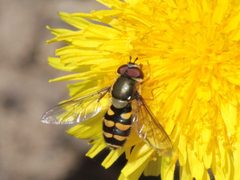
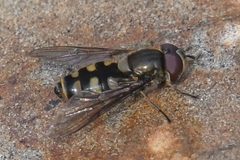
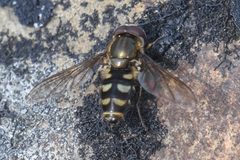
Parasyrphus is a of hoverflies (Syrphidae) comprising 31 described distributed across the Holarctic region. are small to medium-sized (5.6–11 mm) with characteristic yellow abdominal markings. The genus exhibits notable larval trophic diversity: most known larvae are on trees, while at least two species (P. nigritarsis and P. melanderi) are predators of leaf beetle and larvae. This dietary specialization is unusual among syrphid flies and involves sophisticated chemical where predators exploit prey defensive secretions as foraging cues.
Pronunciation
How to pronounce Parasyrphus: /ˌpærəˈsɪrfəs/
These audio files are automatically generated. While they are not always 100% accurate, they are a good starting point.
Identification
Distinguished from other Syrphidae by: oval lacking marginal constriction (weakly marginate only in P. nigritarsis); hind with tufts of strong posteromedial hairs; anepisternum bearing erect hairs; with prominent . Yellow abdominal patterning (spots or bands on segments 2–4) is typical but variable. Separated from similar by the combination of sternal hair patch configuration and coxal hair tufts. -level identification requires regional keys; European species keyed in Speight (2023).
Images
Habitat
Associated with woody vegetation including willow-dominated systems. Larval vary by : arboreal environments for -feeding species; leaf beetle plants (Salix spp. for P. melanderi) for .
Distribution
Holarctic distribution, including northern regions. Documented from Denmark, Norway, Sweden (GBIF records). Specific range varies by : P. tarsatus occurs in very northern areas.
Diet
Larvae exhibit two distinct feeding strategies: (1) on tree-dwelling aphids (most known ); (2) predation on leaf beetle and larvae (P. nigritarsis and P. melanderi confirmed). P. melanderi feeds on Chrysomela aeneicollis (Coleoptera: Chrysomelidae). P. nigritarsis feeds on Phratora vitellinae and Linaeidea aenea. diet unknown.
Host Associations
- Chrysomela aeneicollis - preywillow leaf beetle; and larvae consumed by P. melanderi
- Phratora vitellinae - preyleaf beetle on willows; prey of P. nigritarsis
- Linaeidea aenea - preyalder-feeding leaf beetle; prey of P. nigritarsis
- Salix orestera - indirecthigh-salicylate willow; associated with higher P. melanderi abundance
- Salix geyeriana - indirectmedium-salicylate willow; associated with lower P. melanderi abundance
- Salix lutea - indirectsalicylate-poor willow; prey beetles on this produce no defensive secretion
Life Cycle
laid on or near prey resources: P. melanderi deposits eggs on Chrysomela aeneicollis egg clutches. Larval development proceeds through consumption of eggs and/or larvae of prey . Detailed and data not documented for most species.
Behavior
predatory exhibit sophisticated foraging . P. nigritarsis larvae are attracted to volatile defensive secretions of prey leaf beetles, including pure salicyl aldehyde (main component of Phratora vitellinae secretion). Larvae search extensively on -damaged leaves and follow trails of prey larval fecal matter. P. melanderi larvae feed equally rapidly on chemically defended and undefended prey, showing no deterrence by -plant-derived defensive compounds that repel .
Ecological Role
in arboreal and herbaceous systems. Mediates tri-trophic interactions between plants, herbivorous insects, and predators. P. melanderi and P. nigritarsis function as predators capable of exploiting chemically defended prey that deter predators, potentially regulating leaf beetle . potential in willow systems.
Similar Taxa
- Other Syrphus-group generaShare general hoverfly ; distinguished by abdominal margin shape, coxal hair tufts, and sternal hair patch configuration
- Generalist syrphid predatorsParasyrphus differ in specialized exploitation of chemically defended prey and specific attraction to prey defensive secretions
Sources and further reading
- BugGuide
- Wikipedia
- GBIF taxonomy match
- iNaturalist taxon
- NCBI Taxonomy
- Catalogue of Life
- Defensive larval secretions of leaf beetles attract a specialist predator Parasyrphus nigritarsis
- Host‐plant effects on Parasyrphus melanderi (Diptera: Syrphidae) feeding on a willow leaf beetle Chrysomela aeneicollis (Coleoptera: Chrysomelidae)