
Phratora
Chevrolat in Dejean, 1836
Species Guides
4- Phratora americana
- Phratora hudsonia(birch leaf beetle)
- Phratora interstitialis
- Phratora purpurea(aspen skeletonizer)
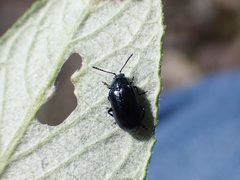
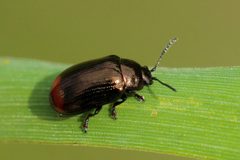
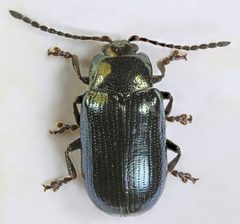
Phratora is a of leaf beetles (Chrysomelidae) distributed across the Northern Hemisphere in cool, moist regions where their plants occur. The genus is synonymous with Phyllodecta. in this genus feed primarily on willows (Salix), poplars (Populus), or birch (Betula), with host plant associations showing evolutionary conservation—closely related species tend to feed on closely related plant species. European species are difficult to distinguish by external alone and require examination of female genitalia for reliable identification. Several species, particularly Phratora vulgatissima, are economically significant pests of short- coppice willow plantations.
Pronunciation
How to pronounce Phratora: //frəˈtɔːrə//
These audio files are automatically generated. While they are not always 100% accurate, they are a good starting point.
Identification
European are morphologically similar in size and body form with overlapping metallic coloration; reliable identification requires dissection and examination of female genitalia. The is synonymous with Phyllodecta, and some literature may use either name. Species-level identification in North America may require reference to regional keys and plant association.
Images
Habitat
Cool, moist environments where plants thrive, including forested areas, riparian zones, and short- coppice plantations. overwinter in crevices and under bark of host or adjacent woody plants.
Distribution
Northern Hemisphere: Northern and Southern Europe, China, Japan, Canada, and the United States. Specific distribution varies by ; Phratora vulgatissima is the most serious pest of willow in Britain and occurs across much of the 's range.
Seasonality
Development from first larval instar to approximately 6 weeks; pupal stage approximately 2 weeks. Adults overwinter and become active in spring. Timing varies with latitude and local climate.
Diet
Herbivorous; larvae and feed on foliage of plants. Specific host associations vary by : willows (Salix) for Phratora americana, P. frosti, P. interstitialis, P. tibialis, P. vitellinae, P. vulgatissima, P. polaris, and P. purpurea; poplars (Populus) for P. laticollis, P. atrovirens, P. vitellinae, and P. purpurea; birch (Betula) for P. polaris in Lapland and P. hudsonia.
Host Associations
- Salix - primary willows; main for most
- Populus - primary poplars; for several
- Betula - primary birch; for P. hudsonia and P. polaris in Lapland
Life Cycle
, larva, pupa, complete . Eggs laid on foliage. Larvae feed externally on leaves, producing defensive secretions. occurs in soil or leaf litter. Adults emerge, feed, and overwinter in protected locations such as bark crevices. Development time from first larval instar to adult approximately 6 weeks under favorable conditions.
Behavior
occur in mobile and show feeding preferences among varieties. Larvae produce defensive secretions that repel natural enemies and conspecifics; secretion chemistry varies with host plant chemistry. Adults are attracted to plants with damage and presence, responding to volatile chemical cues including benzaldehyde and green leaf volatiles that increase with feeding damage.
Ecological Role
Herbivore and defoliator of woody plants in the Salicaceae and Betulaceae. Serves as prey for various natural enemies including predatory (Anthocoris nemorum, Rhacognathus punctatus, Orthotylus marginalis), syrphid flies (Parasyrphus nigritarsis), and (Symmorphus bifasciatus). Larval defensive secretions may contribute to chemical defense guilds in willow systems.
Human Relevance
Phratora vulgatissima is the most serious defoliating pest of short- coppice willow grown for in Britain and Ireland, capable of causing severe damage when build up. Some willow and poplar show resistance or , forming a basis for through varietal mixtures. Other occasionally reach pest status in willow plantations.
Similar Taxa
- ChrysomelaSimilar leaf beetle in Chrysomelinae; Phratora distinguished by associations and, in Europe, by female genitalia
- PlagioderaAnother chrysomeline feeding on Salicaceae; differs in larval and defensive chemistry
More Details
Taxonomic synonymy
Phratora Chevrolat, 1836 is universally accepted as the valid name, though Phyllodecta is widely used in older European literature and some contemporary sources. The two names are complete synonyms.
Evolutionary ecology significance
The is a model system for studying the evolution of -plant use and chemical . Host plant preferences are evolutionarily conserved, and larval defensive secretion chemistry correlates with host plant chemistry, particularly salicylate content.
Host variety resistance
Significant genetic variation exists among willow in susceptibility to Phratora vulgatissima. Resistance mechanisms include reduced feeding preference, reduced larval performance, and plant to defoliation. Susceptibility to adult feeding is not correlated with tolerance to defoliation, offering breeding opportunities for combined resistance traits.
Sources and further reading
- BugGuide
- Wikipedia
- GBIF taxonomy match
- iNaturalist taxon
- NCBI Taxonomy
- Catalogue of Life
- Field Note: Additional Distributions for Species of Phratora Chevrolat
- A study of poplar resistance to Phratora (= Phyllodecta) vitellinae L. (Col., Chrysomelidae)
- Host Preference and Larval Performance of the Salicylate-Using Leaf Beetle Phratora vitellinae
- Habitat difference in abundance of willow leaf beetle Phratora vulgatissima (Coleoptera: Chrysomelidae): plant quality or natural enemies?
- Effect of host plants on growth and defence in two Phratora (Coleoptera: Chrysomelidae) species
- The ecology and population genetics of the blue and brassy willow beetles (Phyllodecta (=Phratora) vulgatissima L.) and P. vitellinae L. on United Kingdom willow (Salix) plantations
- Factors influencing the aggregative response of the blue willow beetle, Phratora vulgatissima
- The distribution of Phratora vulgatissima (Coleoptera: Chrysomelidae) on cultivated willows in Britain and Ireland
- The Evolution of Host-Plant Use and Sequestration in the Leaf Beetle Genus Phratora (Coleoptera: Chrysomelidae)
- HOST PREFERENCE AND LARVAL PERFORMANCE OF THE SALICYLATE-USING LEAF BEETLEPHRATORA VITELLINAE
- THE BIOLOGY OF A BIRCH LEAF BEETLE, PHRATORA HUDSONIA (COLEOPTERA: CHRYSOMELIDAE), WITH A LARVAL KEY TO FOREST CHRYSOMELINAE IN ONTARIO
- Effects of host variety on blue willow beetle Phratora vulgatissima performance
- Responses of the willow beetle Phratora vulgatissima to genetically and spatially diverse Salix spp. plantations
- Interactions between the willow beetle Phratora vulgatissima and different genotypes of Salix viminalis
- The biology and population density of the willow beetle (Phratora vulgatissima [L.]) on Salix viminalis in reclaimed cutaway peat