
Chrysomela
Linnaeus, 1758
leaf beetles
Species Guides
14- Chrysomela aeneicollis(Willow Leaf Beetle)
- Chrysomela confluens
- Chrysomela crotchi(aspen leaf beetle)
- Chrysomela falsa
- Chrysomela interrupta(alder leaf beetle)
- Chrysomela knabi(Knab's Leaf Beetle)
- Chrysomela laurentia
- Chrysomela lineatopunctata
- Chrysomela mainensis(Maine Leaf Beetle)
Chrysomela is a of leaf beetles in the Chrysomelidae, containing approximately 40 distributed across most continents except Australia. The genus is notable for its chemical defense mechanisms, with larvae producing volatile compounds derived from plant chemistry. Several species are economically significant, including the cottonwood leaf beetle (C. scripta) in North America. Research on Chrysomela species has contributed to understanding plant-herbivore interactions, local , and chemical .
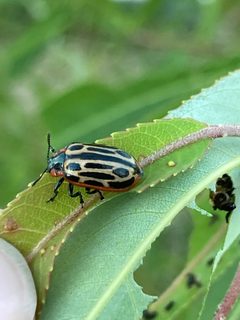
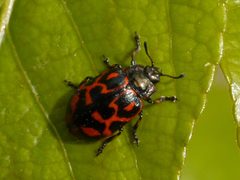
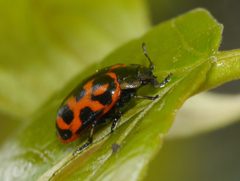
Pronunciation
How to pronounce Chrysomela: //ˌkrɪsoʊˈmiːlə//
These audio files are automatically generated. While they are not always 100% accurate, they are a good starting point.
Images
Distribution
Found on all continents except Australia. Contains 7 in eastern and northern Europe, at least 17 species in North America, and additional species across Asia and other regions.
Host Associations
- Betulaceae - herbivory plant for C. interrupta and C. lapponica
- Salicaceae - herbivory plant for C. lapponica and C. aeneicollis; includes willows and poplars
Behavior
Larvae release volatile defensive compounds through esterification of isobutyric acid and 2-methylbutyric acid with alcohols taken up from plants. associated with Salicaceae show chemical plasticity in defensive secretions depending on food plant phenolglucoside content.
Human Relevance
The cottonwood leaf beetle (Chrysomela scripta) is an economically significant pest of cottonwood and other Populus . Chrysomela species serve as model organisms for studying plant-herbivore interactions and chemical .
Similar Taxa
- CalligraphaBoth are leaf beetle in Chrysomelidae with -specific associations; Calligrapha are distinguished by dome-like shape and distinctive black and white or red elytral patterns, and are generally more host-specific at the genus level than Chrysomela
More Details
Chemical defense evolution
The ability to produce isobutyric acid and 2-methylbutyric acid esters appears to be a synapomorphy uniting the C. interrupta group sensu Brown (1956), suggesting this clade is monophyletic.
Research significance
Chrysomela aeneicollis has been studied since 1984 as a model for understanding local , persistence, and evolutionary responses to thermal variation in montane environments.
Sources and further reading
- BugGuide
- Wikipedia
- GBIF taxonomy match
- iNaturalist taxon
- NCBI Taxonomy
- Catalogue of Life
- Tracking a Montane Leaf Beetle | Bug Squad
- Who's Speaking at UC Davis Entomology Fall Seminars? | Bug Squad
- Beetle botanists | Beetles In The Bush
- Harvestmen Use Glue to Capture Prey
- Pensoft Editorial Team | Blog - Part 69
- Elytral Pattern Distribution in Chrysomela aeneicolls
- Changes in Elytral Pattern Distribution in Chrysomela aeneicollis (Schaeffer) (Coleoptera : Chrysomelidae)
- Larval chemical defence and evolution of host shifts in Chrysomela leaf beetles
- Host plant preference based on salicylate chemistry in a willow leaf beetle (Chrysomela aeneicollis)
- Distribution and occurrence of the neogregarine pathogen, Ophryocystis anatoliensis (Apicomplexa) in populations of Chrysomela populi L. (Coleoptera: Chrysomelidae)
- The genome sequence of a leaf beetle, Chrysomela saliceti (Weise, 1884) (Coleoptera: Chrysomelidae).