
Chrysomela aeneicollis
(C.Schaeffer, 1928)
Willow Leaf Beetle
Chrysomela aeneicollis is a willow leaf beetle in the Chrysomelidae that has served as an important model organism for studies of , climate , and conservation . in the Sierra Nevada mountains of California have been studied intensively since 1984 to understand how montane insects respond to thermal variation, reduced oxygen availability, and environmental change. The sequesters salicin from willows to produce defensive salicylaldehyde secretions, though these are ineffective against . It is included in the California Conservation Genomics Project due to its documented population structure and genetic variation along environmental gradients.
Pronunciation
How to pronounce Chrysomela aeneicollis: //ˌkrɪsəˈmiːlə ˌiːnɪˈkɒlɪs//
These audio files are automatically generated. While they are not always 100% accurate, they are a good starting point.
Identification
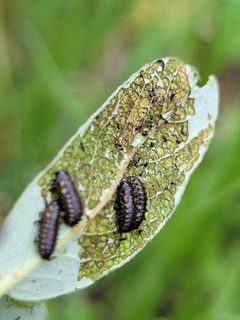
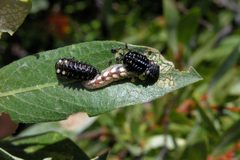
can be distinguished from closely related Chrysomela by the combination of metallic bronze/ pronotal coloration and specific elytral pattern characteristics. In the Sierra Nevada region, it occurs sympatrically with related species in the interrupta subgenus, requiring careful examination for definitive identification. Larval identification relies on coloration of and sclerotized segments. The species is most reliably identified in combination with plant association (willows, particularly Salix orestera in montane California) and geographic location.
Images
Appearance
have metallic bronze to coppery coloration on the pronotum (giving rise to the name 'aeneicollis,' meaning bronze-necked). display variable color patterns that have been subject to morphological study. Larvae are soft-bodied with coloration of the and sclerotized segments that can be used to distinguish them from related species. The overall body form is typical of Chrysomela leaf beetles: compact, convex, and adapted for clinging to leaves.
Habitat
Restricted to cool at high elevations along the western coast of North America. In central California, occur exclusively at high altitudes (2,700–3,500 m) in the Sierra Nevada mountains, where they experience reduced oxygen supply, extreme cold temperatures, and extended winter dormancy. Coastal populations occur in cooler habitats from northern California to British Columbia. Montane populations retreat to higher elevations during dry periods. Habitats are willow-dominated riparian areas and wetlands in montane and coastal regions.
Distribution
Western North America. Coastal distribution from northern California (Mendocino County northward) to British Columbia. Montane in the Sierra Nevada mountains of California from Lone Pine to Modoc County; Rocky Mountains of Colorado and Alberta. Absent from low-elevation, warm areas within its overall geographic range.
Seasonality
Single per year in montane . emerge from sites in June, mate, lay , and larvae develop during the brief summer growing season (June to September). New adults emerge and feed for several weeks before winter dormancy begins. Extended winter dormancy without food is required for survival.
Diet
and larvae feed exclusively on willow leaves (Salix spp.). Documented include Salix orestera, S. lutea, S. boothi, S. geyeriana, and S. drummondiana. Adults and larvae preferentially feed on salicylate-rich willow species; adults are stimulated to feed by salicin itself.
Host Associations
- Salix orestera - primary Salicylate-rich willow; preferred in Sierra Nevada montane
- Salix lutea - Salicylate-poor willow; used but less preferred
- Salix boothi - Salicylate-poor willow; high larval survival despite low salicylate content
- Salix geyeriana - Medium-salicylate willow; low larval survival in field studies
- Salix drummondiana - Documented in laboratory studies
Life Cycle
(one per year) in montane . laid in clutches on willows. Larvae develop through three instars, sequestering salicin from host foliage to produce defensive salicylaldehyde secretions. occurs in soil or protected locations. emerge, feed, and enter extended winter dormancy. Survival depends on ability to withstand extreme cold and prolonged fasting during winter.
Behavior
Larvae expose defensive secretions when attacked by potential . and larvae show feeding preference for salicylate-rich willows regardless of rearing history, indicating innate preference rather than learned . Montane show evidence of local to thermal and oxygen stress conditions.
Ecological Role
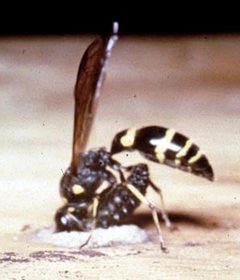
Herbivore that consumes willow foliage and influences willow chemistry through selective feeding on salicylate-rich individuals. Prey for including the syrphid fly Parasyrphus melanderi and the eumenid Symmorphus cristatus. -plant derived defensive secretions repel predators (ants, ladybird beetles, spiders) but not specialist predators, which act as complementary mortality factors. Genetic variation in the serves as a model for understanding to climate change in montane .
Human Relevance
Important model organism for evolutionary , conservation , and climate change research. Included in the California Conservation Genomics Project to inform land management and policy responses to environmental change. Not an agricultural pest; no negative economic impacts documented. Contributes to understanding of how montane insect may respond to warming and drought conditions.
Similar Taxa
- Chrysomela interrupta subgenus speciesClosely related in the interrupta subgenus occur in the same geographic region and share similar ; require careful morphological examination and plant data for differentiation
- Parasyrphus melanderiNot a similar but ecologically linked ; mentioned here because it is frequently associated with C. aeneicollis in ecological studies and may be mistaken for part of the 's
More Details
Conservation Genomics Significance
C. aeneicollis was selected for the California Conservation Project due to its presence across multiple California ecoregions, extensive knowledge of genetic variation, and well-documented evolutionary . Research focuses on PGI (phosphoglucose isomerase) variation related to heat shock protein expression and thermal , as well as mitochondrial-nuclear interactions affecting to temperature and oxygen stress.
Genomic Resources
- assembly completed (2023), consisting of 21 linkage groups including X chromosome identification. Genome contains 12,586 protein-coding genes. Complete mitochondrial genome characterized with documented variation in tRNA and 16S rRNA regions along latitudinal gradients.
Sources and further reading
- BugGuide
- Wikipedia
- GBIF taxonomy match
- iNaturalist taxon
- NCBI Taxonomy
- Tracking a Montane Leaf Beetle | Bug Squad
- Who's Speaking at UC Davis Entomology Fall Seminars? | Bug Squad
- Beetle botanists | Beetles In The Bush
- Harvestmen Use Glue to Capture Prey
- entomology | Blog - Part 8
- Buprestidae type specimens at Fundación Miguel Lillo, Argentina | Beetles In The Bush
- Changes in Elytral Pattern Distribution in Chrysomela aeneicollis (Schaeffer) (Coleoptera : Chrysomelidae)
- Host plant preference based on salicylate chemistry in a willow leaf beetle (Chrysomela aeneicollis)
- Host-plant effects on larval survival of a salicin-using leaf beetle Chrysomela aeneicollis Schaeffer (Coleoptera: Chrysomelidae)
- A chromosome-scale genome assembly and evaluation of mtDNA variation in the willow leaf beetle Chrysomela aeneicollis
- A chromosome scale genome assembly and evaluation of mtDNA variation in the willow leaf beetle Chrysomela aeneicollis
- Host‐plant effects on Parasyrphus melanderi (Diptera: Syrphidae) feeding on a willow leaf beetle Chrysomela aeneicollis (Coleoptera: Chrysomelidae)